

• HOME
  • NEWS
  • EXPLORE
    • CAREER
      • Companies
      • Jobs
    • EVENTS
    • iGEM
      • News
      • Team
    • PHOTOS
    • VIDEO
    • WIKI
  • BLOG
  • COMMUNITY
    • FACEBOOK
    • INSTAGRAM
    • TWITTER
Saturday, February 7, 2026
BIOENGINEER.ORG
No Result
View All Result
  • Login
  • HOME
  • NEWS
  • EXPLORE
    • CAREER
      • Companies
      • Jobs
        • Lecturer
        • PhD Studentship
        • Postdoc
        • Research Assistant
    • EVENTS
    • iGEM
      • News
      • Team
    • PHOTOS
    • VIDEO
    • WIKI
  • BLOG
  • COMMUNITY
    • FACEBOOK
    • INSTAGRAM
    • TWITTER
  • HOME
  • NEWS
  • EXPLORE
    • CAREER
      • Companies
      • Jobs
        • Lecturer
        • PhD Studentship
        • Postdoc
        • Research Assistant
    • EVENTS
    • iGEM
      • News
      • Team
    • PHOTOS
    • VIDEO
    • WIKI
  • BLOG
  • COMMUNITY
    • FACEBOOK
    • INSTAGRAM
    • TWITTER
No Result
View All Result
Bioengineer.org
No Result
View All Result
Home NEWS Science News Health

Hairy, lab-grown human skin cell model could advance hair loss research

Bioengineer by Bioengineer
June 3, 2020
in Health
Reading Time: 2 mins read
0
IMAGE
Share on FacebookShare on TwitterShare on LinkedinShare on RedditShare on Telegram

Oregon Health & Science University Ph.D. candidate grew organoids at Stanford University lab
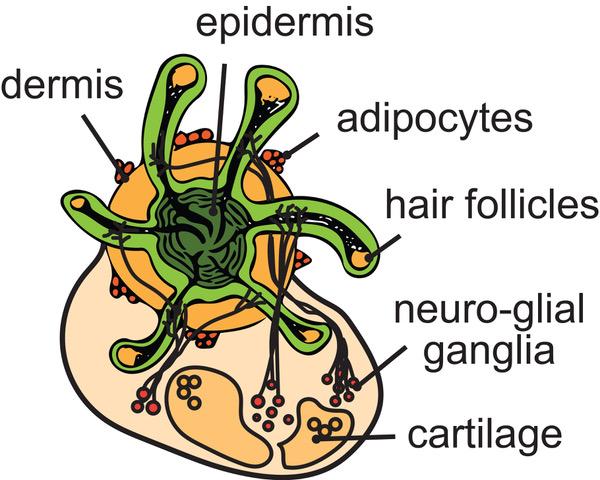
IMAGE

Credit: Karl R. Koehler and Jiyoon Lee, Boston Children’s Hospital/Harvard Medical School.

A new, hair-sprouting dollop of human skin created in the lab might one day help prevent hair loss.

Organoids are small, lab-grown cell groupings are designed to model real-world organs -in this case, skin. A paper published in Nature describes the hairy creation as the first hair-baring human skin organoid made with pluripotent stem cells, or the master cells present during early stages of embryonic development that later turn into specific cell types.

The hirsute organoid’s development was led by Karl Koehler, Ph.D., formerly of Indiana University School of Medicine and now at Boston Children’s Hospital. An Oregon Health & Science University graduate student, Benjamin Woodruff, contributed by helping make the organoids as a post-baccalaureate research technician in the Stanford University lab of Stefan Heller, Ph.D.

“This makes it possible to produce human hair for science without having to take it from a human,” explained Woodruff, who now is completing his first year of cell and developmental biology graduate studies at OHSU. “For the first time, we could have, more or less, an unlimited source of human hair follicles for research.”

Having access to more hair-growing skin can help researchers better understand hair growth and development – and maybe even provide clues needed to reverse a retreating hair line.

###

REFERENCE: Lee J, Rabbani C, Gao H, Steinhart M, Woodruff BW, Pflum Z, Kim A, Heller S, Liu Y, Shipchandler TZ, Koehler KR. Hair-bearing human skin generated entirely from pluripotent stem cells. Nature, June 3, 2020, DOI: 10.1038/s41586-020-2352-3, https://www.nature.com/articles/s41586-020-2352-3

Media Contact
Franny White
[email protected]

Related Journal Article

http://dx.doi.org/10.1038/s41586-020-2352-3

Tags: BiologyBiomedical/Environmental/Chemical EngineeringCell BiologyDermatologyMedicine/Health
Share13Tweet8Share2ShareShareShare2

Related Posts

Digital Health Perspectives from Baltic Sea Experts

February 7, 2026

Exploring Decision-Making in Dementia Caregivers’ Mobility

February 7, 2026

Succinate Receptor 1 Limits Blood Cell Formation, Leukemia

February 7, 2026

Palmitoylation of Tfr1 Drives Platelet Ferroptosis and Exacerbates Liver Damage in Heat Stroke

February 7, 2026
Please login to join discussion

POPULAR NEWS

  • Robotic Ureteral Reconstruction: A Novel Approach

    Robotic Ureteral Reconstruction: A Novel Approach

    82 shares
    Share 33 Tweet 21
  • Digital Privacy: Health Data Control in Incarceration

    63 shares
    Share 25 Tweet 16
  • Study Reveals Lipid Accumulation in ME/CFS Cells

    57 shares
    Share 23 Tweet 14
  • Breakthrough in RNA Research Accelerates Medical Innovations Timeline

    53 shares
    Share 21 Tweet 13

About

We bring you the latest biotechnology news from best research centers and universities around the world. Check our website.

Follow us

Recent News

Digital Health Perspectives from Baltic Sea Experts

Florida Cane Toad: Complex Spread and Selective Evolution

Exploring Decision-Making in Dementia Caregivers’ Mobility

Subscribe to Blog via Email

Enter your email address to subscribe to this blog and receive notifications of new posts by email.

Join 73 other subscribers
  • Contact Us

Bioengineer.org © Copyright 2023 All Rights Reserved.

Welcome Back!

Login to your account below

Forgotten Password?

Retrieve your password

Please enter your username or email address to reset your password.

Log In
No Result
View All Result
  • Homepages
    • Home Page 1
    • Home Page 2
  • News
  • National
  • Business
  • Health
  • Lifestyle
  • Science

Bioengineer.org © Copyright 2023 All Rights Reserved.

