• HOME
  • NEWS
  • EXPLORE
    • CAREER
      • Companies
      • Jobs
    • EVENTS
    • iGEM
      • News
      • Team
    • PHOTOS
    • VIDEO
    • WIKI
  • BLOG
  • COMMUNITY
    • FACEBOOK
    • INSTAGRAM
    • TWITTER
Saturday, June 27, 2026
BIOENGINEER.ORG
No Result
View All Result
  • Login
  • HOME
  • NEWS
  • EXPLORE
    • CAREER
      • Companies
      • Jobs
        • Lecturer
        • PhD Studentship
        • Postdoc
        • Research Assistant
    • EVENTS
    • iGEM
      • News
      • Team
    • PHOTOS
    • VIDEO
    • WIKI
  • BLOG
  • COMMUNITY
    • FACEBOOK
    • INSTAGRAM
    • TWITTER
  • HOME
  • NEWS
  • EXPLORE
    • CAREER
      • Companies
      • Jobs
        • Lecturer
        • PhD Studentship
        • Postdoc
        • Research Assistant
    • EVENTS
    • iGEM
      • News
      • Team
    • PHOTOS
    • VIDEO
    • WIKI
  • BLOG
  • COMMUNITY
    • FACEBOOK
    • INSTAGRAM
    • TWITTER
No Result
View All Result
Bioengineer.org
No Result
View All Result
Home NEWS Science News Health

Hairy, lab-grown human skin cell model could advance hair loss research

Bioengineer by Bioengineer
June 3, 2020
in Health
Reading Time: 2 mins read
0
IMAGE
Share on FacebookShare on TwitterShare on LinkedinShare on RedditShare on Telegram

Oregon Health & Science University Ph.D. candidate grew organoids at Stanford University lab
IMAGE

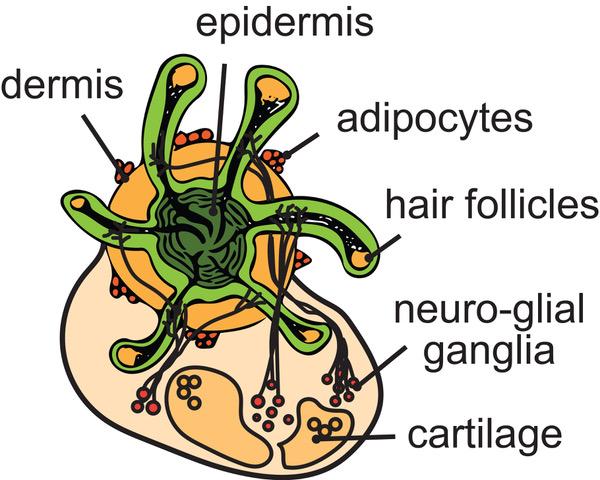
Credit: Karl R. Koehler and Jiyoon Lee, Boston Children’s Hospital/Harvard Medical School.

A new, hair-sprouting dollop of human skin created in the lab might one day help prevent hair loss.

Organoids are small, lab-grown cell groupings are designed to model real-world organs -in this case, skin. A paper published in Nature describes the hairy creation as the first hair-baring human skin organoid made with pluripotent stem cells, or the master cells present during early stages of embryonic development that later turn into specific cell types.

The hirsute organoid’s development was led by Karl Koehler, Ph.D., formerly of Indiana University School of Medicine and now at Boston Children’s Hospital. An Oregon Health & Science University graduate student, Benjamin Woodruff, contributed by helping make the organoids as a post-baccalaureate research technician in the Stanford University lab of Stefan Heller, Ph.D.

“This makes it possible to produce human hair for science without having to take it from a human,” explained Woodruff, who now is completing his first year of cell and developmental biology graduate studies at OHSU. “For the first time, we could have, more or less, an unlimited source of human hair follicles for research.”

Having access to more hair-growing skin can help researchers better understand hair growth and development – and maybe even provide clues needed to reverse a retreating hair line.

###

REFERENCE: Lee J, Rabbani C, Gao H, Steinhart M, Woodruff BW, Pflum Z, Kim A, Heller S, Liu Y, Shipchandler TZ, Koehler KR. Hair-bearing human skin generated entirely from pluripotent stem cells. Nature, June 3, 2020, DOI: 10.1038/s41586-020-2352-3, https://www.nature.com/articles/s41586-020-2352-3

Media Contact
Franny White
[email protected]

Related Journal Article

http://dx.doi.org/10.1038/s41586-020-2352-3

Tags: BiologyBiomedical/Environmental/Chemical EngineeringCell BiologyDermatologyMedicine/Health
Share13Tweet8Share2ShareShareShare2

Related Posts

Tracking Lanthanide-Labeled Microplastics in Plants

June 25, 2026

Neural Design Enables Zero-Shot Drug-Binding Proteins

June 25, 2026

Genomic Insights into Human Skin Fungi Diversity

June 25, 2026

Chiral Laser Gyroscopes Surpass Lock-In Limit

June 25, 2026
Please login to join discussion

POPULAR NEWS

  • Saying Goodbye to PGY-6: Pediatric Fellowship Realities

    103 shares
    Share 41 Tweet 26
  • Multi-Hospital Study Reveals Long Covid Burden Is Twice as High as Current Estimates

    92 shares
    Share 36 Tweet 23
  • Detection of EDCs in Breast Milk and Infant Urine Up to Six Months Highlights Early Exposure Risks

    77 shares
    Share 31 Tweet 19
  • New Drug Candidate Developed at McMaster Shows Potential for Treating Brain Cancer

    58 shares
    Share 23 Tweet 15

About

We bring you the latest biotechnology news from best research centers and universities around the world. Check our website.

Follow us

Recent News

Tracking Lanthanide-Labeled Microplastics in Plants

POSTECH Researchers Slash Cost of Reconstituted Cell-Free Systems by 95%

AI and Physics Collaborate to Design Advanced Hydrogen Storage Materials

Subscribe to Blog via Email

Success! An email was just sent to confirm your subscription. Please find the email now and click 'Confirm' to start subscribing.

Join 82 other subscribers
  • Contact Us

Bioengineer.org © Copyright 2023 All Rights Reserved.

Welcome Back!

Login to your account below

Forgotten Password?

Retrieve your password

Please enter your username or email address to reset your password.

Log In
No Result
View All Result
  • Homepages
    • Home Page 1
    • Home Page 2
  • News
  • National
  • Business
  • Health
  • Lifestyle
  • Science

Bioengineer.org © Copyright 2023 All Rights Reserved.