• HOME
  • NEWS
  • EXPLORE
    • CAREER
      • Companies
      • Jobs
    • EVENTS
    • iGEM
      • News
      • Team
    • PHOTOS
    • VIDEO
    • WIKI
  • BLOG
  • COMMUNITY
    • FACEBOOK
    • INSTAGRAM
    • TWITTER
Thursday, March 26, 2026
BIOENGINEER.ORG
No Result
View All Result
  • Login
  • HOME
  • NEWS
  • EXPLORE
    • CAREER
      • Companies
      • Jobs
        • Lecturer
        • PhD Studentship
        • Postdoc
        • Research Assistant
    • EVENTS
    • iGEM
      • News
      • Team
    • PHOTOS
    • VIDEO
    • WIKI
  • BLOG
  • COMMUNITY
    • FACEBOOK
    • INSTAGRAM
    • TWITTER
  • HOME
  • NEWS
  • EXPLORE
    • CAREER
      • Companies
      • Jobs
        • Lecturer
        • PhD Studentship
        • Postdoc
        • Research Assistant
    • EVENTS
    • iGEM
      • News
      • Team
    • PHOTOS
    • VIDEO
    • WIKI
  • BLOG
  • COMMUNITY
    • FACEBOOK
    • INSTAGRAM
    • TWITTER
No Result
View All Result
Bioengineer.org
No Result
View All Result
Home NEWS Science News Immunology

Blood test as a potential new weapon in the fight to eliminate malaria

Bioengineer by Bioengineer
June 1, 2020
in Immunology
Reading Time: 2 mins read
0
IMAGE
Share on FacebookShare on TwitterShare on LinkedinShare on RedditShare on Telegram

Development and validation of serological markers for detecting recent Plasmodium vivax infection
IMAGE

Credit: Ehime University

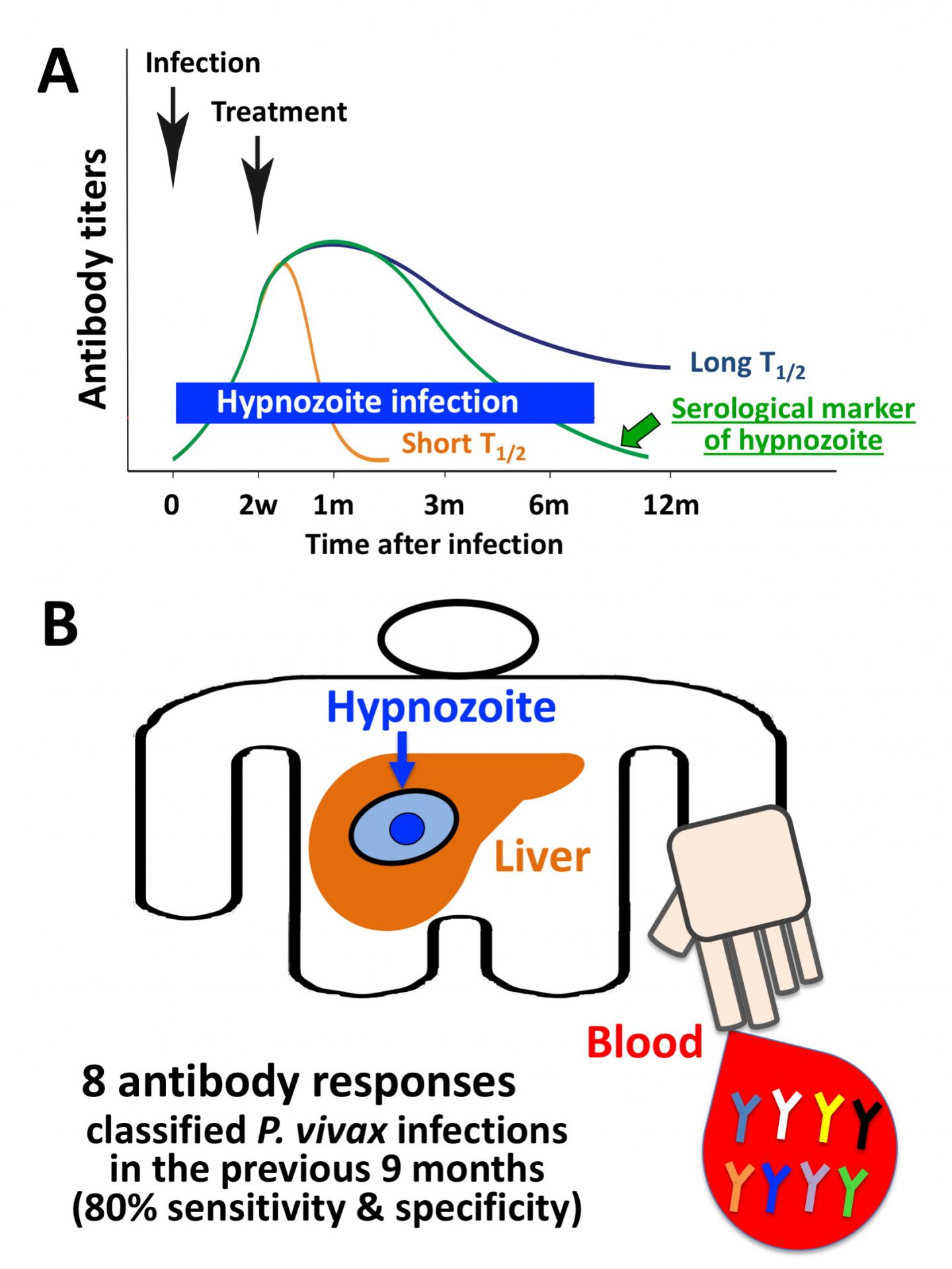
Plasmodium vivax is the most widespread malaria parasite worldwide, with up to two billion people at risk of infection. As well as causing illness and death in its ‘active’ stage of infection, the parasite can hide as hypnozoites, a dormant stage, in the liver, and is a significant cause of ‘relapsing’ malaria.

These hypnozoites, undetectable with current diagnostics, can be responsible for >80% of all blood-stage infections. Identifying and targeting individuals with hypnozoites is thus essential for accelerating and achieving malaria elimination. A major gap in the P. vivax elimination toolkit is the identification of individuals carrying clinically silent and undetectable hypnozoites.

This study developed a panel of serological exposure markers capable of classifying individuals with P. vivax infections within the previous 9 months who have a high likelihood of harboring hypnozoites. 1) We measured IgG antibody responses with the AlphaScreen system to 342 P. vivax proteins expressed by a wheat germ cell-free system, invented at Ehime University, in longitudinal clinical cohorts conducted in Thailand and Brazil and identified 60 candidate serological markers of exposure. 2) Candidate markers were validated using samples from year-long observational cohorts conducted in Thailand, Brazil and the Solomon Islands and antibody responses to eight P. vivax proteins classified P. vivax infections in the previous 9 months with 80% sensitivity and specificity. Mathematical models demonstrate that a serological testing and treatment strategy could reduce P. vivax prevalence by 59-69%.

These eight antibody responses can serve as a biomarker, identifying individuals who should be targeted with anti-hypnozoite therapy. The test offers new opportunities for improving malaria control and elimination strategies.

###

Media Contact
Public Relations Division
[email protected]

Original Source

https://www.nature.com/articles/s41591-020-0841-4

Related Journal Article

http://dx.doi.org/10.1038/s41591-020-0841-4

Tags: BiotechnologyDiagnosticsDisease in the Developing WorldImmunology/Allergies/AsthmaInfectious/Emerging DiseasesMedicine/HealthParasitologyPublic Health
Share12Tweet8Share2ShareShareShare2

Related Posts

IMAGE

UMass Amherst grad student awarded fellowship for food allergy research

July 23, 2021
IMAGE

Less-sensitive COVID-19 tests may still achieve optimal results if enough people tested

July 22, 2021

Public trust in CDC, FDA, and Fauci holds steady, survey shows

July 20, 2021

USC study shows male-female differences in immune cell function

July 19, 2021
Please login to join discussion

POPULAR NEWS

  • blank

    Revolutionary AI Model Enhances Precision in Detecting Food Contamination

    96 shares
    Share 38 Tweet 24
  • Imagine a Social Media Feed That Challenges Your Views Instead of Reinforcing Them

    1003 shares
    Share 397 Tweet 248
  • Uncovering Functions of Cavernous Malformation Proteins in Organoids

    54 shares
    Share 22 Tweet 14
  • Promising Outcomes from First Clinical Trials of Gene Regulation in Epilepsy

    51 shares
    Share 20 Tweet 13

About

We bring you the latest biotechnology news from best research centers and universities around the world. Check our website.

Follow us

Recent News

In-Sensor Cryptography Links Physical Process to Digital Identity

Can Psychosocial Factors Influence Cancer Risk?

Depression Factors in Elderly: Pre vs. Post-COVID Analysis

Subscribe to Blog via Email

Success! An email was just sent to confirm your subscription. Please find the email now and click 'Confirm' to start subscribing.

Join 78 other subscribers
  • Contact Us

Bioengineer.org © Copyright 2023 All Rights Reserved.

Welcome Back!

Login to your account below

Forgotten Password?

Retrieve your password

Please enter your username or email address to reset your password.

Log In
No Result
View All Result
  • Homepages
    • Home Page 1
    • Home Page 2
  • News
  • National
  • Business
  • Health
  • Lifestyle
  • Science

Bioengineer.org © Copyright 2023 All Rights Reserved.