• HOME
  • NEWS
  • EXPLORE
    • CAREER
      • Companies
      • Jobs
    • EVENTS
    • iGEM
      • News
      • Team
    • PHOTOS
    • VIDEO
    • WIKI
  • BLOG
  • COMMUNITY
    • FACEBOOK
    • INSTAGRAM
    • TWITTER
Thursday, January 15, 2026
BIOENGINEER.ORG
No Result
View All Result
  • Login
  • HOME
  • NEWS
  • EXPLORE
    • CAREER
      • Companies
      • Jobs
        • Lecturer
        • PhD Studentship
        • Postdoc
        • Research Assistant
    • EVENTS
    • iGEM
      • News
      • Team
    • PHOTOS
    • VIDEO
    • WIKI
  • BLOG
  • COMMUNITY
    • FACEBOOK
    • INSTAGRAM
    • TWITTER
  • HOME
  • NEWS
  • EXPLORE
    • CAREER
      • Companies
      • Jobs
        • Lecturer
        • PhD Studentship
        • Postdoc
        • Research Assistant
    • EVENTS
    • iGEM
      • News
      • Team
    • PHOTOS
    • VIDEO
    • WIKI
  • BLOG
  • COMMUNITY
    • FACEBOOK
    • INSTAGRAM
    • TWITTER
No Result
View All Result
Bioengineer.org
No Result
View All Result
Home NEWS Science News Chemistry

OU physicists investigate applications of Einstein’ ‘spooky action at a distance’

Bioengineer by Bioengineer
May 20, 2020
in Chemistry
Reading Time: 2 mins read
0
IMAGE
Share on FacebookShare on TwitterShare on LinkedinShare on RedditShare on Telegram

IMAGE

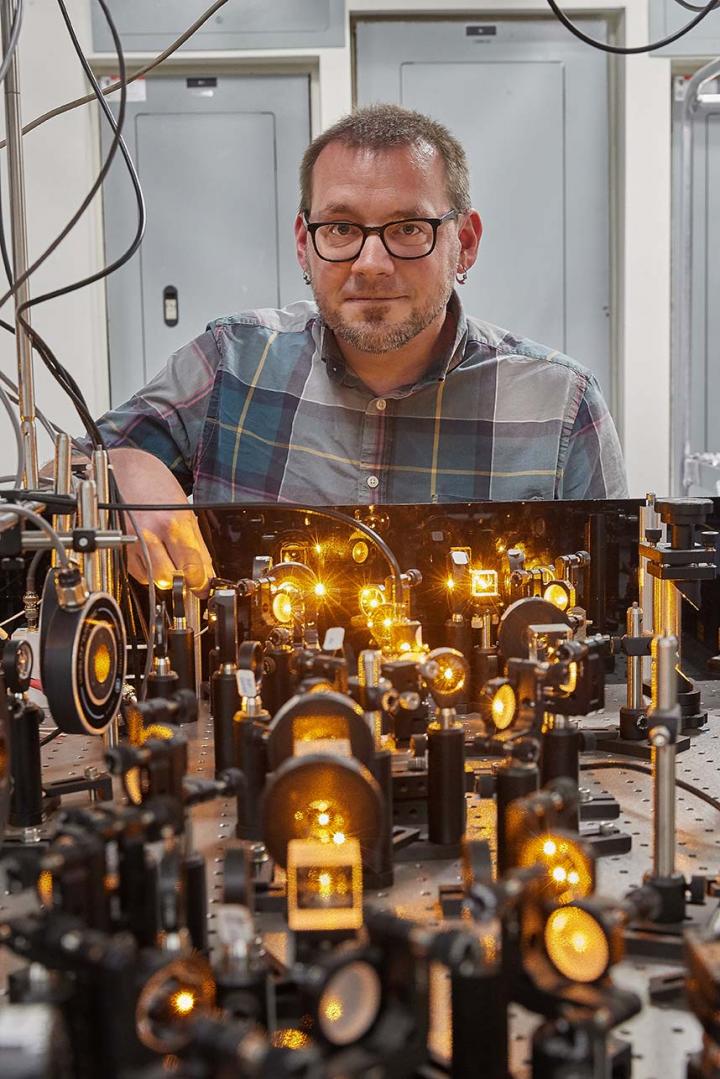
Credit: Photo by Hugh Scott. Courtesy of Sooner Magazine, University of Oklahoma.

University of Oklahoma professors Arne Schwettmann and Grant Biedermann recently received a research award to investigate applications of what Albert Einstein called “spooky action at a distance” from the Defense Established Program to Stimulate Competitive Research, a program within the Department of Defense. The $584,814 grant will be awarded over three years starting in the fall.

Schwettmann, a professor in the Homer L. Dodge Department of Physics and Astronomy, said their research uses nearly 20,000 atoms within a gas cooled to extremely low temperatures to study quantum entanglement and that the study has implications for quantum-enhanced sensing applications.

“In an atomic sodium gas cooled to ultracold temperatures, atoms behave like small magnets that change their orientation when they collide with each other,” Schwettmann said. “In a gas at room temperature, the collisions happen randomly and uncontrollably, but if the sodium gas cloud is cooled all the way down to about 0.00000001 degrees above absolute zero temperature, the collisions happen predictably and can be controlled via microwaves. The atomic magnets become correlated in this process. This correlation is what Einstein called ‘spooky action at a distance,’ now known as quantum entanglement.”

The collaborative research effort through OU’s Center for Quantum Research and Technology combines Schwettmann’s expertise in manipulating ultracold gases with the project’s co-principal investigator and associate professor in the Department of Physics, Biedermann. Biedermann’s expertise is in using light pulses to investigate novel schemes of atom interferometry.

“In a sense, the entangled atoms react ‘together’ to external fields, which can enhance the signal-to-noise ratio for sensing applications,” Schwettmann said. “This line of research will allow us to use the ultracold atoms as gravitational sensors. This is of interest for defense because gravitational fields can’t be shielded. We know that radar can be shielded, but you can’t hide an object’s gravitational signature.”

The possibility of detecting gravity in this way has additional possibilities, including quantum-enhanced sensing of accelerations.

“Once you know how to detect gravity, you can detect acceleration, which allows for inertial sensing, sometimes also called inertial navigation, which can enable us to identify an object’s location without GPS,” Schwettmann said.

The researchers are also studying what happens when these tests are made outside of a fully controlled environment. To do so, they will study outside influences like vibrations and humidity changes to better understand how external factors could influence the performance of future quantum-enhanced sensors.

Schwettmann credits their ability to expand their research to a “match made in Heaven.”

“We have all the experts right here at OU. I don’t have to call up a colleague at another university. They’re down the hall.”

###

Media Contact
Arne Schwettmann
[email protected]

Original Source

http://ou.edu/research-norman/news-events/2020/ou-physicists-awarded-department-of-defense-research-grant

Tags: Atomic PhysicsAtomic/Molecular/Particle PhysicsChemistry/Physics/Materials SciencesElectrical Engineering/ElectronicsElectromagneticsMaterialsNanotechnology/MicromachinesParticle Physics
Share13Tweet8Share2ShareShareShare2

Related Posts

blank

Thermal [2+2] Cycloaddition Builds Gem-Difluoro Bicycloalkanes

January 13, 2026
blank

Cobalt-Catalyzed Thioester Coupling via Siloxycarbene

January 12, 2026

Advancing Alkene Chemistry: Homologative Difunctionalization Breakthrough

January 8, 2026

Biocompatible Ligand Enables Safe In-Cell Protein Arylation

January 8, 2026
Please login to join discussion

POPULAR NEWS

  • Enhancing Spiritual Care Education in Nursing Programs

    155 shares
    Share 62 Tweet 39
  • PTSD, Depression, Anxiety in Childhood Cancer Survivors, Parents

    147 shares
    Share 59 Tweet 37
  • Robotic Ureteral Reconstruction: A Novel Approach

    75 shares
    Share 30 Tweet 19
  • Study Reveals Lipid Accumulation in ME/CFS Cells

    53 shares
    Share 21 Tweet 13

About

We bring you the latest biotechnology news from best research centers and universities around the world. Check our website.

Follow us

Recent News

Endoplasmic Reticulum Stress Boosts Ferroptosis in Ovarian Diseases

Analyzing Post-Birth Discharge Timing in Tanzania

Rising Threat: Global Subsidence of River Deltas

Subscribe to Blog via Email

Enter your email address to subscribe to this blog and receive notifications of new posts by email.

Join 71 other subscribers
  • Contact Us

Bioengineer.org © Copyright 2023 All Rights Reserved.

Welcome Back!

Login to your account below

Forgotten Password?

Retrieve your password

Please enter your username or email address to reset your password.

Log In
No Result
View All Result
  • Homepages
    • Home Page 1
    • Home Page 2
  • News
  • National
  • Business
  • Health
  • Lifestyle
  • Science

Bioengineer.org © Copyright 2023 All Rights Reserved.