• HOME
  • NEWS
  • EXPLORE
    • CAREER
      • Companies
      • Jobs
    • EVENTS
    • iGEM
      • News
      • Team
    • PHOTOS
    • VIDEO
    • WIKI
  • BLOG
  • COMMUNITY
    • FACEBOOK
    • INSTAGRAM
    • TWITTER
Saturday, March 28, 2026
BIOENGINEER.ORG
No Result
View All Result
  • Login
  • HOME
  • NEWS
  • EXPLORE
    • CAREER
      • Companies
      • Jobs
        • Lecturer
        • PhD Studentship
        • Postdoc
        • Research Assistant
    • EVENTS
    • iGEM
      • News
      • Team
    • PHOTOS
    • VIDEO
    • WIKI
  • BLOG
  • COMMUNITY
    • FACEBOOK
    • INSTAGRAM
    • TWITTER
  • HOME
  • NEWS
  • EXPLORE
    • CAREER
      • Companies
      • Jobs
        • Lecturer
        • PhD Studentship
        • Postdoc
        • Research Assistant
    • EVENTS
    • iGEM
      • News
      • Team
    • PHOTOS
    • VIDEO
    • WIKI
  • BLOG
  • COMMUNITY
    • FACEBOOK
    • INSTAGRAM
    • TWITTER
No Result
View All Result
Bioengineer.org
No Result
View All Result
Home NEWS Science News Health

‘Like looking for a needle in a haystack’: the global hunt to block COVID-19

Bioengineer by Bioengineer
May 18, 2020
in Health
Reading Time: 2 mins read
0
IMAGE
Share on FacebookShare on TwitterShare on LinkedinShare on RedditShare on Telegram

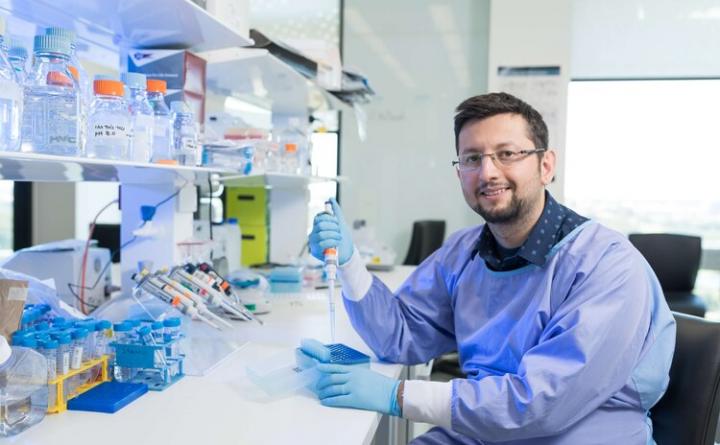
Artificial intelligence identifying compounds
IMAGE

Credit: Hospital Research Foundation

A molecular biologist from the University of South Australia is working with a world leader in artificial intelligence-based drug discovery to help find a molecule that could prevent the SARS-CoV-2 coronavirus strain causing COVID-19 from infecting human cells.

Dr Gokhan Cildir has been selected by San Francisco company Atomwise to collaborate on research to use artificial intelligence to discover compounds that could successfully fight SARS-CoV-2.

From millions of molecules screened virtually, Atomwise has identified likely contenders and has sent those compounds to Dr Cildir to test at the Centre for Cancer Biology (CCB) in Adelaide. The goal is to develop inhibitors for the ‘spike’ protein used by SARS-CoV-2 to invade human cells.

“Although coronavirus uses many different proteins to replicate and invade cells, the spike protein is the major cell surface protein that it uses to bind to a host receptor — another protein that acts like a doorway into a human cell,” Dr Cildir says.

“I believe there is a very high chance we will get a vaccine in the next year, but our own approach is to find the compound which can actually block SARS-CoV-2 because it will be impossible to vaccinate everyone in the world, especially the most vulnerable.”

The team hopes over the next 6-12 months to identify compounds which could potentially be patented and tested in vitro and animal models before undertaking any clinical trials in humans.

Atomwise is leveraging its unique AI-based drug discovery model for several other projects in the fight against COVID-19. There are currently 15 efforts underway and the company anticipates that number will grow.

“Atomwise’s patented AI technology has been proven in hundreds of prospective projects to discover drug leads for a wide variety of diseases, and we’re very optimistic about the role we can play when it comes to COVID-19,” says Dr Stacie Calad-Thomson, vice president and head of Artificial Intelligence Molecular Screen (AIMS) Partnerships at Atomwise.

“We’re hopeful that the therapies discovered will not only target this pandemic, but potential future recurrences.”

Dr Cildir, who is funded by The Hospital Research Foundation, is a postdoctoral researcher based in CCB’s Allergy and Cancer Immunology Laboratory led by Dr Damon Tumes. He has been working at UniSA since late 2016 after completing his PhD at the National University of Singapore in the School of Medicine.

He has previously collaborated with Atomwise on other work, but this is his first virology project.

“It is like looking for a needle in a haystack but if we are successful it will be a world first, so we are very excited about the possibilities,” he says.

###

Media Contact
Candy Gibson
[email protected]

Tags: Biomedical/Environmental/Chemical EngineeringBiotechnologyInfectious/Emerging DiseasesMedicine/HealthRobotry/Artificial Intelligence
Share12Tweet8Share2ShareShareShare2

Related Posts

Aversive Learning Hijacks Brain Sugar Sensor

March 25, 2026

Can Psychosocial Factors Influence Cancer Risk?

March 23, 2026

Depression Factors in Elderly: Pre vs. Post-COVID Analysis

March 23, 2026

Hidden Health Crises Among US and UK Volunteers in Ukraine Uncovered in New Study

March 23, 2026
Please login to join discussion

POPULAR NEWS

  • blank

    Revolutionary AI Model Enhances Precision in Detecting Food Contamination

    96 shares
    Share 38 Tweet 24
  • Imagine a Social Media Feed That Challenges Your Views Instead of Reinforcing Them

    1003 shares
    Share 397 Tweet 248
  • Uncovering Functions of Cavernous Malformation Proteins in Organoids

    54 shares
    Share 22 Tweet 14
  • Promising Outcomes from First Clinical Trials of Gene Regulation in Epilepsy

    51 shares
    Share 20 Tweet 13

About

We bring you the latest biotechnology news from best research centers and universities around the world. Check our website.

Follow us

Recent News

In-Sensor Cryptography Links Physical Process to Digital Identity

Can Psychosocial Factors Influence Cancer Risk?

Depression Factors in Elderly: Pre vs. Post-COVID Analysis

Subscribe to Blog via Email

Success! An email was just sent to confirm your subscription. Please find the email now and click 'Confirm' to start subscribing.

Join 78 other subscribers
  • Contact Us

Bioengineer.org © Copyright 2023 All Rights Reserved.

Welcome Back!

Login to your account below

Forgotten Password?

Retrieve your password

Please enter your username or email address to reset your password.

Log In
No Result
View All Result
  • Homepages
    • Home Page 1
    • Home Page 2
  • News
  • National
  • Business
  • Health
  • Lifestyle
  • Science

Bioengineer.org © Copyright 2023 All Rights Reserved.