• HOME
  • NEWS
  • EXPLORE
    • CAREER
      • Companies
      • Jobs
    • EVENTS
    • iGEM
      • News
      • Team
    • PHOTOS
    • VIDEO
    • WIKI
  • BLOG
  • COMMUNITY
    • FACEBOOK
    • INSTAGRAM
    • TWITTER
Wednesday, July 8, 2026
BIOENGINEER.ORG
No Result
View All Result
  • Login
  • HOME
  • NEWS
  • EXPLORE
    • CAREER
      • Companies
      • Jobs
        • Lecturer
        • PhD Studentship
        • Postdoc
        • Research Assistant
    • EVENTS
    • iGEM
      • News
      • Team
    • PHOTOS
    • VIDEO
    • WIKI
  • BLOG
  • COMMUNITY
    • FACEBOOK
    • INSTAGRAM
    • TWITTER
  • HOME
  • NEWS
  • EXPLORE
    • CAREER
      • Companies
      • Jobs
        • Lecturer
        • PhD Studentship
        • Postdoc
        • Research Assistant
    • EVENTS
    • iGEM
      • News
      • Team
    • PHOTOS
    • VIDEO
    • WIKI
  • BLOG
  • COMMUNITY
    • FACEBOOK
    • INSTAGRAM
    • TWITTER
No Result
View All Result
Bioengineer.org
No Result
View All Result
Home NEWS Science News Health

Passive immunization may slow down SARS-CoV-2 and boost immunity in patients, buying time

Bioengineer by Bioengineer
May 12, 2020
in Health
Reading Time: 3 mins read
0
IMAGE
Share on FacebookShare on TwitterShare on LinkedinShare on RedditShare on Telegram

Using antibodies from recovered patients has been life-saving for other acute infections and should be explored in response to COVID-19
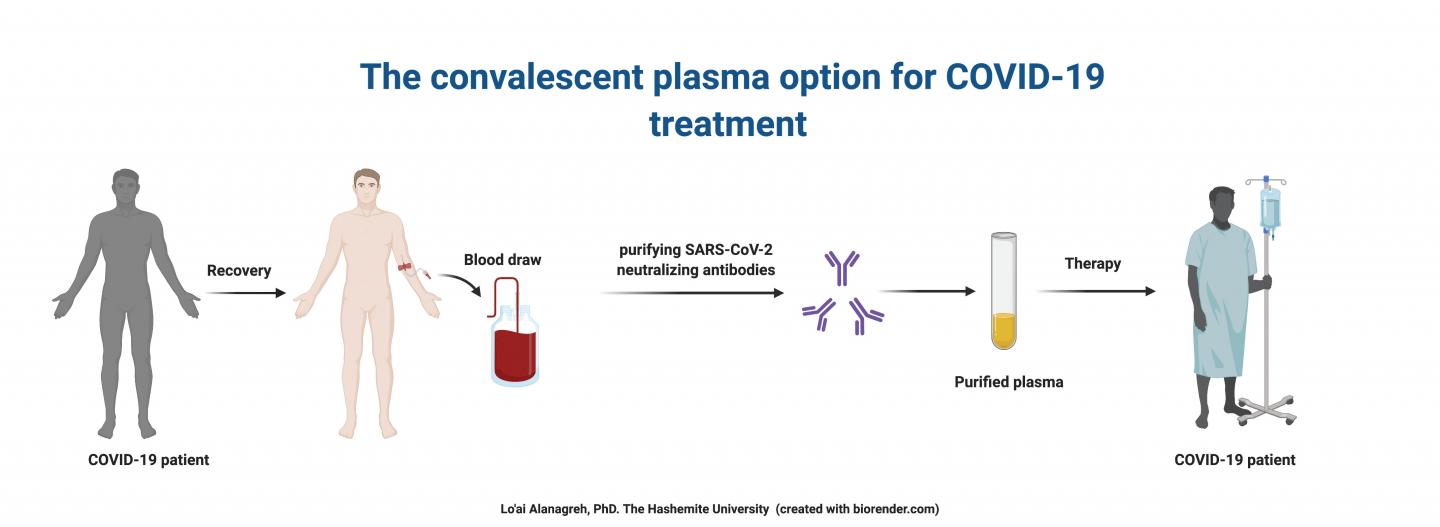
IMAGE

Credit: The Hashemite University

Amsterdam, May 12, 2020 – The worldwide COVID-19 pandemic has infected more than 4 million people and killed close to 280,000.1 Finding a vaccine has become a global public health priority. However, creating a viable vaccine might take a long time; scientists estimate a vaccine may be available in between 12 and 18 months. A potential interim solution reported in the International Journal of Risk & Safety in Medicine may be a passive vaccine, or passive immummization (PI), which can provide instant, short-term fortification against infectious agents.

“Using valuable plasma from recovered patients might be useful in our global war against COVID-19,” explained Foad Alzoughool, PhD. He and his co-author, Lo’ai Alanagreh, PhD, both of the Department of Laboratory Medical Sciences, Faculty of Applied Medical Sciences, The Hashemite University, Jordan, have studied the application of PI in previous pandemics and conclude that this approach is a potential solution to address the immediate health threat of COVID-19.

After exposure to a viral infection, an individual’s body creates antibodies to fight off the virus. These antibodies in the blood of a recovered patient can be collected as convalescent plasma and transferred to the blood of a newly infected patient where it can neutralize the pathogen, eliminate it from the blood stream, and boost immunity. While PI does not provide long-term protection against the virus, it can reduce the aggressiveness and mortality of an infection.

The use of PI immunization dates to the beginning of the twentieth century during the Spanish flu epidemic, when patients who received convalescent plasma serum had lower mortality rates than others. Experimental usage of PI during outbreaks of Ebola virus, chikungunya virus and the H1N1 flu also shows the potential of using PI in the prevention and treatment of viral infecitions.

There is evidence as well of the effectiveness of the PI technique in the SARS-CoV epidemic in Guandong, China and the MERS-CoV in Saudi Arabia, particularly if it is introduced soon after symptom onset. In one report, patients who received PI had a significantly shorter hospital stay and lower mortality than other groups. In another, patients who received convalescent plasma before day 14 of illness had a higher discharge rate. Healthcare workers who were infected with SARS-CoV and failed to respond to treatment survived after transfusion with convalescent plasma.

“If you are looking for COVID-19 treatment, you will find it in the blood of survivors,” said Dr. Alanagreah. “In a time when no registered antiviral drug or vaccine is available, PI might help in slowing down the deadly virus and save lives, particuarly for the elderly and patients with pre-existing conditions.”

More than 1.5 million people have recovered from the disease,2 and many of them would be willing to donate plasma to help slow down the pandemic. Dr. Alzoughool and Dr. Alanagreh noted, importantly, that practicing this method now will help health systems be prepared in case a second wave of disease occurs.

###

Media Contact
Diana Murray
[email protected]

Related Journal Article

http://dx.doi.org/10.3233/JRS-201017

Tags: Infectious/Emerging DiseasesMedicine/Health
Share12Tweet8Share2ShareShareShare2

Related Posts

Flame retardant BDE-209 targets molecularly linked to ulcerative colitis

July 6, 2026

Kidney transplant outcomes in older adults studied by German researchers

July 6, 2026

Salmonella protein SopB curbs early inflammation to slow disease progression

July 6, 2026

Multi-metal cooperation drives lung cancer chemoresistance, reversed by MiADMSA

July 6, 2026
Please login to join discussion

POPULAR NEWS

  • Detection of EDCs in Breast Milk and Infant Urine Up to Six Months Highlights Early Exposure Risks

    77 shares
    Share 31 Tweet 19
  • New Drug Candidate Developed at McMaster Shows Potential for Treating Brain Cancer

    58 shares
    Share 23 Tweet 15
  • Saying Goodbye to PGY-6: Pediatric Fellowship Realities

    103 shares
    Share 41 Tweet 26
  • KTU Researchers Explore Ultrasound’s Role in Enhancing Blood Flow Beyond Diagnostics

    53 shares
    Share 21 Tweet 13

About

We bring you the latest biotechnology news from best research centers and universities around the world. Check our website.

Follow us

Recent News

Flame retardant BDE-209 targets molecularly linked to ulcerative colitis

Ultra-high frequency particle impacts mimic rockbursts to shatter hard rock

Kidney transplant outcomes in older adults studied by German researchers

Subscribe to Blog via Email

Success! An email was just sent to confirm your subscription. Please find the email now and click 'Confirm' to start subscribing.

Join 83 other subscribers
  • Contact Us

Bioengineer.org © Copyright 2023 All Rights Reserved.

Welcome Back!

Login to your account below

Forgotten Password?

Retrieve your password

Please enter your username or email address to reset your password.

Log In
No Result
View All Result
  • Homepages
    • Home Page 1
    • Home Page 2
  • News
  • National
  • Business
  • Health
  • Lifestyle
  • Science

Bioengineer.org © Copyright 2023 All Rights Reserved.