Mainz-based researchers present new technique for measuring the charge state, defects, and capacity losses of rechargeable batteries using atomic magnetometry
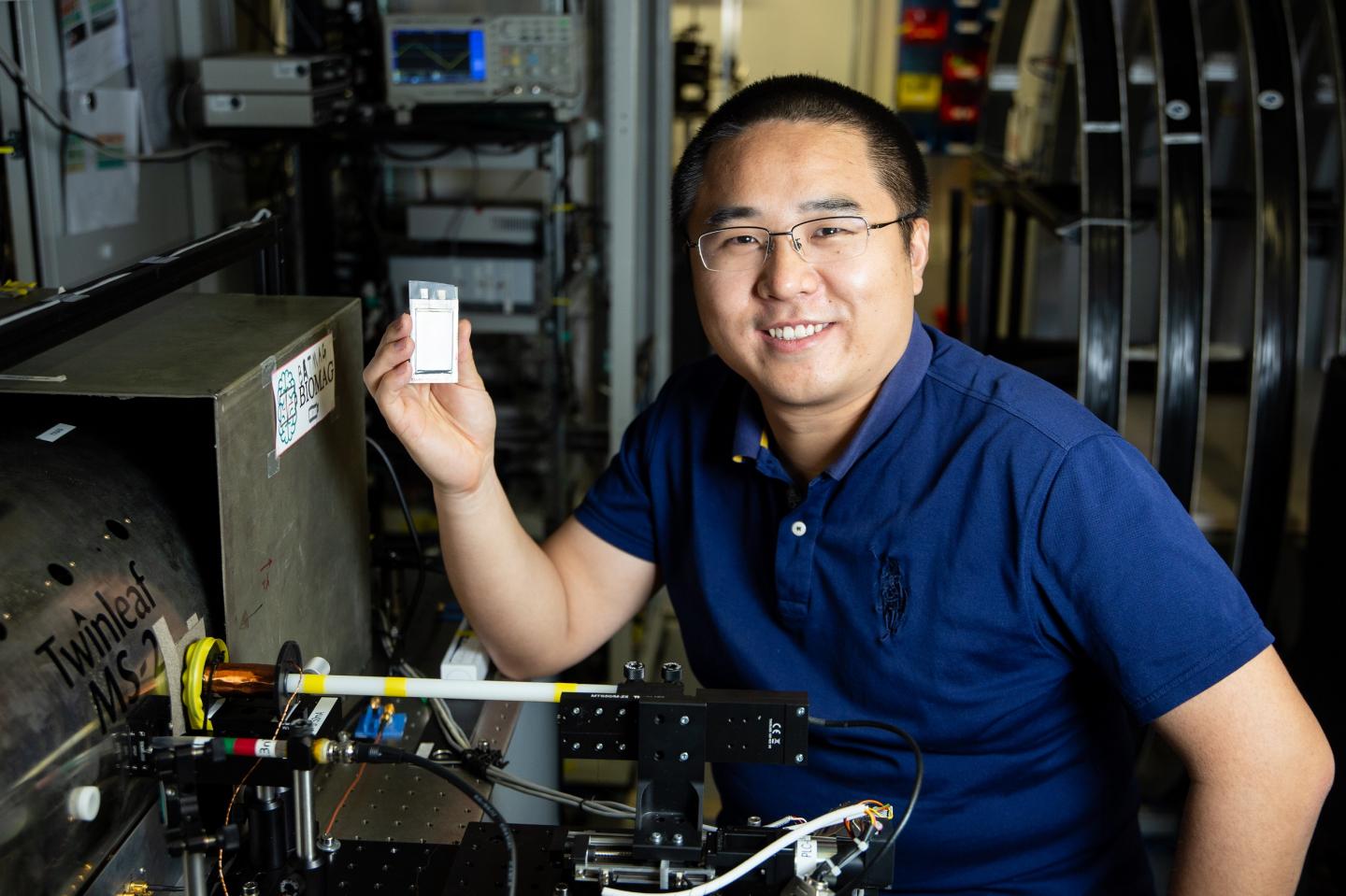
Credit: photo/©: Arne Wickenbrock
Rechargeable batteries are at the heart of many new technologies involving, for example, the increased use of renewable energies. More specifically, they are employed to power electric vehicles, cell phones, and laptops. Scientists at Johannes Gutenberg University Mainz (JGU) and the Helmholtz Institute Mainz (HIM) in Germany have now presented a non-contact method for detecting the state of charge and any defects in lithium-ion batteries. For this purpose, atomic magnetometers are used to measure the magnetic field around battery cells. Professor Dmitry Budker and his team usually use atomic magnetometry to explore fundamental questions of physics, such as the search for new particles. Magnetometry is the term used to describe the measurement of magnetic fields. One simple example of its application is the compass, which the Earth’s magnetic field causes to point north.
Non-contact quality assurance of batteries using atomic magnetometers
The demand for high-capacity rechargeable batteries is growing and so is the need for a form of sensitive, accurate diagnostic technology for determining the state of a battery cell. The success of many new developments will depend on whether batteries can be produced that can deliver sufficient capacity and a long effective life span. “Undertaking the quality assurance of rechargeable batteries is a significant challenge. Non-contact methods can potentially provide fresh stimulus for improvement in batteries,” said Dr. Arne Wickenbrock, a member of Professor Dmitry Budker’s work group at the JGU Institute of Physics and the Helmholtz Institute Mainz. The group has achieved a breakthrough by using atomic magnetometers to take measurements. The idea came about during a teleconference between Budker and his colleague Professor Alexej Jerschow of New York University. They developed a concept and, with close cooperation between the two groups, carried out the related experiments in Mainz.
“Our technique works in essentially the same way as magnetic resonance imaging, but it is much simpler because we use atomic magnetometers,” said Wickenbrock, who is part of the team conducting the investigations. Atomic magnetometers are optically pumped magnetometers that use atoms in gaseous form as probes for a magnetic field. They are commercially available and are used in industrial applications as well as fundamental research. Budker’s group at JGU and HIM, which also develops advanced magnetic sensors of their own, uses these atomic magnetometers for fundamental research in physics, such as in the search for dark matter and in attempts to solve the riddle as to why matter and antimatter did not immediately annihilate each other after the Big Bang.
Simple method enables fast, high-throughput measurements
In the case of battery measurements, the batteries are placed in a background magnetic field. The batteries alter this background magnetic field and the change is measured using atomic magnetometers. “The change gives us information about the state of charge of the battery, about how much charge is left in the battery, and about possible damage,” added Wickenbrock. “The process is fast and, in our opinion, can be easily integrated into production processes.” Recurring reports of serious injuries resulting from the explosion of e-cigarettes and the restrictions on taking certain types of cell phones on airplanes show that there is a need for detecting defects in battery cells.
“The diagnostic power of this technique is promising for the assessment of cells in research, for quality control, or during operation,” the authors stated in their recent PNAS paper. Last summer, the same work group organized two events on applied atomic and nuclear physics with high-level international participation. About 200 researchers from all over the world addressed current questions of atomic magnetometry and other forms of quantum measurement techniques.
###
Media Contact
Dr. Arne Wickenbrock
[email protected]
Original Source
https:/
Related Journal Article
http://dx.