• HOME
  • NEWS
  • EXPLORE
    • CAREER
      • Companies
      • Jobs
    • EVENTS
    • iGEM
      • News
      • Team
    • PHOTOS
    • VIDEO
    • WIKI
  • BLOG
  • COMMUNITY
    • FACEBOOK
    • INSTAGRAM
    • TWITTER
Monday, May 11, 2026
BIOENGINEER.ORG
No Result
View All Result
  • Login
  • HOME
  • NEWS
  • EXPLORE
    • CAREER
      • Companies
      • Jobs
        • Lecturer
        • PhD Studentship
        • Postdoc
        • Research Assistant
    • EVENTS
    • iGEM
      • News
      • Team
    • PHOTOS
    • VIDEO
    • WIKI
  • BLOG
  • COMMUNITY
    • FACEBOOK
    • INSTAGRAM
    • TWITTER
  • HOME
  • NEWS
  • EXPLORE
    • CAREER
      • Companies
      • Jobs
        • Lecturer
        • PhD Studentship
        • Postdoc
        • Research Assistant
    • EVENTS
    • iGEM
      • News
      • Team
    • PHOTOS
    • VIDEO
    • WIKI
  • BLOG
  • COMMUNITY
    • FACEBOOK
    • INSTAGRAM
    • TWITTER
No Result
View All Result
Bioengineer.org
No Result
View All Result
Home NEWS Science News Chemistry

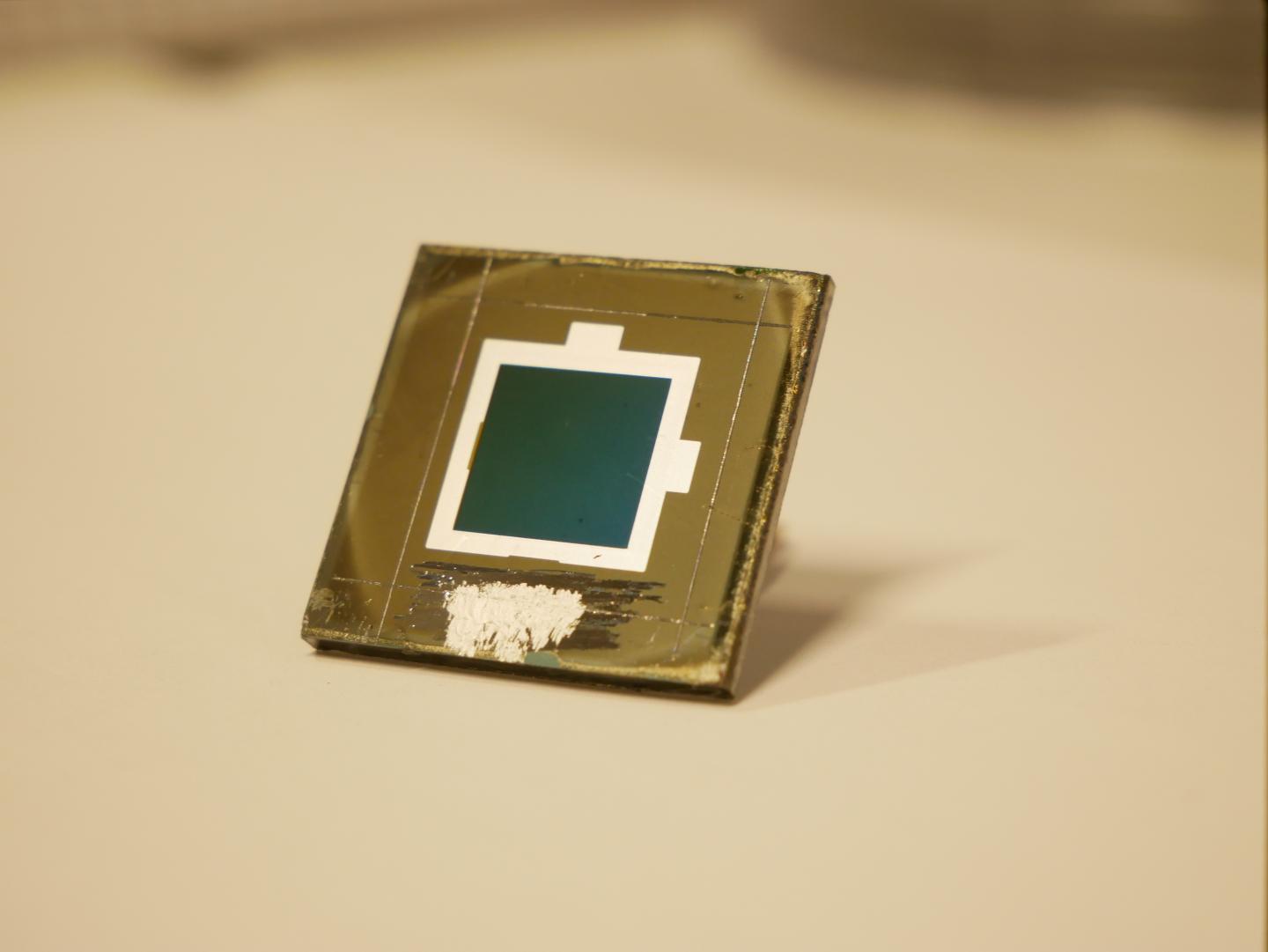
Tandem solar cell world record: New branch in the NREL chart

Bioengineer by Bioengineer
April 14, 2020
in Chemistry
Reading Time: 2 mins read
0
IMAGE
Share on FacebookShare on TwitterShare on LinkedinShare on RedditShare on Telegram

IMAGE

Credit: HZB

Tandem cells combine two different semiconductors that convert different parts of the light spectrum into electrical energy. Metal-halide perovskite compounds mainly use the visible parts of the spectrum, while CIGS semiconductors convert rather the infrared light. CIGS cells, which consist of copper, indium, gallium and selenium, can be deposited as thin-films with a total thickness of only 3 to 4 micrometers; the perovskite layers are even much thinner at 0.5 micrometers. The new tandem solar cell made of CIGS and perovskite thus has a thickness of well below 5 micrometers, which would allow the production of flexible solar modules.

“This combination is also extremely light weight and stable against irradiation, and could be suitable for applications in satellite technology in space”, says Prof. Dr. Steve Albrecht, HZB. These results, obtained in a big collaboration, have been just published in the renowned journal JOULE.

“This time, we have connected the bottom cell (CIGS) directly with the top cell (perovskite), so that the tandem cell has only two electrical contacts, so-called terminals”, explains Dr. Christian Kaufmann from PVcomB at HZB, who developed the CIGS bottom cell with his team and he adds “Especially the introduction of rubidium has significantly improved the CIGS absorber material”.

Albrecht and his team have deposited in the HySPRINT lab at HZB the perovskite layer directly on the rough CIGS layer. “We used a trick that we had previously developed,” explains former postdoc from Albrecht’s group Dr. Marko Jošt, who is now a scientist at the University of Ljubjana, Slovenia. They applied so-called SAM molecules to the CIGS layer, which form a self-organised monomolecular layer, improving the contact between perovskite and CIGS.

The new perovskite CIGS tandem cell achieves an efficiency of 24.16 percent. This value has been officially certified by the CalLab of the Fraunhofer Institute for Solar Energy Systems (ISE).

Since such “2 Terminal” tandem cells made of CIGS and perovskite now represent a separate category, the National Renewable Energy Lab NREL, USA, has created a new branch on the famous NREL chart for this purpose. This chart shows the development of efficiencies for almost all solar cell types since 1976. Perovskite compounds have only been included since 2013 – the efficiency of this material class has increased more steeply than any other material.

###

Prof. Dr. Steve Albrecht heads a BMBF-funded junior research group at HZB and is a junior professor at the Technical University of Berlin. Dr. Christian Kaufmann heads a research group at HZB’s PVcomB. Recently, several world records for tandem solar cells made of perovskite in combination with inorganic semiconductors have been reported from HZB.Currently, Albrecht’s team also holds the world record for tandem cells made of silicon and perovskite with 29.1 percent, which is also listed in the NREL charts.

Media Contact
Antonia Roetger
[email protected]

Original Source

https://www.helmholtz-berlin.de/pubbin/news_seite?nid=21263;sprache=en;seitenid=1

Related Journal Article

http://dx.doi.org/10.1016/j.joule.2020.03.006

Tags: Chemistry/Physics/Materials SciencesEnergy/Fuel (non-petroleum)Industrial Engineering/ChemistryMaterialsSatellite Missions/Shuttles
Share12Tweet8Share2ShareShareShare2

Related Posts

Miniature Sensor Uses Light to Detect Touch — Chemistry

Miniature Sensor Uses Light to Detect Touch

May 8, 2026
Iron Minerals Determine Whether Dissolved Organic Matter Fuels Microbes or Becomes Long-Term Carbon Storage — Chemistry

Iron Minerals Determine Whether Dissolved Organic Matter Fuels Microbes or Becomes Long-Term Carbon Storage

May 8, 2026

Kate Evans Appointed Associate Lab Director for Biological and Environmental Systems Science at ORNL

May 8, 2026

Advancing Multiscale Modeling and Overcoming Operational Challenges in Autothermal CO₂-to-Methanol Reactors

May 8, 2026
Please login to join discussion

POPULAR NEWS

  • Research Indicates Potential Connection Between Prenatal Medication Exposure and Elevated Autism Risk

    840 shares
    Share 336 Tweet 210
  • New Study Reveals Plants Can Detect the Sound of Rain

    728 shares
    Share 290 Tweet 182
  • Salmonella Haem Blocks Macrophages, Boosts Infection

    61 shares
    Share 24 Tweet 15
  • Breastmilk Balances E. coli and Beneficial Bacteria in Infant Gut Microbiomes

    57 shares
    Share 23 Tweet 14

About

We bring you the latest biotechnology news from best research centers and universities around the world. Check our website.

Follow us

Recent News

Transforming Jellyfish Bycatch into a Valuable Collagen Source for Cosmetics and Biotechnology

New Post-Hoc Analysis Explores Daily Oral Orforglipron Use in Adults Over 65 with Obesity, Regardless of Diabetes Status

Evaluating Digoxin Use in Patients with Symptomatic Rheumatic Heart Disease

Subscribe to Blog via Email

Enter your email address to subscribe to this blog and receive notifications of new posts by email.

Join 82 other subscribers
  • Contact Us

Bioengineer.org © Copyright 2023 All Rights Reserved.

Welcome Back!

Login to your account below

Forgotten Password?

Retrieve your password

Please enter your username or email address to reset your password.

Log In
No Result
View All Result
  • Homepages
    • Home Page 1
    • Home Page 2
  • News
  • National
  • Business
  • Health
  • Lifestyle
  • Science

Bioengineer.org © Copyright 2023 All Rights Reserved.