Researchers say nanoparticle film would ‘catch’ and kill virus, better protect healthcare providers
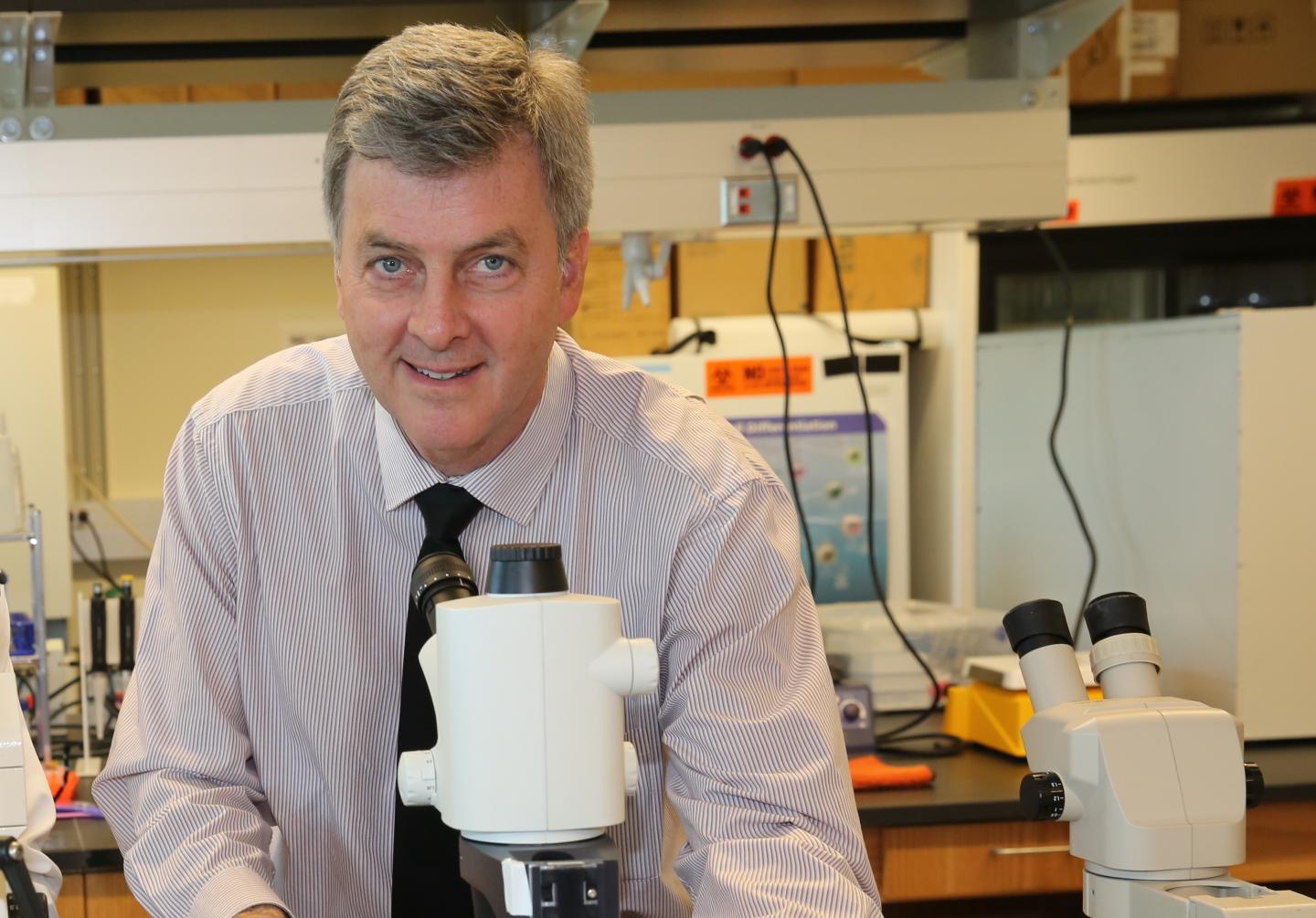
Credit: UCF College of Medicine
Masks that protect doctors and nurses from COVID-19 only block the virus before it reaches their faces, but UCF researchers are working to create a protective coating that would include a novel mask material that would catch the virus and kill it within seconds.
Sudipta Seal, an engineer specializing in material science and nanotechnology, initiated this project working with Griffith Parks, a virologist who leads research efforts at UCF’s College of Medicine.
Seal came up with the idea, which the National Science Foundation funded last week, approving the research proposal through a rapid review process that took about a month.
“Why not come up with a protective film made of nanostructures that could catch and kill the virus?” Seal said. “I could come up with the nanoparticles, I was sure, but would the concept work with a virus? I called Dr. Parks and yes, he thought it could work.”
Seal will create nanostructures that can capture the virus and then trigger a chemical reaction using ultraviolet light to destroy it. The scientists said that if successful, the coating could be added to masks, gloves and gowns, which could keep healthcare providers safer as they battle COVID-19. The virus has infected more than 374,000 people in the United States and resulted in more than 12,000 deaths (and climbing). Worldwide more than 1 million have been infected with more than 81,000 deaths. (statistics as of April 7)
The nanostructures will be created at UCF’s main campus and then shipped to Park’s lab at the College of Medicine to test against a “dictionary of viruses” he has stored in a freezer.
“I make the recipe and Dr. Parks checks against his dictionary of viruses,” Seal said. “The viruses are similar in their RNA and DNA structure to the coronavirus, but not as contagious or lethal. If it works on these closely related viruses, then we go the next step.”
After Seal creates the materials, Parks will put them through a battery of tests to see which materials kill specific viruses and how fast. While one material might kill all viruses, Parks expects that some materials will work better on particular types of viruses – a finding that would allow them to tailor the materials in the future for a specific outbreak by a specific virus type. If Seal and Parks are successful, they hope to develop materials that can also kill disease-causing organisms such as bacteria.
Because Parks’ lab is not Biohazard Safety 3 certified, he cannot test using the actual COVID-19 virus, which requires high-containment facilities. If a material Seal develops proves effective at killing viruses in the coronavirus family, the UCF scientists will send it to a certified outside lab. From there it would go through necessary testing before getting approval to be used in the field.
It could be months, but the approach could prove useful for other potential pandemics as well as the varied viruses and bacteria that healthcare providers face in caring for their patients. “This is a terrific example of two scientific experts – who see things in very different ways and have very different backgrounds – coming together to tackle an important problem. The fact that this interdisciplinary approach might help the world deal with this pandemic makes it even more rewarding,” says Parks.
###
Seal is chair of the Materials Science and Engineering Department, has an appointment at the College of Medicine and is a member of UCF’s prosthetics Cluster Biionix. He is the former director of UCF’s Nanoscience Technology Center and Advanced Materials Processing Analysis Center. His expertise is engineering materials with nanoparticle additives. He has used this approach to create novel products, including cancer therapies and substances that clean up oil spills. He received his doctorate in materials engineering with a minor in biochemistry from the University of Wisconsin-Madison and was a postdoctoral fellow at the Lawrence Berkeley National Laboratory at the University of California Berkeley.
Parks is the College of Medicine’s associate dean for research. He came to UCF in 2014 as director of the Burnett School of Biomedical Sciences after 20 years at the Wake Forest School of Medicine, where he was professor and chairman of the Department of Microbiology and Immunology. He earned his doctorate in biochemistry at the University of Wisconsin-Madison and was an American Cancer Society Fellow at Northwestern University.
Media Contact
Zenaida Gonzalez Kotala
[email protected]