• HOME
  • NEWS
  • EXPLORE
    • CAREER
      • Companies
      • Jobs
    • EVENTS
    • iGEM
      • News
      • Team
    • PHOTOS
    • VIDEO
    • WIKI
  • BLOG
  • COMMUNITY
    • FACEBOOK
    • INSTAGRAM
    • TWITTER
Wednesday, February 4, 2026
BIOENGINEER.ORG
No Result
View All Result
  • Login
  • HOME
  • NEWS
  • EXPLORE
    • CAREER
      • Companies
      • Jobs
        • Lecturer
        • PhD Studentship
        • Postdoc
        • Research Assistant
    • EVENTS
    • iGEM
      • News
      • Team
    • PHOTOS
    • VIDEO
    • WIKI
  • BLOG
  • COMMUNITY
    • FACEBOOK
    • INSTAGRAM
    • TWITTER
  • HOME
  • NEWS
  • EXPLORE
    • CAREER
      • Companies
      • Jobs
        • Lecturer
        • PhD Studentship
        • Postdoc
        • Research Assistant
    • EVENTS
    • iGEM
      • News
      • Team
    • PHOTOS
    • VIDEO
    • WIKI
  • BLOG
  • COMMUNITY
    • FACEBOOK
    • INSTAGRAM
    • TWITTER
No Result
View All Result
Bioengineer.org
No Result
View All Result
Home NEWS Science News Biology

Blocking the iron transport could stop tuberculosis

Bioengineer by Bioengineer
April 1, 2020
in Biology
Reading Time: 3 mins read
0
IMAGE
Share on FacebookShare on TwitterShare on LinkedinShare on RedditShare on Telegram

IMAGE

Credit: Imre Gonda, University of Zurich

One of the most devastating pathogens that lives inside human cells is Mycobacterium tuberculosis, the bacillus that causes tuberculosis. According to the World Health Organization, 1.5 million people died in 2019 from this disease that generally affects the lungs. The rise of multidrug resistant M. tuberculosis strains, which are resistant to many of the most effective anti-tuberculosis drugs, is particularly worrying. In other words, novel drugs to treat tuberculosis are urgently needed.

Tuberculosis bacteria need iron to survive

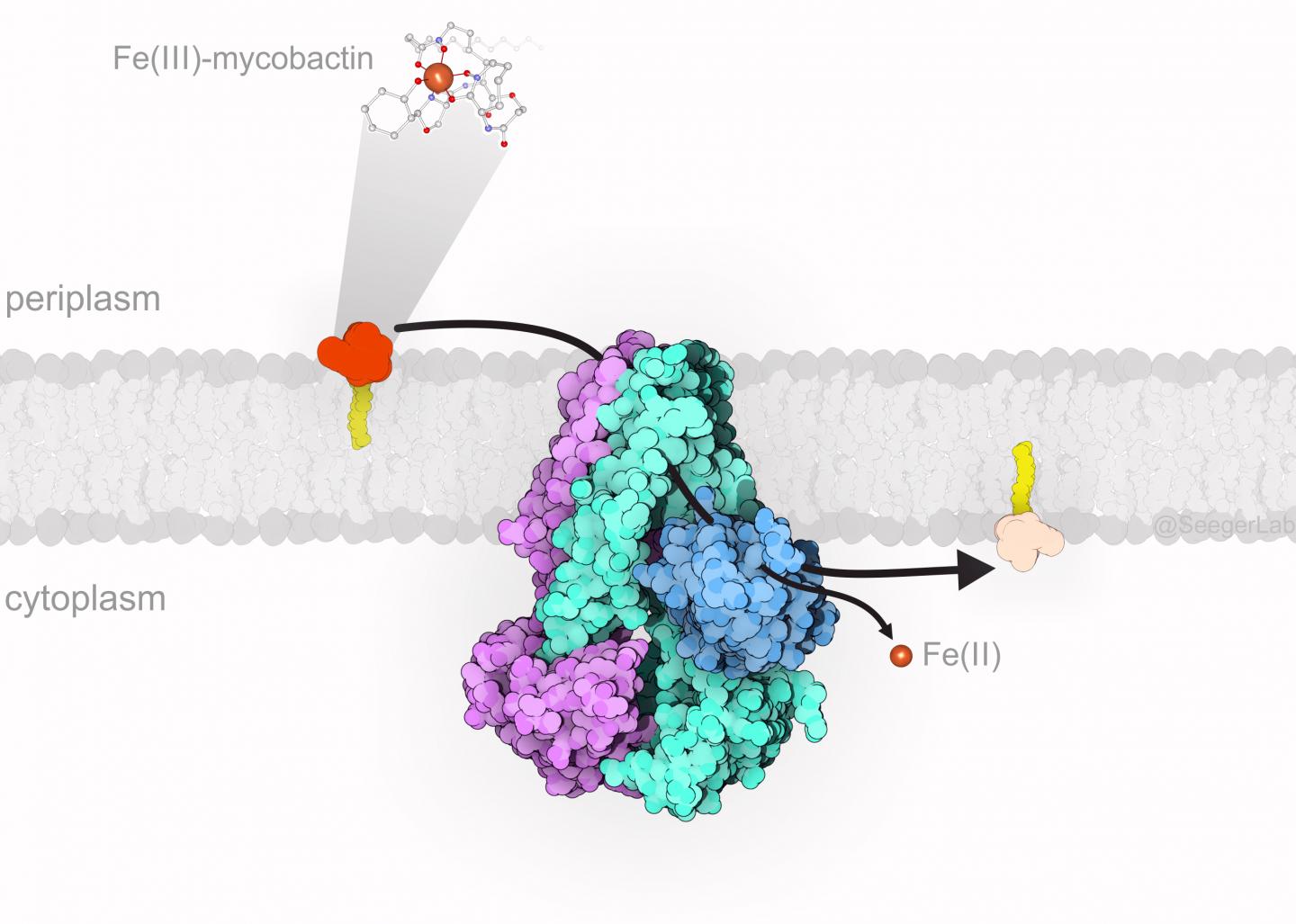
All living organisms, including pathogens, need iron to survive. When a human cell is infected by pathogens like M. tuberculosis, it reduces the iron concentration to a minimum and thereby tries to starve the invader. The tuberculosis bacteria, in turn, start to release small molecules called mycobactins. These can bind free iron extremely well and thus steel it from the host cell. The iron captured by mycobactin is then transported into the bacteria by a protein named IrtAB.

A team of researchers led by Markus Seeger, professor at the Institute of Medical Microbiology of the University of Zurich (UZH), has now analyzed in detail the protein responsible for transporting iron from the infected host cell into the bacteria. “The transport protein, which is located in the bacterial membrane, is essential for the survival of the pathogens. If IrtAB is absent or not functioning, M. tuberculosis can no longer reproduce inside the human cell”, says Seeger.

Iron transport protein works in the opposite direction

Using a combination of cryo-electron microscopy and X-ray crystallography, the researchers solved for the first time a high-resolution structure of the transport protein IrtAB. This analysis was done in collaboration with Ohad Medalia, professor at the Department of Biochemistry of UZH. According to its spatial structure, IrtAB belongs to the so-called ABC exporters, which are typically involved in the efflux of molecules out of the bacterial cell. “However, we were able to show that IrtAB in fact imports mycobactins into M. tuberculosis. It therefore transports molecules in the opposite direction than expected,” says Markus Seeger.

Together with scientists from the University of Texas, USA, the research team identified an additional peculiarity of the transport protein IrtAB: It can modify the iron bound to mycobactin after it is imported into the bacteria. The iron is thus released inside the cell and the empty mycobactin can be recycled.

Inhibiting the iron transport could lead to new tuberculosis drugs

“IrtAB is a potential drug target, because its deletion renders M. tuberculosis inactive and incapable of infection. With our structural and functional elucidation of IrtAB, we opened avenues to develop novel tuberculosis drugs that inhibit the iron transport into the bacteria”, Seeger concludes. “In view of Covid-19, a disease that also affects the lungs, tuberculosis will likely play a more important role again in the future. It is quite conceivable that patients weakened by Covid-19 will show increased infection rates with tuberculosis,” he adds.

###

Media Contact
Markus A. Seeger
[email protected]

Original Source

https://www.media.uzh.ch/en/Press-Releases/2020/Tuberculosis.html

Related Journal Article

http://dx.doi.org/10.1038/s41586-020-2136-9

Tags: BacteriologyBiologyCell BiologyDisease in the Developing WorldInfectious/Emerging DiseasesMedicine/HealthMicrobiologyMolecular Biology
Share12Tweet8Share2ShareShareShare2

Related Posts

Enhanced IVF Success: Innovative Transparent Culture Dishes Boost Embryo Selection Accuracy

Enhanced IVF Success: Innovative Transparent Culture Dishes Boost Embryo Selection Accuracy

February 4, 2026
Dog Behavior Traits Connected to Salivary Cortisol Levels and Serotonin Activity

Dog Behavior Traits Connected to Salivary Cortisol Levels and Serotonin Activity

February 4, 2026

Study Finds Ideal Scent Detection Dogs Are Confident, Persistent, and Resilient—Traits Valued by Dutch Police Handlers

February 4, 2026

High-Dose Antioxidants May Increase Risk of Birth Defects, Texas A&M Study Shows

February 4, 2026
Please login to join discussion

POPULAR NEWS

  • Enhancing Spiritual Care Education in Nursing Programs

    158 shares
    Share 63 Tweet 40
  • Robotic Ureteral Reconstruction: A Novel Approach

    81 shares
    Share 32 Tweet 20
  • Digital Privacy: Health Data Control in Incarceration

    63 shares
    Share 25 Tweet 16
  • Study Reveals Lipid Accumulation in ME/CFS Cells

    57 shares
    Share 23 Tweet 14

About

We bring you the latest biotechnology news from best research centers and universities around the world. Check our website.

Follow us

Recent News

UT Health San Antonio Scientists Author American Heart Association Statement on Early Detection and Treatment of Post-Stroke Spasticity

Revolutionary AI Model Enhances Fluency for Native and Non-Native Arabic Readers of Undiacritized Texts

New Guidelines Standardize Tumor Response Measurement Following Surgery

Subscribe to Blog via Email

Enter your email address to subscribe to this blog and receive notifications of new posts by email.

Join 73 other subscribers
  • Contact Us

Bioengineer.org © Copyright 2023 All Rights Reserved.

Welcome Back!

Login to your account below

Forgotten Password?

Retrieve your password

Please enter your username or email address to reset your password.

Log In
No Result
View All Result
  • Homepages
    • Home Page 1
    • Home Page 2
  • News
  • National
  • Business
  • Health
  • Lifestyle
  • Science

Bioengineer.org © Copyright 2023 All Rights Reserved.