Urban waste and bio-inspired engineering provide key ingredients to 3D printed bioplastic, allowing for global adoption of sustainable manufacturing processes.
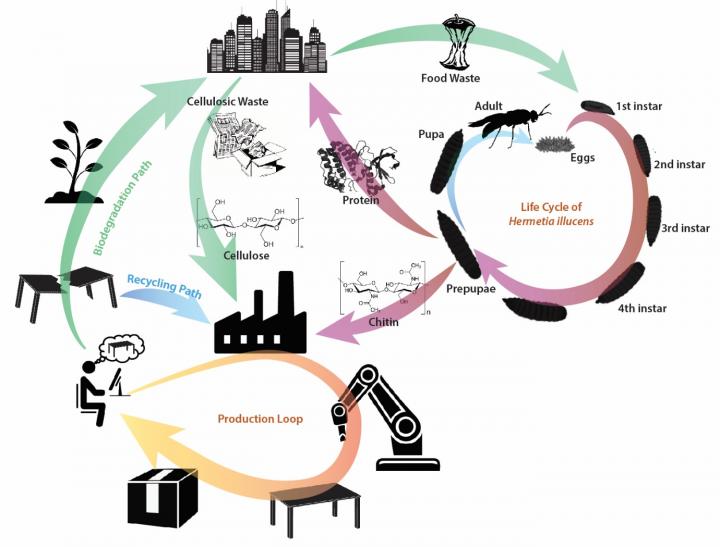
Credit: SUTD
Researchers from the Singapore University of Technology and Design (SUTD) have developed a process that allows for the production and degradation of almost any object within a circular economy using additive manufacturing and urban waste, the largest by-product of civilization.
Inspired by the cyclical mode of production and degradation of biological materials by organisms using limited energy and material resources found within localized conditions, the researchers, together with its collaborators, focused on translating those principles in urban ecosystems. This was to reduce its reliance in intercontinental transport, energy demanding manufacturing processes, use of harmful chemicals substances, and dependence on man-made synthetic materials which require complex reclamation procedures past their end-of-life.
SUTD researchers from the same team previously developed a fungus-like adhesive material, also known as FLAM, by effectively transforming chitin and cellulose, into materials for sustainable manufacturing. Derived from the shells of crustaceans and insects, as well as wood and paper, respectively, chitin and cellulose are the two most abundant organic polymers on earth. Touted as a ‘green’ alternative to plastic, FLAM is not only biodegradable, flexible, and durable; it can be mass-produced on a large scale using 3D printing technology.
Cellulose can be easily obtainable from urban waste such as tissue paper, textiles, and plant matter. However, despite the ubiquitous nature of chitin, this polymer is mostly harvested as an industrial and agricultural product. For instance, chitin is mostly available as a seasonal by-product of the fishing industry and is limited to rural coastal areas. This means that chitin would be needed to be transported over different ecosystems when there is a demand, contributing to freight transportation, which is known to be a key contributor to carbon dioxide emissions.
In the study published by Nature’s Scientific Reports, the researchers have developed a link between bio inspired manufacturing and urban waste bio conversion, enabling a different mode of production based on materials that are conveniently available within any regional ecosystem, significantly reducing the need for transportation.
It was determined that chitin can be produced within limited energy requirements and reduce food waste at the same time, easing the largest expense for municipalities all around the world – all with the help of the humble black soldier fly (BSF, Hermetia illucens). The study reports successful extraction of chitin from the shells of these BSFs.
At the same time, the BSF is also globally known for its efficient breakdown of a wide variety of organic materials, such as food waste into proteins, oils and other biomass, thus reducing the amount of waste sent to the landfills.
Despite BSF’s popularity, the research team ensured that their developed system was not reliant on the use of BSF or any other unique source of materials since chitin and cellulose are present in a myriad of organisms in every ecosystem on earth such as other insects, fungi, and worms. While these organisms are also used to process waste, they in turn produce chitin as a by-product.
With annual food losses disposed in landfills estimated to be around one-third of the world’s total production, bio conversion via insects, fungi and worms, is not only gaining popularity as an effective solution to urban waste management, but it also suggests for an emergent paradigm of a circular urban ecology, spanning from material production and manufacturing to end-of-life reclamation.
Manufacturing with the world’s most abundant biological polymers within, or in close proximity to the source of production and consumption – such as cellulose and chitin used for 3D printed FLAM – may not only allow us to address key deviations arising from our urban way of life, but motivate a fundamentally more sustainable economy and society.
“This new development will transform the way we manufacture, enabling an alternative model where materials are produced and consumed using locally available resources. Also, it will allow anyone around the world to adapt and integrate general manufacturing to its surrounding ecosystem,” said Assistant Professor Javier G. Fernandez from SUTD, lead author of the paper.
“Close proximity and deep integration of production and consumption cycles inspired by biology within urban ecosystems may not only influence the way we inhabit the cities of tomorrow, but also upstream envision, design and build them,” added Associate Professor Stylianos Dritsas also from SUTD and co-author of the paper.
###
Media Contact
Jessica Sasayiah
[email protected]
656-499-4823
Original Source
https:/