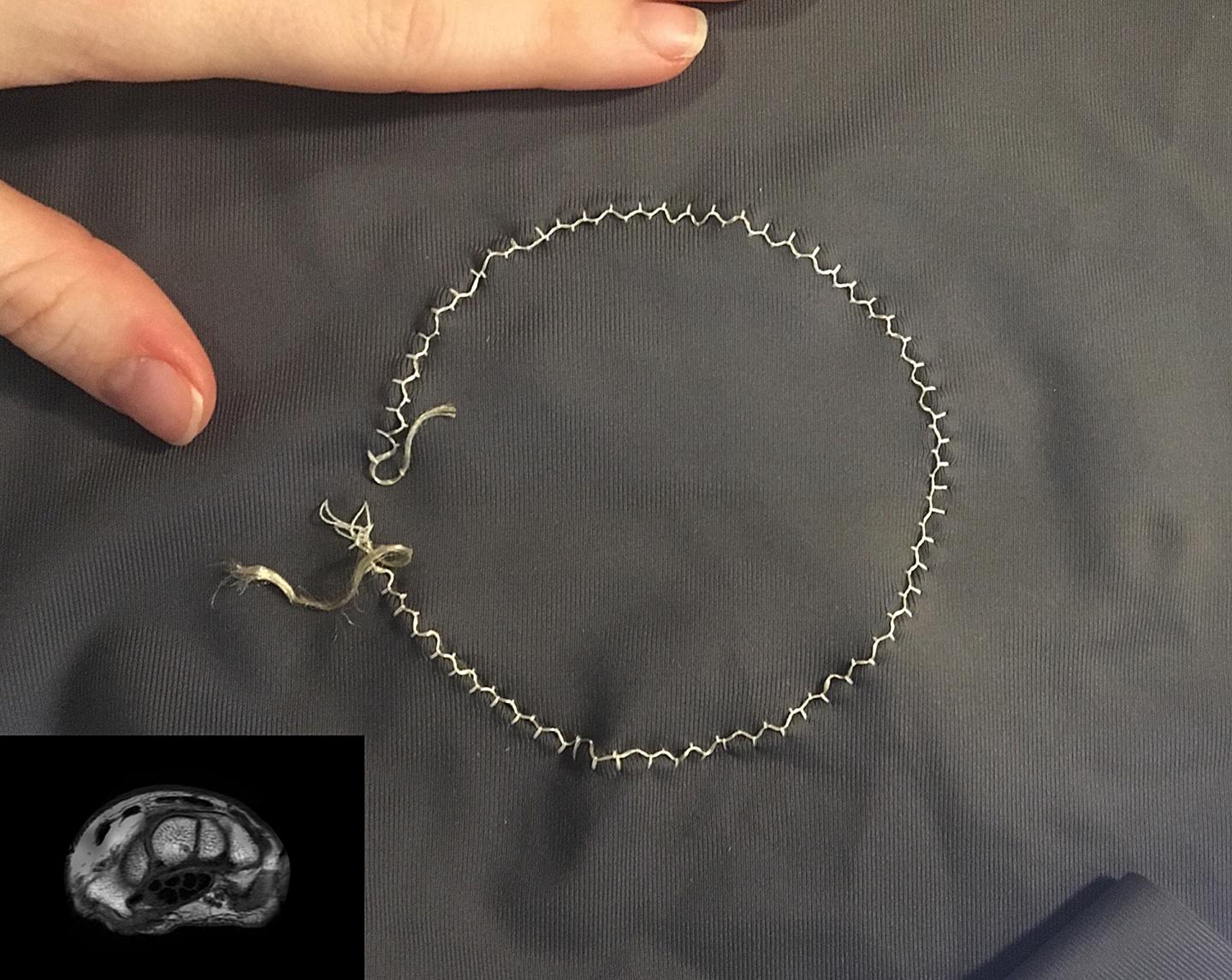
Credit: Joseph Rispoli/Purdue University
WEST LAFAYETTE, Ind. – Anyone who has had a mammogram or an MRI knows how uncomfortable and awkward the tests can be. Now, Purdue University researchers have taken technology used in the defense and aerospace industries to create a novel way of doing some medical imaging.
One reason the tests are uncomfortable is that they often use rigid radio-frequency (RF) coils to detect signals from the body. Now, the Purdue team has developed RF coils that are formable and stretchable.
“Imagine going for an imaging session and they strap on a comfortable fabric with the coils embedded inside,” said Joseph Rispoli, an assistant professor of biomedical engineering and electrical and computer engineering in Purdue’s College of Engineering. “We created an adaptable, wearable and stretchable fabric embroidered with conductive threads that provides excellent signal-to-noise ratio for enhanced MRI scanning.”
The Purdue team’s work appeared in the journal IEEE Transactions on Biomedical Engineering.
Current approaches to enhancing signal-to-noise ratio, known as SNR, include shaping receive coil arrays to encompass a generalized form of the body part of interest, but these are often rigid and require the patient be posed in a specific way. The Purdue flexible and stretchable coil could be placed close to the skin on an area or joint, regardless of its positioning.
The thread technology used in the Purdue innovation is similar to that found in applications for the aerospace and defense industries. Rispoli said the technology also is applicable to breast MRI and to enhancing medical device communication using wearable or implantable antennas.
“Our preliminary results show a full-scale device will be superior in all aspects of diagnostic testing, including increased sensitivity and fewer false positives,” Rispoli said.
The innovators are working with the Purdue Research Foundation Office of Technology Commercialization to patent the technology. The office recently moved into the Convergence Center for Innovation and Collaboration in Discovery Park District, located on the west side of the Purdue campus.
The researchers are looking for partners to continue developing their technology. For more information on licensing and other opportunities, contact Patrick Finnerty of OTC at [email protected] and mention track code 2019-RISP-68630.
The National Institutes of Health funded some of the work on the technology. The Purdue innovators also presented the technology at the International Society for Magnetic Resonance in Medicine Annual Meeting and the IEEE International Engineering in Medicine and Biology Conference.
Rispoli also is a member of the drug delivery and molecular sensing program at the Purdue University Center for Cancer Research, where he works on technologies to diagnose and monitor brain, breast and other cancers.
###
About Purdue Research Foundation Office of Technology Commercialization
The Purdue Research Foundation Office of Technology Commercialization operates one of the most comprehensive technology transfer programs among leading research universities in the U.S. Services provided by this office support the economic development initiatives of Purdue University and benefit the university’s academic activities through commercializing, licensing and protecting Purdue intellectual property. The office is managed by the Purdue Research Foundation, which received the 2019 Innovation and Economic Prosperity Universities Award for Place from the Association of Public and Land-grant Universities. The Purdue Research Foundation is a private, nonprofit foundation created to advance the mission of Purdue University. Visit the Office of Technology Commercialization for more information.
Writer: Chris Adam, 765-588-3341, [email protected]
Source: Joseph Rispoli, [email protected]
Media Contact
Chris Adam
[email protected]
Related Journal Article
http://dx.