• HOME
  • NEWS
  • EXPLORE
    • CAREER
      • Companies
      • Jobs
    • EVENTS
    • iGEM
      • News
      • Team
    • PHOTOS
    • VIDEO
    • WIKI
  • BLOG
  • COMMUNITY
    • FACEBOOK
    • INSTAGRAM
    • TWITTER
Saturday, February 7, 2026
BIOENGINEER.ORG
No Result
View All Result
  • Login
  • HOME
  • NEWS
  • EXPLORE
    • CAREER
      • Companies
      • Jobs
        • Lecturer
        • PhD Studentship
        • Postdoc
        • Research Assistant
    • EVENTS
    • iGEM
      • News
      • Team
    • PHOTOS
    • VIDEO
    • WIKI
  • BLOG
  • COMMUNITY
    • FACEBOOK
    • INSTAGRAM
    • TWITTER
  • HOME
  • NEWS
  • EXPLORE
    • CAREER
      • Companies
      • Jobs
        • Lecturer
        • PhD Studentship
        • Postdoc
        • Research Assistant
    • EVENTS
    • iGEM
      • News
      • Team
    • PHOTOS
    • VIDEO
    • WIKI
  • BLOG
  • COMMUNITY
    • FACEBOOK
    • INSTAGRAM
    • TWITTER
No Result
View All Result
Bioengineer.org
No Result
View All Result
Home NEWS Science News Chemistry

Regioselective magnetization enabled chiral semiconducting heteronanorods

Bioengineer by Bioengineer
February 25, 2020
in Chemistry
Reading Time: 2 mins read
0
IMAGE
Share on FacebookShare on TwitterShare on LinkedinShare on RedditShare on Telegram

IMAGE

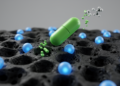
Credit: ZHUANG et al.

The USTC team led by Prof. Shu-Hong Yu (USTC), collaborating with Prof. Zhiyong Tang (National Center for Nanoscience and Technology, China) and Prof. Edward H. Sargent (University of Toronto), has shed new lights on the topic of chiral inorganic nanomaterials. Researchers demonstrated a regioselective magnetization strategy, achieving a library of semiconducting heteronanorods with chiroptical activities.

The research article entitled “Regioselective magnetization in semiconducting nanorods” was published in Nature Nanotechnology on Jan 20th.

Chirality – the property of an object non-superimposable with its mirror image – is of widespread interest in physics, chemistry, and biology. The chiroptical activity in materials can be tuned by electric and magnetic transition dipoles. To date, the chemical construction of chiral nanomaterials has been achieved through the introduction of chiral molecules and geometrically helical structures to provide modulation; but these methods limit their environmental instability – chirality disappears under illumination, heating, or in a harsh chemical environment – and poor conductivity, since charge transfer processes towards surface reactants and electrodes are impeded. These limitations hamper further practical applications of chiral materials in various areas.

Designing magneto-optical nanomaterials offers an opportunity to modulate the interactions between electric and magnetic dipoles via the local magnetic field, underlining another promising approach to enable chirality. To materialize such chiroptically active media, the growth of magnetic units has to be achieved at targeted locations of parent nanomaterials. One-dimensional chalcogenide semiconductor nanorods stand out as compelling candidates to serve as the parent materials due to their high geometric anisotropy, large electric dipole moment along nanorods, ease of composition and size modulations, as well as promising applications in catalysis, photonics, and electronics. However, technical challenges lie in the epitaxial growth between host and motif materials of large lattice and chemical mismatches, let alone the regioselective growth.

Taking up the challenge, researchers reported a double-buffer-layer engineering strategy to achieve the selective growth of magnetic materials at specific locations on a wide variety of semiconducting nanorods (i.e. ZnxC1-xS, where 0?x?1). The authors sequentially integrated Ag2S and Au intermediate layers at one apex of each nanorod to catalyze the site-specific growth of Fe3O4 nanodomains. Due to the location-specific magnetic field, the resulting magnetized heteronanorods exhibit deflected electric dipole moment. In this way, the non-zero interaction between electric and magnetic transition dipoles induces chiroptical activity in the absence of chiral ligands, helical structures, and chiral lattices – a phenomenon not observed outside of modulation. The regioselective magnetization strategy opens a new avenue to designing optically active nanomaterials for chirality and spintronics.

###

Media Contact
Jane FAN Qiong
[email protected]
86-551-636-07280

Related Journal Article

http://dx.doi.org/10.1038/s41565-019-0606-8

Tags: Chemistry/Physics/Materials SciencesMaterials
Share12Tweet8Share2ShareShareShare2

Related Posts

blank

Breakthrough in Environmental Cleanup: Scientists Develop Solar-Activated Biochar for Faster Remediation

February 7, 2026
blank

Cutting Costs: Making Hydrogen Fuel Cells More Affordable

February 6, 2026

Scientists Develop Hand-Held “Levitating” Time Crystals

February 6, 2026

Observing a Key Green-Energy Catalyst Dissolve Atom by Atom

February 6, 2026
Please login to join discussion

POPULAR NEWS

  • Robotic Ureteral Reconstruction: A Novel Approach

    Robotic Ureteral Reconstruction: A Novel Approach

    82 shares
    Share 33 Tweet 21
  • Digital Privacy: Health Data Control in Incarceration

    63 shares
    Share 25 Tweet 16
  • Study Reveals Lipid Accumulation in ME/CFS Cells

    57 shares
    Share 23 Tweet 14
  • Breakthrough in RNA Research Accelerates Medical Innovations Timeline

    53 shares
    Share 21 Tweet 13

About

We bring you the latest biotechnology news from best research centers and universities around the world. Check our website.

Follow us

Recent News

Improving Dementia Care with Enhanced Activity Kits

Decoding Prostate Cancer Origins via snFLARE-seq, mxFRIZNGRND

Digital Health Perspectives from Baltic Sea Experts

Subscribe to Blog via Email

Enter your email address to subscribe to this blog and receive notifications of new posts by email.

Join 73 other subscribers
  • Contact Us

Bioengineer.org © Copyright 2023 All Rights Reserved.

Welcome Back!

Login to your account below

Forgotten Password?

Retrieve your password

Please enter your username or email address to reset your password.

Log In
No Result
View All Result
  • Homepages
    • Home Page 1
    • Home Page 2
  • News
  • National
  • Business
  • Health
  • Lifestyle
  • Science

Bioengineer.org © Copyright 2023 All Rights Reserved.