• HOME
  • NEWS
  • EXPLORE
    • CAREER
      • Companies
      • Jobs
    • EVENTS
    • iGEM
      • News
      • Team
    • PHOTOS
    • VIDEO
    • WIKI
  • BLOG
  • COMMUNITY
    • FACEBOOK
    • INSTAGRAM
    • TWITTER
Saturday, November 28, 2026
BIOENGINEER.ORG
No Result
View All Result
  • Login
  • HOME
  • NEWS
  • EXPLORE
    • CAREER
      • Companies
      • Jobs
        • Lecturer
        • PhD Studentship
        • Postdoc
        • Research Assistant
    • EVENTS
    • iGEM
      • News
      • Team
    • PHOTOS
    • VIDEO
    • WIKI
  • BLOG
  • COMMUNITY
    • FACEBOOK
    • INSTAGRAM
    • TWITTER
No Result
View All Result
Bioengineer.org
No Result
View All Result
Home NEWS Science News Biology

Sustainable light sources: LEDs from bacterial production

Bioengineer by Bioengineer
February 25, 2020
in Biology
Reading Time: 3 mins read
0
IMAGE
Share on FacebookShare on TwitterShare on LinkedinShare on RedditShare on Telegram

IMAGE

Credit: © Lunghammer – TU Graz

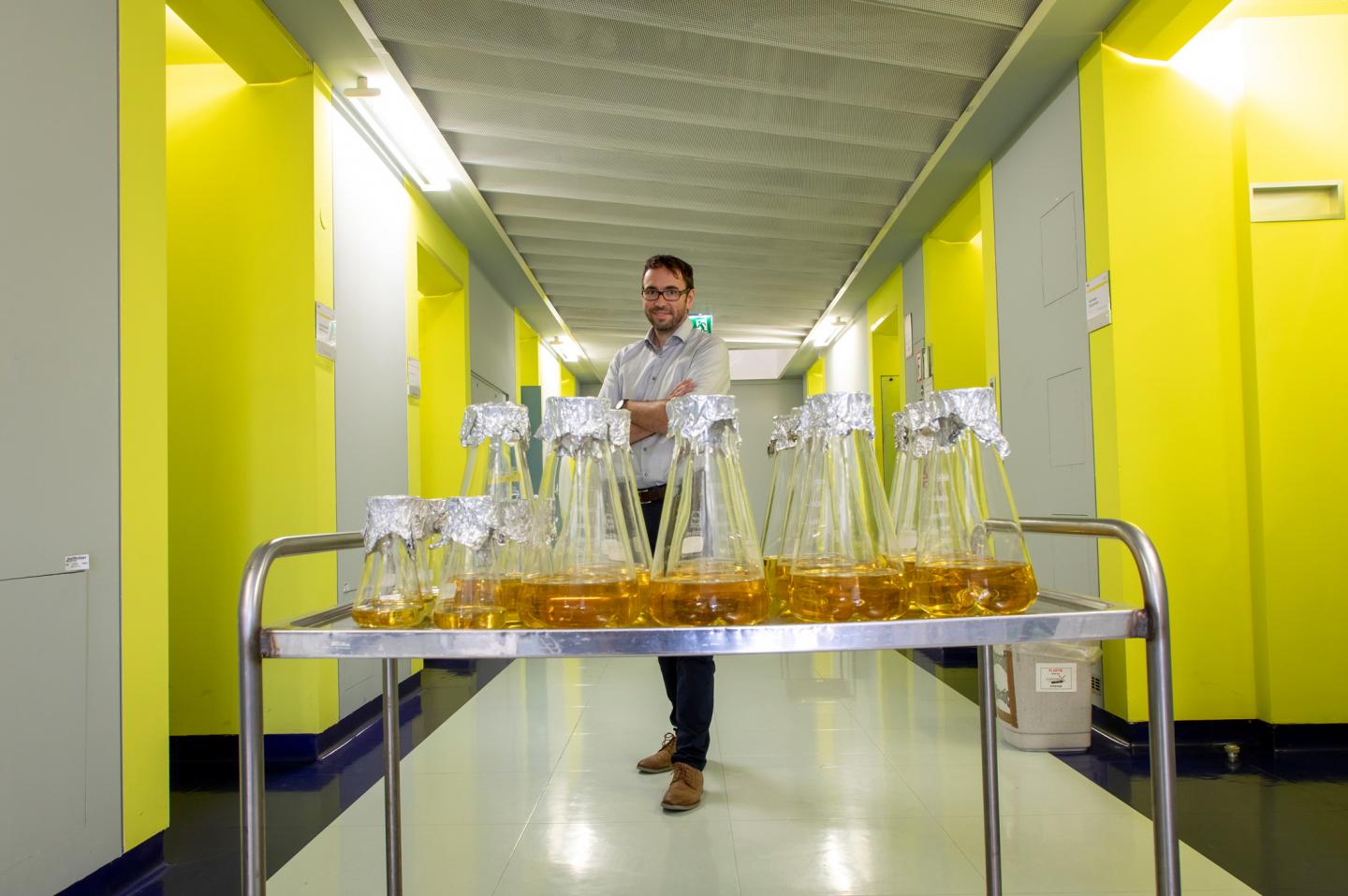
The basis for this vision is being laid at the Institute of Biochemistry at Graz University of Technology, where Gustav Oberdorfer and his team are designing proteins with the help of simulation software. “For this project, we’re analysing fluorescent protein structures from nature and testing how we need to modify them so that they bind different fluorescent organic molecules,” explains Oberdorfer. LEDs emit short-wave blue light which is then absorbed by a layer of inorganic lighting materials and converted into light of longer wavelength. The entire spectrum then results in the white light as we perceive it.

Oberdorfer developed the idea for the project together with cooperation partners from Spain and Italy who worked on the topic independently of each other and were able to achieve promising success.

Environmentally friendly LED coating

Rubén Costa from the Madrid Institute for Advanced Studies (IMDEA) developed a stable organic LED coating as an alternative to conventional LED coatings, which usually consist of problematic rare earth minerals. The mixture consists of organic polymers in which he and his team managed to embed fluorescent proteins. These fluorescent proteins are found in marine organisms and are used by them as a light source for hunting, communication and self-protection. The luminosity that can be achieved with such devices is however still too low to use them in lamps that illuminate entire rooms.

Organic dyes with good light emitting efficiency

Researchers of the Department of Chemistry at the University of Turin led by Claudia Barolo are in turn dealing with the synthesis of organic dyes that have a good light emitting efficiency and are used in organic light-emitting diodes (OLEDs). However, many of these dyes are costly and complex to synthesize. As part of the FET Open project, Barolo and her team are now looking for a suitable dye that can be produced with minimal effort and that can be modified so that it can be incorporated into proteins as an artificial amino acid.

FET Open project ENABLED combines the best of all the sub-sectors

The FET Open project ENABLED now brings together the successes of all groups. The goal is to use bacteria to develop completely new artificial fluorescent proteins. To this end, the Graz biochemists first simulate thousands of different hypothetical proteins that are to bind specifically to the synthetic dyes. A handful of these proteins – namely those closest to the structure of naturally fluorescent proteins – are then ordered as synthetic DNA constructs. The next step is to investigate whether these proteins really bind the dyes for which they were designed. As soon as this is confirmed, these new, artificial fluorescent proteins will be integrated into the polymer matrix and tested for their suitability with regard to bio-LEDs.

“The plan is that we will ‘harvest’ the proteins from the bacterial cell; in other words, we will be able to grow some part of the light sources,” said Oberdorfer, hoping for a proof of principle at the end of the project in four years’ time.

###

Cooperation partners:

CIC biomaGUNE – Centro de Investigación Cooperativa en Biomateriales (Spain)

IMDEA Materials Institute (Spain)

TU Graz, Institute of Biochemistry (Austria)

University of Oviedo (Spain)

University of Turin (Italy)

The ENABLED research project is part of TU Graz’s Field of Expertise “Human & Biotechnology”, one of five research foci of Graz University of Technology. It is funded by the FETopen research funding programme under the EU Horizon2020 programme to the amount of approx. 2.6 million euros. FET Open is reserved for unconventional, new research ideas at an early stage which aim at breakthroughs for new technologies.

Media Contact
Gustav Oberdorfer
gustav.oberdorfer@tugraz.at
43-316-873-6462

Original Source

https://www.tugraz.at/en/tu-graz/services/news-stories/media-service/singleview/article/nachhaltige-leuchtmittel-leds-aus-bakterieller-produktion0/

Tags: BiochemistryBiomedical/Environmental/Chemical EngineeringBiotechnologyChemistry/Physics/Materials SciencesMaterialsOpticsPolymer ChemistryResearch/Development
Share12Tweet8Share2ShareShareShare2

Related Posts

Proximal First Phalanx Physeal Closure in Icelandic Foals Estimated at Median 216 Days

Proximal First Phalanx Physeal Closure in Icelandic Foals Estimated at Median 216 Days

November 28, 2026
Wild Afrotropical Rodents Show Greater Seasonal Stability in Gut Than Oral Microbiota

Wild Afrotropical Rodents Show Greater Seasonal Stability in Gut Than Oral Microbiota

November 28, 2026

LiCCoAOMT Gene Positively Regulates Regaloside F Accumulation in Developing Lily Bulbs

November 28, 2026

Spatial Validation Exposes Overestimated Accuracy in Machine Learning Soil Carbon Maps

November 28, 2026
Please login to join discussion

POPULAR NEWS

  • CCND1 Alterations Link to Lethal Outcomes in Refractory Urothelial Carcinoma

    CCND1 Alterations Link to Lethal Outcomes in Refractory Urothelial Carcinoma

    29 shares
    Share 12 Tweet 7
  • Diabetes Linked to Higher Urinary Urgency and Poorer Quality of Life

    29 shares
    Share 12 Tweet 7
  • Collaborative Systems Framework Developed to Reduce Ketamine Harms in Northwest England

    29 shares
    Share 12 Tweet 7
  • Microbial Inoculant Performance Depends on Manufacturing and Delivery Beyond Strain Selection

    29 shares
    Share 12 Tweet 7

About

We bring you the latest biotechnology news from best research centers and universities around the world. Check our website.

Follow us

Recent News

Mixed Reality Resuscitation Training Boosts Nursing Students’ Advanced Life Support Knowledge

Proximal First Phalanx Physeal Closure in Icelandic Foals Estimated at Median 216 Days

Wild Afrotropical Rodents Show Greater Seasonal Stability in Gut Than Oral Microbiota

Subscribe to Blog via Email

Enter your email address to subscribe to this blog and receive notifications of new posts by email.

Join 89 other subscribers
  • Contact Us

Bioengineer.org © Copyright 2023 All Rights Reserved.

Welcome Back!

Login to your account below

Forgotten Password?

Retrieve your password

Please enter your username or email address to reset your password.

Log In
No Result
View All Result
  • Homepages
    • Home Page 1
    • Home Page 2
  • News
  • National
  • Business
  • Health
  • Lifestyle
  • Science

Bioengineer.org © Copyright 2023 All Rights Reserved.