A randomized trial conducted in South Korea found that nursing students who trained with a mixed reality simulation achieved significantly higher post-test cardiopulmonary resuscitation knowledge scores than peers trained through standard human-team simulation. The convergent mixed methods study evaluated whether mixed reality technology could address a persistent limitation in conventional resuscitation education, where scenario time is typically split among four to six participants and individual learners rarely gain direct experience managing cardiac arrest scenarios as team leaders.
Prior to this trial, however, no randomized investigation had directly compared mixed reality with human-team simulation using an identical instructional blueprint.
To evaluate the approach, investigators implemented a convergent mixed methods design comprising a two-arm, parallel-group, pretest–posttest randomized controlled trial paired with a qualitative strand. The research was conducted at the simulation centers of two nursing colleges in South Korea and officially registered with the Clinical Research Information Service under identifier KCT0011036. The study compared how the two training modalities influenced cardiopulmonary resuscitation knowledge, readiness for clinical practice, objective performance, chest compression time, and learner satisfaction.
The study cohort consisted of 40 final-year baccalaureate nursing students who were randomly allocated to either the mixed reality intervention program or a conventional human-team simulation program. Eighteen students were assigned to the mixed reality arm, while 22 students participated in the human-team control group. Both educational programs shared an instructional blueprint derived from the four-component instructional design model, ensuring that the total contact time and underlying curriculum structure remained balanced across both arms of the investigation.
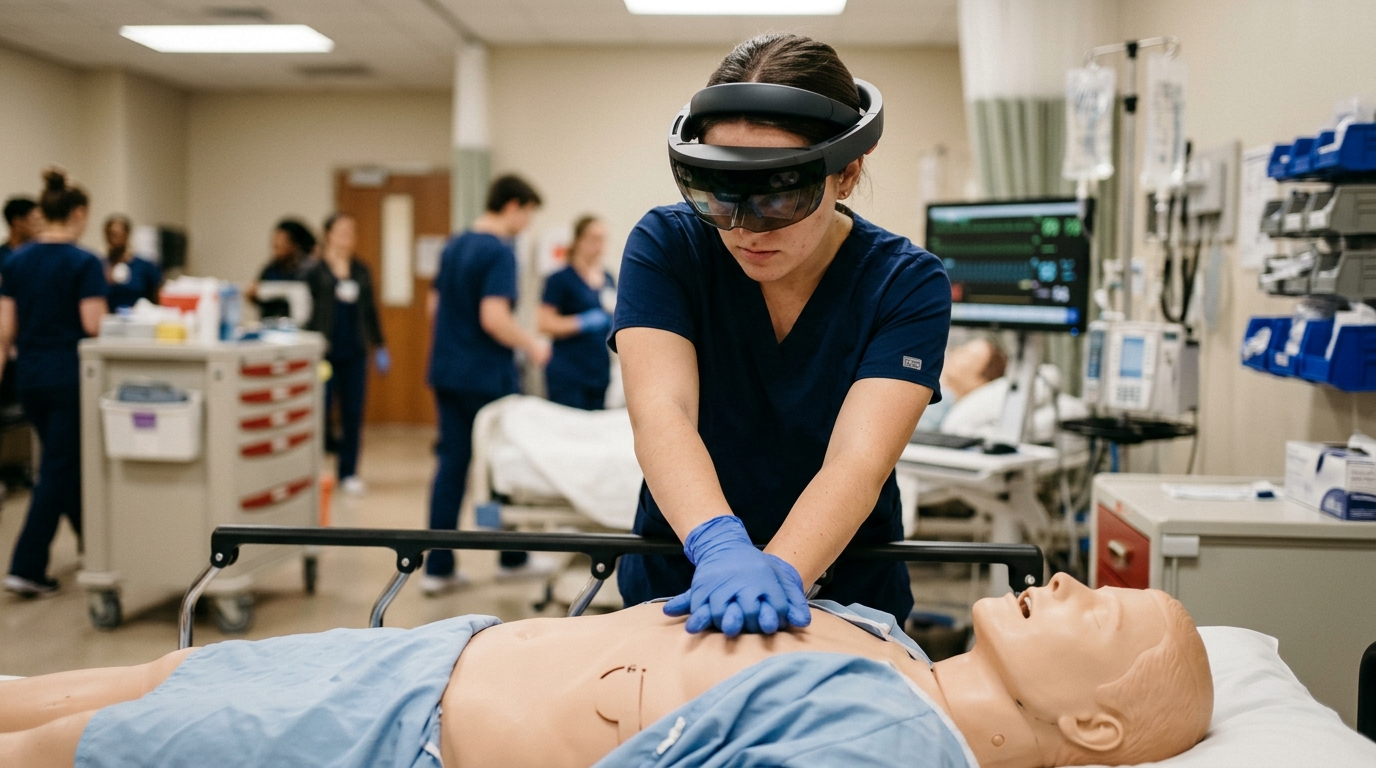
The experimental and control curricula differed solely within their 90-minute whole-task simulation block. In the intervention arm, students worked in pairs, with each participant actively leading simulated resuscitation scenarios by issuing vocal commands to a team of virtual avatars while simultaneously performing chest compressions on a physical manikin. In contrast, control participants completed their whole-task training within conventional human teams of four to five peers, distributing scenario roles and responsibilities in a traditional group format.
Following training, students in the mixed reality cohort demonstrated significantly higher post-test resuscitation knowledge than those in the human-team control cohort, exhibiting an effect size of r = .45 with a 95 percent confidence interval ranging from 0.13 to 0.75. Both educational groups demonstrated marked improvements in readiness for clinical practice with no significant between-group difference, performance scores approached the upper scale maximum in both cohorts, and chest compression rates derived from group mean times fell within recommended clinical ranges.
Qualitative findings from focus group discussions involving 12 intervention participants identified four primary thematic categories: gaining access to the leader’s perspective, experiencing a distinctive learning environment, navigating design and technical constraints, and acquiring confidence in cardiac rhythm interpretation but not in overall resuscitation leadership. The authors concluded that mixed reality provides an effective preparatory tool prior to hands-on team training, though differences in delivery media, feedback mechanisms, and role allocation prevent isolating the specific factors responsible for the knowledge gain.
Subject of Research: Comparison of mixed reality and human-team simulation for advanced life support training among nursing students
Article Title: Mixed reality versus human-team simulation for advanced life support training in nursing students: a convergent mixed methods study
Article References: Moon, S.-H., Jeong, H. W., Shin, J., Park, J., & Park, S. W. (2026). Mixed reality versus human-team simulation for advanced life support training in nursing students: a convergent mixed methods study. BMC Nursing. https://doi.org/10.1186/s12912-026-05705-6
Image Credits: AI Generated
DOI: 10.1186/s12912-026-05705-6
Keywords: mixed reality, advanced life support, cardiopulmonary resuscitation, nursing education, simulation training, randomized controlled trial, convergent mixed methods, resuscitation leadership, baccalaureate nursing students, CPR knowledge, readiness for practice, chest compression rate, clinical simulation, four-component instructional design, virtual team simulation, rhythm interpretation, health professions education
News Source: Ophelia Keating. (November 28, 2026). Mixed Reality Resuscitation Training Boosts Nursing Students’ Advanced Life Support Knowledge. Scienmag.