American Journal of Roentgenology (AJR) finds mobile devices both reliable and accurate for the clinical decision to administer IV thrombolysis in patients with acute stroke
Credit: American Journal of Roentgenology (AJR)
Leesburg, VA, February 12, 2020–Mobile devices proved both reliable and accurate for the clinical decision to administer IV thrombolysis in patients with acute stroke, according to an ahead-of-print article in the April issue of the American Journal of Roentgenology (AJR).
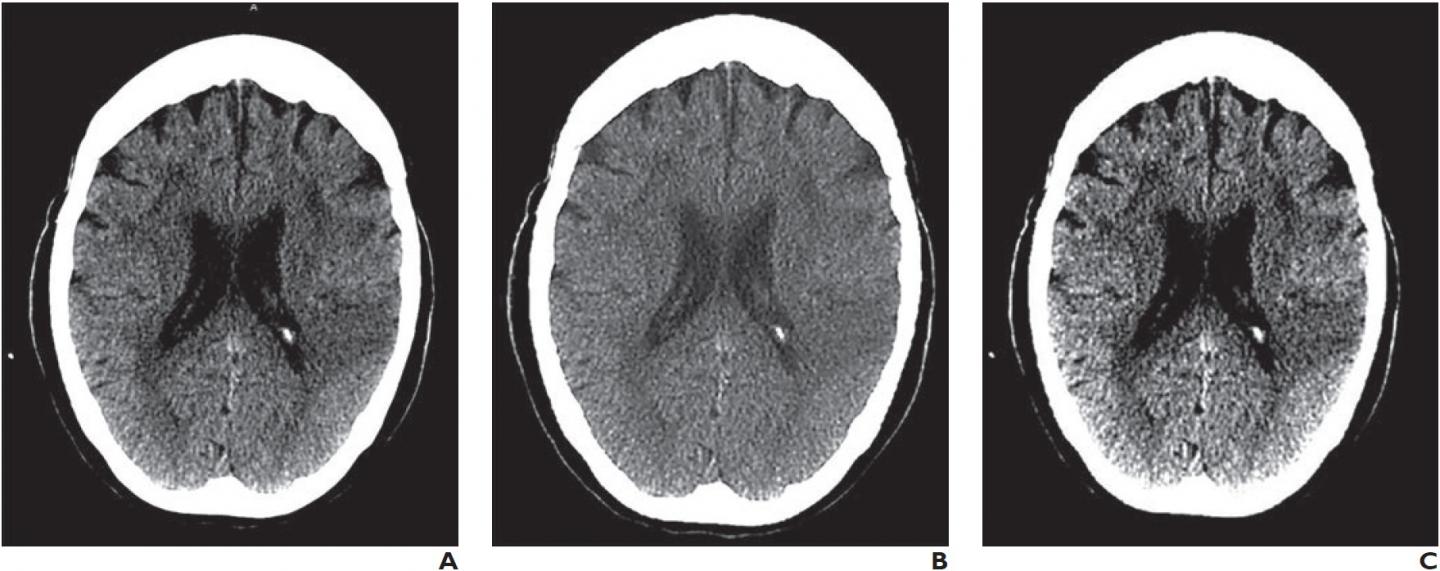
To assess reliability and accuracy of IV thrombolysis recommendations made after interpretation of head CT images of patients with acute stroke symptoms displayed on smartphone or laptop reading systems–compared with those made after interpretation of images displayed on a medical workstation monitor–Antonio J. Salazar at the University of Los Andes in Bogotá, Columbia utilized a factorial design with 188 patients, four radiologists, and three reading systems to produce 2256 interpretations.
To evaluate reliability, Salazar and colleagues calculated the intraobserver and interobserver agreements using the intraclass correlation coefficient (ICC) and five interpretation variables: hemorrhagic lesions, intraaxial neoplasm, stroke dating (acute, subacute, chronic), hyperdense arteries, and infarct size assessment. Accuracy equivalence tests were also performed for the IV thrombolysis recommendation; for this variable, sensitivity, specificity, and ROC curves were evaluated.
Good or very good intraobserver agreements were observed for all the variables. Specifically, for those variables required to establish contraindications for IV thrombolysis, the agreements were ranked as very good. “This finding is important,” wrote Salazar et al., “because it reflects the good performance of mobile devices to evaluate the most significant imaging variables for clinical decisions.”
For IV thrombolysis recommendation, the main subject of this evaluation, the interobserver agreements for the three reading systems were ranked as very good (ICC > 0.88). Similarly, very good intraobserver agreements were observed for all comparisons (ICC > 0.84). The AUC values (0.83-0.84) and sensitivities (0.94-0.95) for IV thrombolysis recommendation were equivalent among all the reading systems at a 5% equivalent threshold.
A unique assessment of imaging-based recommendations for the administration of IV recombinant tissue plasminogen activator based on unenhanced brain CT scans, Salazar also noted: “These results constitute a strong foundation for the development of mobile-based telestroke services because they increase neuroradiologist availability and the possibility of using reperfusion therapies in resource-limited countries.”
###
Founded in 1900, the American Roentgen Ray Society (ARRS) is the first and oldest radiological society in North America, dedicated to the advancement of medicine through the profession of radiology and its allied sciences. An international forum for progress in medical imaging since the discovery of the x-ray, ARRS maintains its mission of improving health through a community committed to advancing knowledge and skills with an annual scientific meeting, monthly publication of the peer-reviewed American Journal of Roentgenology (AJR), quarterly issues of InPractice magazine, AJR Live Webinars and Podcasts, topical symposia, print and online educational materials, as well as awarding scholarships via The Roentgen Fund®.
Media Contact
Logan K. Young
[email protected]
703-858-4332
Original Source
https:/
Related Journal Article
http://dx.