• HOME
  • NEWS
  • EXPLORE
    • CAREER
      • Companies
      • Jobs
    • EVENTS
    • iGEM
      • News
      • Team
    • PHOTOS
    • VIDEO
    • WIKI
  • BLOG
  • COMMUNITY
    • FACEBOOK
    • INSTAGRAM
    • TWITTER
Tuesday, October 13, 2026
BIOENGINEER.ORG
No Result
View All Result
  • Login
  • HOME
  • NEWS
  • EXPLORE
    • CAREER
      • Companies
      • Jobs
        • Lecturer
        • PhD Studentship
        • Postdoc
        • Research Assistant
    • EVENTS
    • iGEM
      • News
      • Team
    • PHOTOS
    • VIDEO
    • WIKI
  • BLOG
  • COMMUNITY
    • FACEBOOK
    • INSTAGRAM
    • TWITTER
  • HOME
  • NEWS
  • EXPLORE
    • CAREER
      • Companies
      • Jobs
        • Lecturer
        • PhD Studentship
        • Postdoc
        • Research Assistant
    • EVENTS
    • iGEM
      • News
      • Team
    • PHOTOS
    • VIDEO
    • WIKI
  • BLOG
  • COMMUNITY
    • FACEBOOK
    • INSTAGRAM
    • TWITTER
No Result
View All Result
Bioengineer.org
No Result
View All Result
Home NEWS Science News Health

X-ray microscopy at BESSY II: Nanoparticles can change cells

Bioengineer by Bioengineer
February 12, 2020
in Health
Reading Time: 2 mins read
0
IMAGE
Share on FacebookShare on TwitterShare on LinkedinShare on RedditShare on Telegram

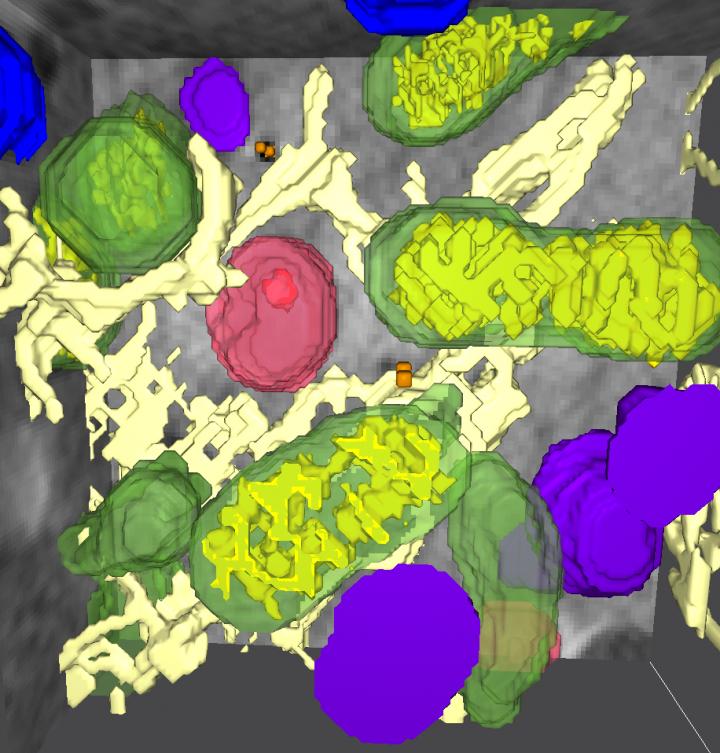
IMAGE

Credit: Burcu Kepsutlu/HZB


Today, nanoparticles are not only in cosmetic products, but everywhere, in the air, in water, in the soil and in food. Because they are so tiny, they easily enter into the cells in our body. This is also of interest for medical applications: Nanoparticles coated with active ingredients could be specifically introduced into cells, for example to destroy cancer cells. However, there is still much to be learned about how nanoparticles are distributed in the cells, what they do there, and how these effects depend on their size and coating.

New insights have come from a study at BESSY II, where Prof. Gerd Schneider’s team can take X-ray microscopy images with soft, intensive X-rays. Researchers from the X-ray microscopy group led by HZB biophysicist Dr. James McNally investigated cells with differently coated nanoparticles. The nanoparticles were exactly the same size, but were coated with different active ingredients.

“X-ray microscopy offers significantly better resolution than light microscopy, and a much better overview than electron microscopy,” emphasizes Schneider. For the first time, the team obtained complete, three-dimensional, high-resolution images of the nanoparticle-treated cells with the organelles contained therein: including lipid droplets, mitochondria, multivesicular bodies and endosomes. Lipid droplets act as energy stores in the cell, while mitochondria metabolize this energy.

The analysis of the images showed: The nanoparticles accumulate preferentially in a subset of the cell organelles and also change the number of certain organelles at the expense of other organelles. The changes in organelle numbers were similar regardless of the nanoparticle coating, suggesting that many different kinds of nanoparticle coatings may induce a similar effect. To evaluate how general this effect is, further studies with other nanoparticle coatings and with other cell types must be performed.

“X-ray microscopy allows us to see the cell as a whole, so we were able to observe this behavior for the first time,” explains McNally. “We found that the absorption of such nanoparticles increases the number of mitochondria and endosomes, while other organelles, namely lipid droplets and multivesicular bodies, decrease,” says Burcu Kepsutlu, who carried out the experiments for her doctorate.”When we go on a starvation diet or run a marathon, we see similar changes in the cell – namely an increase in mitochondria and a decrease in lipid droplets,” says McNally. “Apparently it takes energy for the cell to absorb the nanoparticles, and the cell feels like it has just run a marathon.”

###

Media Contact
Antonia Roetger
[email protected]

Original Source

https://www.helmholtz-berlin.de/pubbin/news_seite?nid=21060;sprache=en;seitenid=1

Related Journal Article

http://dx.doi.org/10.1021/acsnano.9b09264

Tags: BiologyBiomechanics/BiophysicsBiotechnologyCell BiologyEcology/EnvironmentMicrobiologyNanotechnology/MicromachinesPhysiologyPollution/Remediation
Share12Tweet8Share2ShareShareShare2

Related Posts

Simple Blood Score Predicts Failure and Death After Joint Replacement Infection Surgery

Simple Blood Score Predicts Failure and Death After Joint Replacement Infection Surgery

October 13, 2026
Oxidative Stress Takes Center Stage in Vitiligo as Scientists Target the Nrf2 Antioxidant Pathway

Oxidative Stress Takes Center Stage in Vitiligo as Scientists Target the Nrf2 Antioxidant Pathway

October 13, 2026

Physician-Scientist Livia Veress Takes Dual Leadership Role in Pediatric Medicine at Mount Sinai

October 13, 2026

HIV Treatment Starts Faster in Chongqing, But Gaps Persist, Five-Year Study Finds

October 13, 2026
Please login to join discussion

POPULAR NEWS

  • Alloys That Shrink Their Own Grains: New PIX Mechanism Refines Metals With Heat Alone

    Alloys That Shrink Their Own Grains: New PIX Mechanism Refines Metals With Heat Alone

    29 shares
    Share 12 Tweet 7
  • Endurance Exercise Reshapes the Liver in Males and Females Through Distinct Molecular Routes

    29 shares
    Share 12 Tweet 7
  • Single Transcription Factor PU.1 Rapidly Converts Fibroblasts into Macrophage-Lineage Cells

    29 shares
    Share 12 Tweet 7
  • New Scale Measures How Ready Nurse Educators Really Are for the AI Era

    29 shares
    Share 12 Tweet 7

About

We bring you the latest biotechnology news from best research centers and universities around the world. Check our website.

Follow us

Recent News

Alloys That Shrink Their Own Grains: New PIX Mechanism Refines Metals With Heat Alone

Endurance Exercise Reshapes the Liver in Males and Females Through Distinct Molecular Routes

Single Transcription Factor PU.1 Rapidly Converts Fibroblasts into Macrophage-Lineage Cells

Subscribe to Blog via Email

Success! An email was just sent to confirm your subscription. Please find the email now and click 'Confirm' to start subscribing.

Join 85 other subscribers
  • Contact Us

Bioengineer.org © Copyright 2023 All Rights Reserved.

Welcome Back!

Login to your account below

Forgotten Password?

Retrieve your password

Please enter your username or email address to reset your password.

Log In
No Result
View All Result
  • Homepages
    • Home Page 1
    • Home Page 2
  • News
  • National
  • Business
  • Health
  • Lifestyle
  • Science

Bioengineer.org © Copyright 2023 All Rights Reserved.