• HOME
  • NEWS
  • EXPLORE
    • CAREER
      • Companies
      • Jobs
    • EVENTS
    • iGEM
      • News
      • Team
    • PHOTOS
    • VIDEO
    • WIKI
  • BLOG
  • COMMUNITY
    • FACEBOOK
    • INSTAGRAM
    • TWITTER
Saturday, February 7, 2026
BIOENGINEER.ORG
No Result
View All Result
  • Login
  • HOME
  • NEWS
  • EXPLORE
    • CAREER
      • Companies
      • Jobs
        • Lecturer
        • PhD Studentship
        • Postdoc
        • Research Assistant
    • EVENTS
    • iGEM
      • News
      • Team
    • PHOTOS
    • VIDEO
    • WIKI
  • BLOG
  • COMMUNITY
    • FACEBOOK
    • INSTAGRAM
    • TWITTER
  • HOME
  • NEWS
  • EXPLORE
    • CAREER
      • Companies
      • Jobs
        • Lecturer
        • PhD Studentship
        • Postdoc
        • Research Assistant
    • EVENTS
    • iGEM
      • News
      • Team
    • PHOTOS
    • VIDEO
    • WIKI
  • BLOG
  • COMMUNITY
    • FACEBOOK
    • INSTAGRAM
    • TWITTER
No Result
View All Result
Bioengineer.org
No Result
View All Result
Home NEWS Science News Chemistry

Oblique electrostatic inject-deposited TiO2 film leads efficient perovskite solar cells

Bioengineer by Bioengineer
February 10, 2020
in Chemistry
Reading Time: 3 mins read
0
IMAGE
Share on FacebookShare on TwitterShare on LinkedinShare on RedditShare on Telegram

A collaborative research team from Kanazawa University, Waseda University, and Tokai university reports a simple new approach to electrostatic layer deposition for preparing low-cost solar cells with scale-up potential.
IMAGE

Credit: Kanazawa University


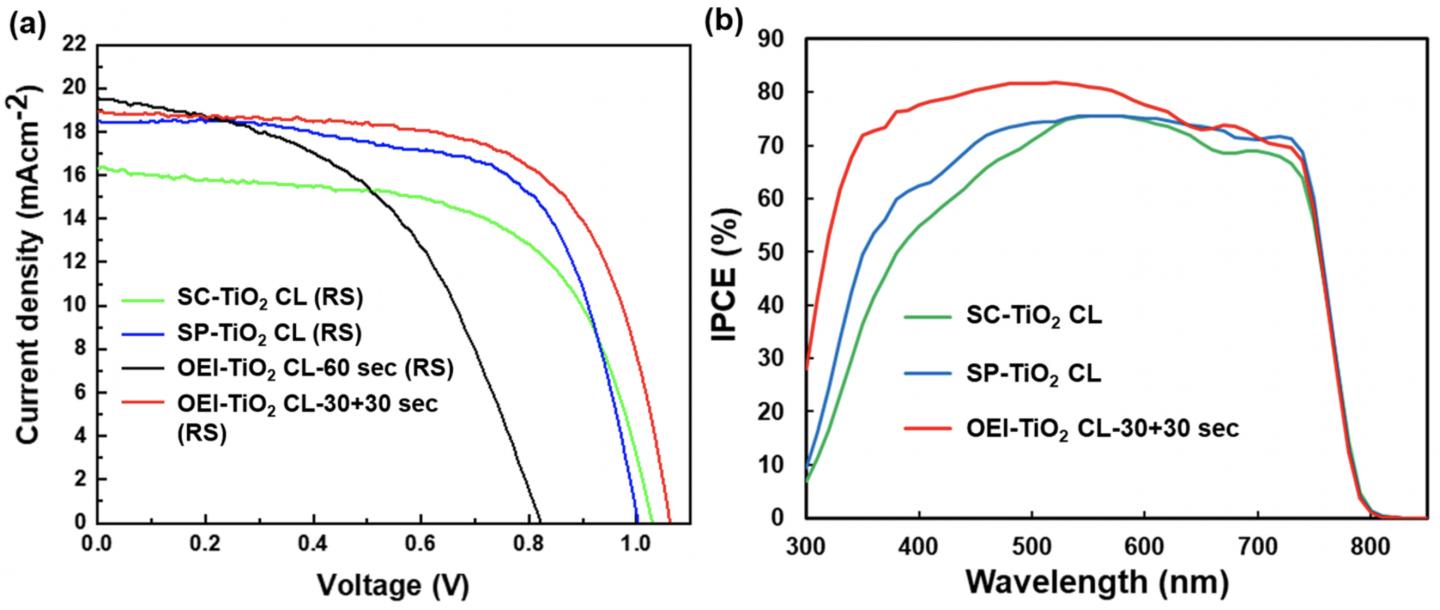
Kanazawa, Japan – The need to efficiently harvest solar energy for a more sustainable future is increasingly becoming accepted across the globe. A new family of solar cells based on perovskites–materials with a particular crystal structure–is now competing with conventional silicon materials to satisfy the demand in this area. Perovskite solar cells (PSCs) are continually being optimized to fulfill their commercial potential, and a team led by researchers from Kanazawa University has now reported a new and simple oblique electrostatic inkjet (OEI) approach to deposit a titanium oxide (TiO2) compact layer on FTO-pattern substrates without the need for a vacuum environment as an electron transport layer (ETL) for enhancing the efficiency of PSCs. The findings are published in Scientific Reports.

The PSCs comprise a stack of different component layers that all have a specific role. The ETL, which is often composed of TiO2, enables the transport of electrons–which carry charge–to the electrodes, while blocking the transport of holes–which can recombine with electrons to prevent their flow. Establishing a complete TiO2 layer with the correct thickness, which is uniform and free of flaws, is therefore critical to producing efficient solar cells.

Many of the numerous TiO2 deposition techniques reported to date have associated limitations, such as poor coverage or reproducibility, or being unsuitable for scale-up. They can also require challenging preparation conditions such as a vacuum. The researchers report a simple, low-cost OEI-method that achieves a compact layer without requiring a vacuum.

“Our technique can produce uniform electron transport layers whose thickness can be varied by controlling the deposition time.” Study lead author Assistant Professor Dr. Md. Shahiduzzaman explains. “Solar cells made using our approach had power-conversion efficiencies of up to 13.19%, which, given the other advantages of our technique, is very promising for scale-up and commercialization.”

The technique is based on the deposition of positively charged droplets that are attracted to a negatively charged surface. Previous reports using the same electrostatic approach achieved lower power-conversion efficiencies because the droplets formed a stack on the surface as a result of gravity. Introducing an oblique angle into the process–spraying the TiO2 precursor at 45° to the surface–eliminated the effect of gravity, leading to the deposition of a more uniform layer.

“An optimum ETL deposition method must offer a number of properties to result in a high efficiency solar cell,” Dr. Shahiduzzaman explains. “The ability to control the layer thickness and achieve a uniform, reproducible layer at low cost, without the need for a vacuum, provides a unique package of advantages that has not been reported to date. We hope that these properties will lead to effective and commercially relevant scale-up that will contribute to the drive towards cleaner energy worldwide.”

###

Media Contact
Tomoya Sato
[email protected]
81-762-645-024

Original Source

https://doi.org/10.1038/s41598-019-56164-w

Related Journal Article

http://dx.doi.org/10.1038/s41598-019-56164-w

Tags: Chemistry/Physics/Materials SciencesEnergy SourcesEnergy/Fuel (non-petroleum)Industrial Engineering/ChemistryMaterialsSuperconductors/Semiconductors
Share12Tweet8Share2ShareShareShare2

Related Posts

blank

Breakthrough in Environmental Cleanup: Scientists Develop Solar-Activated Biochar for Faster Remediation

February 7, 2026
blank

Cutting Costs: Making Hydrogen Fuel Cells More Affordable

February 6, 2026

Scientists Develop Hand-Held “Levitating” Time Crystals

February 6, 2026

Observing a Key Green-Energy Catalyst Dissolve Atom by Atom

February 6, 2026
Please login to join discussion

POPULAR NEWS

  • Robotic Ureteral Reconstruction: A Novel Approach

    Robotic Ureteral Reconstruction: A Novel Approach

    82 shares
    Share 33 Tweet 21
  • Digital Privacy: Health Data Control in Incarceration

    63 shares
    Share 25 Tweet 16
  • Study Reveals Lipid Accumulation in ME/CFS Cells

    57 shares
    Share 23 Tweet 14
  • Breakthrough in RNA Research Accelerates Medical Innovations Timeline

    53 shares
    Share 21 Tweet 13

About

We bring you the latest biotechnology news from best research centers and universities around the world. Check our website.

Follow us

Recent News

Personalized Guide to Understanding and Reducing Chemicals

Inflammasome Protein ASC Drives Pancreatic Cancer Metabolism

Phage-Antibiotic Combo Beats Resistant Peritoneal Infection

Subscribe to Blog via Email

Enter your email address to subscribe to this blog and receive notifications of new posts by email.

Join 73 other subscribers
  • Contact Us

Bioengineer.org © Copyright 2023 All Rights Reserved.

Welcome Back!

Login to your account below

Forgotten Password?

Retrieve your password

Please enter your username or email address to reset your password.

Log In
No Result
View All Result
  • Homepages
    • Home Page 1
    • Home Page 2
  • News
  • National
  • Business
  • Health
  • Lifestyle
  • Science

Bioengineer.org © Copyright 2023 All Rights Reserved.