• HOME
  • NEWS
  • EXPLORE
    • CAREER
      • Companies
      • Jobs
    • EVENTS
    • iGEM
      • News
      • Team
    • PHOTOS
    • VIDEO
    • WIKI
  • BLOG
  • COMMUNITY
    • FACEBOOK
    • INSTAGRAM
    • TWITTER
Monday, August 24, 2026
BIOENGINEER.ORG
No Result
View All Result
  • Login
  • HOME
  • NEWS
  • EXPLORE
    • CAREER
      • Companies
      • Jobs
        • Lecturer
        • PhD Studentship
        • Postdoc
        • Research Assistant
    • EVENTS
    • iGEM
      • News
      • Team
    • PHOTOS
    • VIDEO
    • WIKI
  • BLOG
  • COMMUNITY
    • FACEBOOK
    • INSTAGRAM
    • TWITTER
  • HOME
  • NEWS
  • EXPLORE
    • CAREER
      • Companies
      • Jobs
        • Lecturer
        • PhD Studentship
        • Postdoc
        • Research Assistant
    • EVENTS
    • iGEM
      • News
      • Team
    • PHOTOS
    • VIDEO
    • WIKI
  • BLOG
  • COMMUNITY
    • FACEBOOK
    • INSTAGRAM
    • TWITTER
No Result
View All Result
Bioengineer.org
No Result
View All Result
Home NEWS Science News Biology

Bovine embryo completely regenerates placenta-forming cells

Bioengineer by Bioengineer
February 7, 2020
in Biology
Reading Time: 2 mins read
0
IMAGE
Share on FacebookShare on TwitterShare on LinkedinShare on RedditShare on Telegram

IMAGE

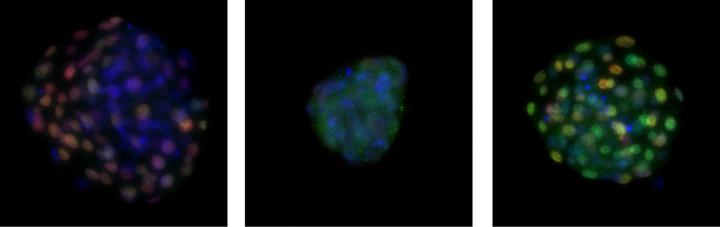
Credit: Kohri N. et al., Journal of Biological Chemistry. November 8, 2019


A calf was born from an embryo lacking cells which form a large part of the placenta, providing new insight into the regenerative capacity of mammalian embryos.

Mammalian development starts from a single cell — a fertilized egg. The egg goes through multiple cell divisions to increase its cell numbers and then starts forming a sphere-like structure with a cavity inside, called the blastocyst. The blastocyst consists of two types of cells, the inner cell mass (ICM) and the trophectoderm (TE), which develop into an embryo proper and a large part of the placenta, respectively.

Scientists led by Manabu Kawahara at Hokkaido University have shown that, since bovine ICM cells can regenerate TE, they are capable of forming both the embryo and placenta. The study was published in the Journal of Biological Chemistry and became one of the top 50 most viewed papers from November through December 2019 on the Journal’s website.

To examine the ICM’s capacity to regenerate TE, the researchers cultivated mouse and bovine blastocysts and removed entire TE from both blastocysts. They found that both blastocysts regained their sphere-like shapes in 24 hours. However, the regeneration rate to reform the blastocyst was remarkably higher in bovine cells (97%) than mouse cells (57%). The more complete recovery of bovine blastocysts in cell numbers compared to mouse blastocysts suggests the bovine cells have a higher regenerative capacity.

Further experiments revealed abnormal protein expression in the TE of mouse regenerated blastocysts, whereas bovine regenerated blastocysts showed normal gene expressions overall.

To test its developmental abilities, the researchers then transferred the regenerated blastocysts to recipient females. After the embryo-transfer, to their surprise, one of the four cows became pregnant and a female calf was naturally born with an apparently normal placenta. In contrast, none of the more than 100 mouse embryos transferred to recipients developed to term.

“We will continue to monitor the health of the calf born from the regenerated blastocyst,” says Manabu Kawahara. “Our study suggests that we can remove and use a large part of TE for genetic testing to breed cattle with improved qualities. Also, further studies could reveal the mechanism of cell fate decision in mammals and its differences between species.”

###

Media Contact
Naoki Namba
[email protected]
81-117-062-185

Original Source

https://www.global.hokudai.ac.jp/blog/bovine-embryo-completely-regenerates-placenta-forming-cells/

Related Journal Article

http://dx.doi.org/10.1074/jbc.RA119.010746

Tags: BiologyBiotechnologyCell BiologyDevelopmental/Reproductive BiologyGenesMolecular Biology
Share12Tweet8Share2ShareShareShare2

Related Posts

Cochrane Map Reveals Major Evidence Gaps in Dengue Prevention Research

Cochrane Map Reveals Major Evidence Gaps in Dengue Prevention Research

August 24, 2026
Delayed antiviral response in alveolar type 2 cells heightens influenza susceptibility

Delayed antiviral response in alveolar type 2 cells heightens influenza susceptibility

August 22, 2026

Genetic evidence links sleep disruption to hemorrhoidal disease, revealing a hidden connection

August 22, 2026

LASIK Versus Contact Lenses for Correcting Myopia

August 22, 2026
Please login to join discussion

POPULAR NEWS

  • Cochrane Map Reveals Major Evidence Gaps in Dengue Prevention Research

    Cochrane Map Reveals Major Evidence Gaps in Dengue Prevention Research

    29 shares
    Share 12 Tweet 7
  • Study reveals surge in type 2 diabetes among people under 20

    29 shares
    Share 12 Tweet 7
  • KAIST discovers pathway to faster-charging, longer-lasting electric vehicle batteries

    29 shares
    Share 12 Tweet 7
  • Blocking glucosylceramide production kills cancer cells via lysosomal dysfunction, not ceramide buildup

    29 shares
    Share 12 Tweet 7

About

We bring you the latest biotechnology news from best research centers and universities around the world. Check our website.

Follow us

Recent News

Cochrane Map Reveals Major Evidence Gaps in Dengue Prevention Research

Study reveals surge in type 2 diabetes among people under 20

KAIST discovers pathway to faster-charging, longer-lasting electric vehicle batteries

Subscribe to Blog via Email

Enter your email address to subscribe to this blog and receive notifications of new posts by email.

Join 85 other subscribers
  • Contact Us

Bioengineer.org © Copyright 2023 All Rights Reserved.

Welcome Back!

Login to your account below

Forgotten Password?

Retrieve your password

Please enter your username or email address to reset your password.

Log In
No Result
View All Result
  • Homepages
    • Home Page 1
    • Home Page 2
  • News
  • National
  • Business
  • Health
  • Lifestyle
  • Science

Bioengineer.org © Copyright 2023 All Rights Reserved.