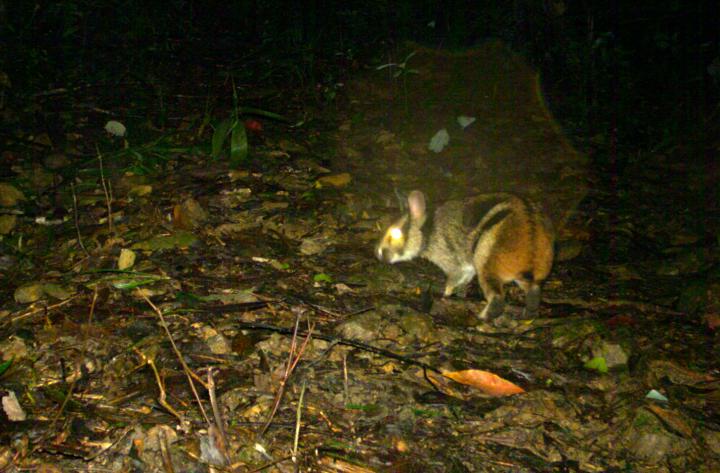
Credit: Tilker/Wilting
Widespread poaching in tropical biodiversity hotspots is causing unprecedented declines in wildlife populations, known as defaunation. A new study published in the journal Diversity & Distributions, provides evidence that large-scale systematic surveys and novel methods of data collection and analysis, are necessary to assess the extent and distribution of poaching and its impact on biodiversity in forest exposed to severe defaunation. Mapping biodiversity in this way will provide information critical to protecting rare species that may still exist in these landscapes. The research was conducted in the Annamite mountains on the border of Laos and Vietnam, an area with an exceptionally high occurrence of endemic species that is threatened by illegal poaching through the setting of wire snares. The research team, led by the Leibniz Institute for Zoo and Wildlife Research (Leibniz-IZW), comprised scientists, conservationists and government counterparts, including representatives from WWF-Vietnam and WWF-Laos.
High levels of unsustainable hunting have decimated wildlife populations in many forests in the Annamites. This situation is not unique to Vietnam and Laos – tropical rainforests in other parts of Southeast Asia are also experiencing a similar fate. To protect wildlife communities in these areas, the researchers argue that limited conservation resources must be utilized effectively and that understanding where rare and threatened species still occur will be an important first step to identify priority areas for targeted conservation activities.
The authors provide evidence that surveying biodiversity in defaunated landscapes may require novel approaches. “By conducting systematic surveys at the landscape-scale, we were able to get a better overview of the wildlife communities and a deeper understanding of the underlying factors which influence species distribution,” said Andrew Tilker of the Leibniz-IZW and lead author of the study. “We also found that using two complementary survey methods – camera-traps and vertebrate DNA extracted from parasitic blood-sucking leeches – improved our ability to detect species, which is especially important for rare and elusive animals. We then used these data and applied advanced statistical techniques to produce maps of species distributions across the landscape – the first for the Annamites.” Ultimately, the researchers expect that biodiversity baselines established through such scientifically-robust approaches will help conservation managers to protect rare and endangered species still present in these landscapes.
“The threat posed by illegal snares to the survival of endemic wildlife cannot be overstated,” said Benjamin Rawson, Conservation and Program Development Director of WWF-Vietnam. “WWF is deploying probably the largest effort in the region to get these snares out of the forest and provide wildlife a fighting chance, but the sheer number of wire snares set in the Annamites is alarming.”
“With evidence from landscape-level surveys we will now deploy snare-removal teams to freshly identified areas of high biodiversity,” says Adrian Klocke, Project Manager of the KfW Development Bank in Germany, which supports the Carbon and Biodiversity Phase 2 project (CarBi II) in the Annamites. CarBi II is implemented by WWF through KfW as part of the International Climate Initiative (IKI) of the German Federal Ministry for the Environment, Nature Conservation and Nuclear Safety (BMU). “Additionally, the results of this study help us identify areas that are not currently protected but which are important for rare species,” Klocke adds. “For instance, one interesting result was that a mostly unpatrolled forest area in Laos called the Palé area is a hotspot for numerous endemic and threatened species. We hope that as a part of CarBi II, this area can be protected.”
Amphone Phommachak, WWF-Laos Landscape Manager for the Central Annamites, agrees that this type of scientific study is highly valuable. “We need to develop and implement evidence-driven conservation strategies to protect the remarkable biodiversity of the Annamites. There is no doubt that the Central Annamites have been hit hard by intensive snaring, but fortunately, rare and endemic species are still hanging on. There is still time to protect species like the Annamite striped rabbit, but the window of opportunity is rapidly closing. Focusing snare-removal efforts and protecting new areas will hopefully help us prevent further extinctions in the Annamites.”
###
Media Contact
Andrew Tilker
[email protected]
49-305-168-335
Original Source
https:/
Related Journal Article
http://dx.