• HOME
  • NEWS
  • EXPLORE
    • CAREER
      • Companies
      • Jobs
    • EVENTS
    • iGEM
      • News
      • Team
    • PHOTOS
    • VIDEO
    • WIKI
  • BLOG
  • COMMUNITY
    • FACEBOOK
    • INSTAGRAM
    • TWITTER
Friday, March 27, 2026
BIOENGINEER.ORG
No Result
View All Result
  • Login
  • HOME
  • NEWS
  • EXPLORE
    • CAREER
      • Companies
      • Jobs
        • Lecturer
        • PhD Studentship
        • Postdoc
        • Research Assistant
    • EVENTS
    • iGEM
      • News
      • Team
    • PHOTOS
    • VIDEO
    • WIKI
  • BLOG
  • COMMUNITY
    • FACEBOOK
    • INSTAGRAM
    • TWITTER
  • HOME
  • NEWS
  • EXPLORE
    • CAREER
      • Companies
      • Jobs
        • Lecturer
        • PhD Studentship
        • Postdoc
        • Research Assistant
    • EVENTS
    • iGEM
      • News
      • Team
    • PHOTOS
    • VIDEO
    • WIKI
  • BLOG
  • COMMUNITY
    • FACEBOOK
    • INSTAGRAM
    • TWITTER
No Result
View All Result
Bioengineer.org
No Result
View All Result
Home NEWS Science News Chemistry

New research could aid cleaner energy technologies

Bioengineer by Bioengineer
January 30, 2020
in Chemistry
Reading Time: 2 mins read
0
IMAGE
Share on FacebookShare on TwitterShare on LinkedinShare on RedditShare on Telegram

Study looks beneath surface to see how oxides, gases interact
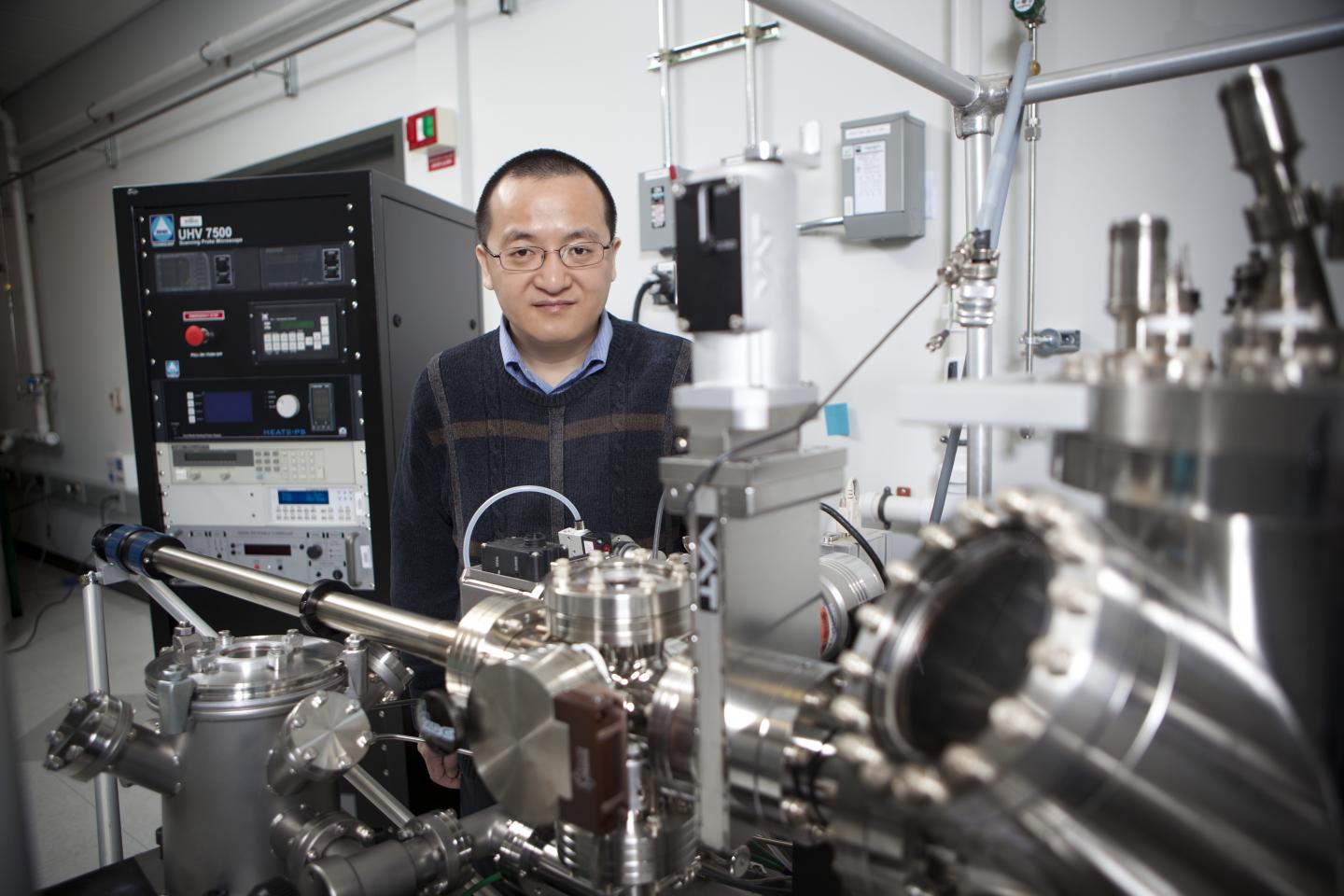
IMAGE

Credit: Binghamton University, State University of New York

BINGHAMTON, N.Y. – New research led by faculty at Binghamton University, State University of New York, could aid cleaner energy technologies.

The atomic reaction between gases and oxides is a key piece for many technological puzzles. It can lead to benefits such as better catalysts to enable cleaner energy technologies, or to problems like corrosion.

Understanding those interactions isn’t always easy, though, and often doesn’t go beyond the surface — quite literally.

A team from Binghamton University, the Brookhaven National Laboratory and the National Institute of Standards and Technology — led by Professor Guangwen Zhou from the Thomas J. Watson School of Engineering and Applied Science’s Department of Mechanical Engineering — has a new way to look deeper into how gas molecules affect the atoms beneath the surface of a material.

The material studied is cupric oxide, a copper oxide that many researchers are interested in because it is more abundant and affordable than noble metals such as silver, gold and platinum, and it is used for numerous processes such as methanol production.

For the paper “Surface-reaction induced structural oscillations in the subsurface,” published earlier this month in Nature Communications, Zhou and his fellow researchers (including Binghamton PhD students Xianhu Sun, Wenhui Zhu, Dongxiang Wu, Chaoran Li, Jianyu Wang, Yaguang Zhu and Xiaobo Chen) examined the reaction between hydrogen and copper oxide using atomic-scale transmission electron microscopy.

The technique allowed them to see the surface and subsurface simultaneously and in real time, showing that structural oscillations are induced in the subsurface by loss of oxygen from the oxide surface.

“This study shows how the reaction from the surface propagates to deeper atomic layers. We look at it from a cross-section so we can see atoms both in the top layer and subsurface layers more clearly,” said Zhou, who teaches as part of the Materials Science and Engineering Program and also is the associate director of Binghamton’s Institute for Materials Research.

This new study is funded by the Department of Energy, in the hope that the results can lead to better catalysts, improved batteries, longer-lasting vehicles and other higher-quality products.

“If we know these reaction mechanisms, we can design better materials,” Zhou said. “We can’t care just about the surface but also the deeper layers if we want to understand the process better.”

###

Media Contact
John Brhel
[email protected]
607-240-9786

Related Journal Article

http://dx.doi.org/10.1038/s41467-019-14167-1

Tags: Atomic/Molecular/Particle PhysicsChemistry/Physics/Materials SciencesEnergy/Fuel (non-petroleum)Industrial Engineering/ChemistryMaterialsMechanical EngineeringTechnology/Engineering/Computer Science
Share12Tweet8Share2ShareShareShare2

Related Posts

Isolated H2-Reduced Clusters Boost CO2-to-Methanol Catalysis

Isolated H2-Reduced Clusters Boost CO2-to-Methanol Catalysis

March 25, 2026
blank

Physicists Identify Electronic Drivers Behind Flat Band Quantum Materials

March 21, 2026

Würzburg Chemistry Professor Claudia Höbartner Receives Prestigious Honor

March 20, 2026

Scientists Reveal How Magnets Control Metamaterial Behavior

March 20, 2026
Please login to join discussion

POPULAR NEWS

  • blank

    Revolutionary AI Model Enhances Precision in Detecting Food Contamination

    96 shares
    Share 38 Tweet 24
  • Imagine a Social Media Feed That Challenges Your Views Instead of Reinforcing Them

    1003 shares
    Share 397 Tweet 248
  • Uncovering Functions of Cavernous Malformation Proteins in Organoids

    54 shares
    Share 22 Tweet 14
  • Promising Outcomes from First Clinical Trials of Gene Regulation in Epilepsy

    51 shares
    Share 20 Tweet 13

About

We bring you the latest biotechnology news from best research centers and universities around the world. Check our website.

Follow us

Recent News

In-Sensor Cryptography Links Physical Process to Digital Identity

Can Psychosocial Factors Influence Cancer Risk?

Depression Factors in Elderly: Pre vs. Post-COVID Analysis

Subscribe to Blog via Email

Enter your email address to subscribe to this blog and receive notifications of new posts by email.

Join 78 other subscribers
  • Contact Us

Bioengineer.org © Copyright 2023 All Rights Reserved.

Welcome Back!

Login to your account below

Forgotten Password?

Retrieve your password

Please enter your username or email address to reset your password.

Log In
No Result
View All Result
  • Homepages
    • Home Page 1
    • Home Page 2
  • News
  • National
  • Business
  • Health
  • Lifestyle
  • Science

Bioengineer.org © Copyright 2023 All Rights Reserved.