FAU Harbor Branch researcher collaborates with US Centers for Disease Control and Prevention
Credit: Florida Atlantic University
Blooms of toxin-producing algae exploded in both fresh and salt water ecosystems in southern Florida during the summer months of 2018, impacting wildlife and humans living in these marine environments. During harmful algal blooms, species of cyanobacteria release toxic peptides, including microcystins and nodularin into waterways.
Human exposure comes from ingestion, direct skin contact, or inhalation and can lead to a variety of symptoms ranging from gastroenteritis, nausea, allergic reactions and skin rashes to hepatic injury and hemorrhage in more severe cases. Microcystins also have been linked to tumor progression and are harmful to renal, immune and reproductive systems.
A researcher from Florida Atlantic University’s Harbor Branch Oceanographic Institute collaborated with the United States Centers for Disease Control and Prevention to test a newly developed immunocapture protein phosphatase inhibition assay (IC-PPIA) method for detection of microcystins and nodularin in human urine. This method uses a commercially available antibody to specifically isolate microcystins and nodularine from human urine prior to measurement.
Results of the study, published in the journal Toxins, demonstrate that the IC-PPIA method developed by the CDC was able to detect low-dose human exposures to microcystins by analysis of urine from three of the 86 urine specimens analyzed by this new method, which yielded positive results with concentrations of 0.055, 0.089 and 0.052 ng/mL MC-LR equivalents. These findings are the first to report microcystin concentrations directly from exposed residents impacted by cyanobacteria in Florida.
“This new test can detect even low-dose human exposure to microcystins and nodularin, so this method will be important as we study the long-term health impacts of harmful algal blooms, especially the low-level concentrations from human inhalation exposure,” said Adam Schaefer, MPH, co-author and an epidemiologist at FAU’s Harbor Branch. “This method could complement water monitoring programs by identifying human exposures to these toxins at the time of harmful algal blooms and will assist our ongoing research to elucidating health effects associated with these algal blooms. This research is a critical step in developing and interpreting clinical diagnostic tests for harmful algal bloom exposure around the world.”
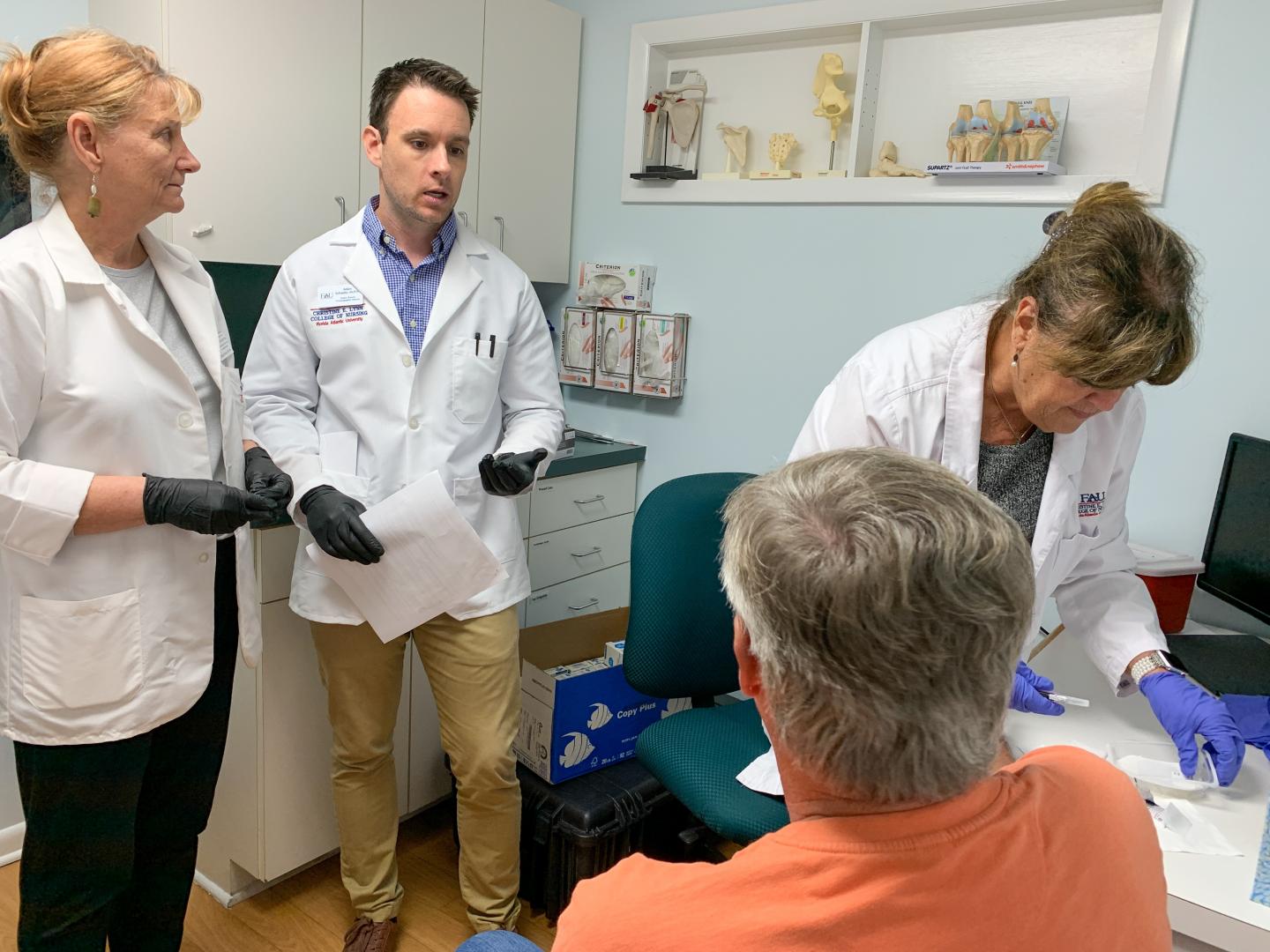
To assess human exposure to microcystins during the 2018 algal blooms, Schaefer and faculty and collaborators from FAU’s Christine E. Lynn College of Nursing, collected urine, nasal swabs and blood from residents of St. Lucie, Indian River, Palm Beach and Martin counties as a part of a cross-sectional exposure study. A comprehensive questionnaire that included questions on potential routes of exposure to the blooms, fish consumption, and demographic data was administered at the time of sample collection.
###
Study co-authors are Rebekah E. Wharton, Ph.D., senior author; Brady R. Cunningham, Ph.D.; Elizabeth I. Hamelin, M.S.; and Rudolph C. Johnson, Ph.D., all with the Division of Laboratory Sciences, National Center for Environmental Health, CDC; and Sophia M. Guldberg, Oak Ridge Institute of Science, CDC.
Funding for direct human sampling was supported by the FAU Foundation SpringBoard program.
About Harbor Branch Oceanographic Institute:
Founded in 1971, Harbor Branch Oceanographic Institute at Florida Atlantic University is a research community of marine scientists, engineers, educators and other professionals focused on Ocean Science for a Better World. The institute drives innovation in ocean engineering, at-sea operations, drug discovery and biotechnology from the oceans, coastal ecology and conservation, marine mammal research and conservation, aquaculture, ocean observing systems and marine education. For more information, visit http://www.
About Florida Atlantic University:
Florida Atlantic University, established in 1961, officially opened its doors in 1964 as the fifth public university in Florida. Today, the University, with an annual economic impact of $6.3 billion, serves more than 30,000 undergraduate and graduate students at sites throughout its six-county service region in southeast Florida. FAU’s world-class teaching and research faculty serves students through 10 colleges: the Dorothy F. Schmidt College of Arts and Letters, the College of Business, the College for Design and Social Inquiry, the College of Education, the College of Engineering and Computer Science, the Graduate College, the Harriet L. Wilkes Honors College, the Charles E. Schmidt College of Medicine, the Christine E. Lynn College of Nursing and the Charles E. Schmidt College of Science. FAU is ranked as a High Research Activity institution by the Carnegie Foundation for the Advancement of Teaching. The University is placing special focus on the rapid development of critical areas that form the basis of its strategic plan: Healthy aging, biotech, coastal and marine issues, neuroscience, regenerative medicine, informatics, lifespan and the environment. These areas provide opportunities for faculty and students to build upon FAU’s existing strengths in research and scholarship. For more information, visit fau.edu.
Media Contact
Gisele Galoustian
[email protected]
561-297-2676
Related Journal Article
http://dx.