• HOME
  • NEWS
  • EXPLORE
    • CAREER
      • Companies
      • Jobs
    • EVENTS
    • iGEM
      • News
      • Team
    • PHOTOS
    • VIDEO
    • WIKI
  • BLOG
  • COMMUNITY
    • FACEBOOK
    • INSTAGRAM
    • TWITTER
Thursday, December 4, 2025
BIOENGINEER.ORG
No Result
View All Result
  • Login
  • HOME
  • NEWS
  • EXPLORE
    • CAREER
      • Companies
      • Jobs
        • Lecturer
        • PhD Studentship
        • Postdoc
        • Research Assistant
    • EVENTS
    • iGEM
      • News
      • Team
    • PHOTOS
    • VIDEO
    • WIKI
  • BLOG
  • COMMUNITY
    • FACEBOOK
    • INSTAGRAM
    • TWITTER
  • HOME
  • NEWS
  • EXPLORE
    • CAREER
      • Companies
      • Jobs
        • Lecturer
        • PhD Studentship
        • Postdoc
        • Research Assistant
    • EVENTS
    • iGEM
      • News
      • Team
    • PHOTOS
    • VIDEO
    • WIKI
  • BLOG
  • COMMUNITY
    • FACEBOOK
    • INSTAGRAM
    • TWITTER
No Result
View All Result
Bioengineer.org
No Result
View All Result
Home NEWS Science News Chemistry

Molecular understanding of drug interactions suggests pathway to better malaria treatments

Bioengineer by Bioengineer
January 15, 2020
in Chemistry
Reading Time: 2 mins read
0
IMAGE
Share on FacebookShare on TwitterShare on LinkedinShare on RedditShare on Telegram

The work also has implications for speeding drug development
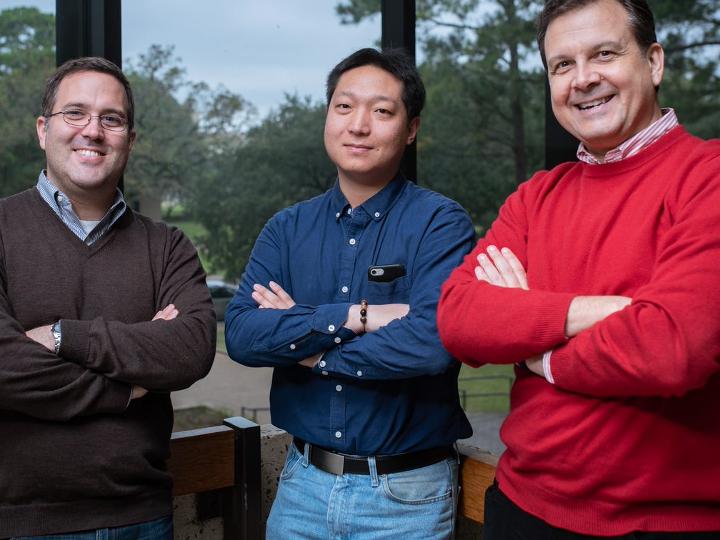
IMAGE

Credit: University of Houston


The process of crystallization is central to drug development, petrochemical processing and other industrial actions, but scientists say they still are learning about the complex interactions involved in the building and dissolution of crystals.

Researchers from the University of Houston and the Université libre de Bruxelles reported in the journal Nature that they have for the first time demonstrated at the molecular level what happens when two compounds known to inhibit crystal growth – in this case, antimalarial drugs – were combined. The results were unexpected.

“You would expect using two drugs that attacked crystallization in two different ways would be synergistic, or at the very least additive,” said Jeffrey Rimer, Abraham E. Dukler Professor of Chemical and Biomolecular Engineering at UH and a co-author of the paper. “Instead, we found that they can work against each other.”

Working against each other, known as antagonistic cooperation, meant that the drugs were actually less effective in tandem than individually. Peter Vekilov, John and Rebecca Moores Professor of Chemical and Biomolecular Engineering and Chemistry at UH and another co-author, said the work will allow the design of more effective treatments for malaria, a mosquito-borne disease that killed 435,000 people in 2017, most of them children in Africa.

But more broadly, it suggests a new way to screen molecules for their potential in drug development, allowing new treatments to be developed more quickly.

“When you are using modifiers, a small change in the molecule’s structure can dramatically alter its performance,” Rimer said.

Malaria is caused by a parasite, which consumes hemoglobin and leaves behind a compound known as hematin, which the parasite sequesters inside a crystal. Antimalarial treatments work by inhibiting the crystal growth, freeing hematin to attack the parasite.

For this work, the researchers studied the growth of hematin crystals in the presence of four antimalarial drugs – chloroquine, quinine, mefloquine and amodiaquine – which work in one of two distinct ways.

Both computationally and experimentally, including through the use of atomic force microscopy, the researchers demonstrated how compounds which attack crystallization by two different mechanisms behave when combined. The resulting molecular-level understanding of that behavior suggests a new mechanism for materials science, Vekilov said.

“This mechanism may provide guidance in the search for suitable inhibitor combinations to control crystallization of pathological, biomimetic, and synthetic materials,” the researchers wrote. “In a broader context, our results highlight modifier interactions mediated by the dynamics and structures on the crystal interface as a prime element of the regulation of the shapes and patterns of crystalline structures in nature and industry.”

###

In addition to Vekilov and Rimer, researchers involved with the project include UH Ph.D. student Wenchuan Ma and collaborator Dr. James Lutsko of the Université libre de Bruxelles.

Media Contact
Jeannie Kever
[email protected]
713-743-0778

Tags: Biomedical/Environmental/Chemical EngineeringBiotechnologyInfectious/Emerging DiseasesMedicine/HealthPharmaceutical ChemistryPharmaceutical Science
Share12Tweet8Share2ShareShareShare2

Related Posts

blank

Iridium Catalysis Enables Piperidine Synthesis from Pyridines

December 3, 2025
Neighboring Groups Speed Up Polymer Self-Deconstruction

Neighboring Groups Speed Up Polymer Self-Deconstruction

November 28, 2025

Activating Alcohols as Sulfonium Salts for Photocatalysis

November 26, 2025

Carbonate Ions Drive Water Ordering in CO₂ Reduction

November 25, 2025
Please login to join discussion

POPULAR NEWS

  • New Research Unveils the Pathway for CEOs to Achieve Social Media Stardom

    New Research Unveils the Pathway for CEOs to Achieve Social Media Stardom

    204 shares
    Share 82 Tweet 51
  • Scientists Uncover Chameleon’s Telephone-Cord-Like Optic Nerves, A Feature Missed by Aristotle and Newton

    120 shares
    Share 48 Tweet 30
  • Neurological Impacts of COVID and MIS-C in Children

    107 shares
    Share 43 Tweet 27
  • MoCK2 Kinase Shapes Mitochondrial Dynamics in Rice Fungal Pathogen

    69 shares
    Share 28 Tweet 17

About

We bring you the latest biotechnology news from best research centers and universities around the world. Check our website.

Follow us

Recent News

Boosting Cancer Immunotherapy by Targeting DNA Repair

Evaluating eGFR Equations in Chinese Children

Metformin-Alogliptin Combo vs. Monotherapy in Diabetes

Subscribe to Blog via Email

Enter your email address to subscribe to this blog and receive notifications of new posts by email.

Join 69 other subscribers
  • Contact Us

Bioengineer.org © Copyright 2023 All Rights Reserved.

Welcome Back!

Login to your account below

Forgotten Password?

Retrieve your password

Please enter your username or email address to reset your password.

Log In
No Result
View All Result
  • Homepages
    • Home Page 1
    • Home Page 2
  • News
  • National
  • Business
  • Health
  • Lifestyle
  • Science

Bioengineer.org © Copyright 2023 All Rights Reserved.