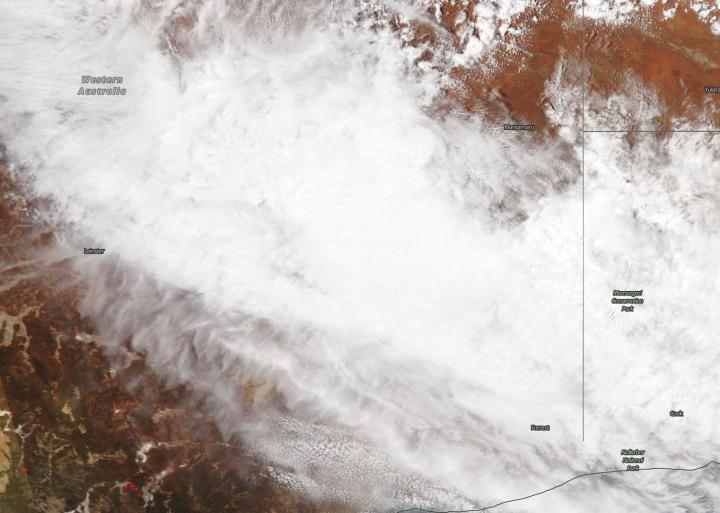
Credit: Credit: NASA Worldview
NASA’s Aqua satellite provided a look at the remnant clouds and storms associated with Ex-tropical Cyclone Blake as it continues to move through Western Australia and generate rainfall over desert areas. Blake’s rainfall has triggered four area flood warnings in some parts of southeastern Western Australia. The remnants have dropped over 10 inches of rain in the Sandy Desert.
Slow moving ex-Tropical Cyclone Blake is continuing to track south southeast and is expected to weaken sometime on Friday.
On January 10, 2020, the Moderate Imaging Spectroradiometer or MODIS instrument that flies aboard NASA’s Aqua satellite provided a visible image of Blake. The MODIS image revealed the elongated shape of the remnants that stretched from the central part of Western Australia to the southeastern corner of the region.
The Australian Government Bureau of Meteorology (ABM) in Western Australia issued several flood warnings at 10:47 a.m. WST on Friday Jan. 10. Flood Warnings were in effect for four areas. There is a Major Flood Warning for the De Grey River Catchment and a Flood Warning for the Fortescue River, Salt Lakes District Rivers, and southwestern parts the Sandy Desert Catchment.
ABM said, “Major flooding is occurring in the Nullagine River in the De Grey river catchment. Most upstream locations have now peaked with minor to moderate flooding expected to continue during Friday before flooding starts to ease throughout the area over the weekend. Heavy rainfall from ex-Tropical Cyclone Blake has resulted in in rapid river level rises, and areas of flooding throughout the De Grey river catchment. Flooding has adversely impacted road conditions particularly at floodways resulting in multiple road closures.”
Rainfall totals over 24 hours in the De Grey catchment indicated 1.30 inches (33 mm) at Nullagine.
On Jan. 10, areas of flooding were occurring in the Fortescue River upstream of Roy Hill. Twenty-four hour rainfall totals recorded over Fortescue River catchment include 0.4 inches (9.4 mm) at Newman Airport and at Upper Portland. ABM expects flooding to continue in the Fortescue River catchment during Friday. Flooding could adversely affect road conditions particularly at floodways. Some roads may become impassable and some communities may become isolated.
Flooding in the southwestern parts of the Sandy Desert Catchment is expected to affect road conditions. In the 24 hours to 9 a.m. WST today, Jan. 10, rainfall totals recorded over the Sandy Desert Catchment include 10.6 inches (270 mm) at Carnegie, 5.8 inches (148 mm) at Prenit Downs and 5.6 inches (142 mm) and 2.8 inches (71 mm) at Gruyere mine Airport.
In the Salt Lakes District, ABM issued a Flood Warning for the Salt Lakes District Rivers as flooding is occurring due to heavy rainfall. ABM’s forecast calls for rainfall for the next 24 hours is 0.4 to 1.2 inches (10-30 mm) in the central and southern part of the district, with the possibility of isolated totals of 2 inches (50 mm). Flooding is expected to continue in the Salt Lakes District during Friday.
Blake is continuing to track slowly south-southeast over the Salt Lakes District and is expected weaken during the day.
NASA’s Aqua satellite is one in a fleet of NASA satellites that provide data for hurricane research.
Tropical cyclones/hurricanes are the most powerful weather events on Earth. NASA’s expertise in space and scientific exploration contributes to essential services provided to the American people by other federal agencies, such as hurricane weather forecasting.
###
Media Contact
Rob Gutro
[email protected]
Original Source
https:/