Credit: Francisco Maiato P. Gonçalves
Hunting wild animals has been practised by humans for millions of years; however, the extraction of wildlife for subsistence and commercialisation has become a major biodiversity threat in recent decades. Meanwhile, over-exploitation is reported to be the second most important driver of change and biodiversity loss globally.
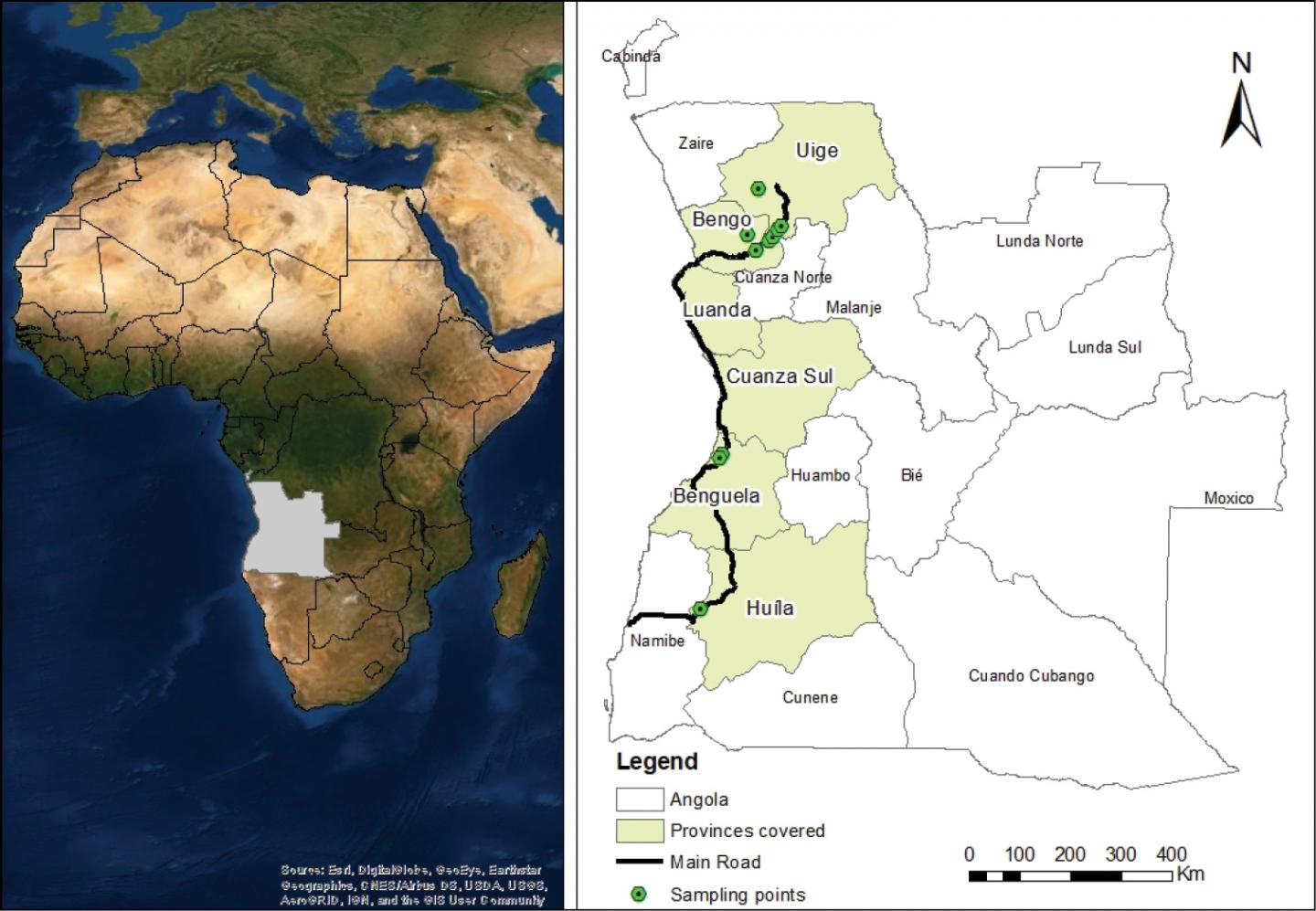
To assess the state of affairs, an international group of scientists, led by Dr. Francisco M. P. Gonçalves of the University of Hamburg in Germany, went on a roundtrip along the roads between five main Angolan cities. Their observations made it possible to conclude that, despite the existing legislation, as well as government efforts to handle poaching and bushmeat trade, currently there is no effective law enforcement mechanism to help dealing with the situation.
In their study, the team also states that Angola is one of the richest and most biodiverse countries in Africa with an estimated 6,850 native and 226 non-native plant species, 940 bird species (including many endemic species), 117 amphibians species, 278 reptile species, 358 freshwater fishes (22% of them endemic) and 275 species of mammals.
The long-lasting civil war in Angola has contributed to the dramatic loss of wildlife and led to the near extinction of many species, as a result of the increase in illegal poaching. A variety of fresh, smoked or dried bushmeat, as well as live animals, are being sold along the roads, mostly to urban dwellers travelling between the main cities of Angola.
Despite the recent outbreaks of diseases (i.e. Ebola in the neighbouring Democratic Republic of Congo), animals still appear to be obtained directly from hunters and slaughtered with no sanitary measures, while the consumption of wildlife in Africa is frequently associated with an increased risk of acquiring zoonotic diseases.
The major trade road runs between the provinces of Bengo and Uíge, where the animals sold include many species of antelopes, monkeys, snakes and a globally protected species of pangolin (Manis tricuspis). Multiple species of wading birds and parrots are often sold in pet shops, as well as along the streets. At fairs and entry points to the main cities, these can be found offered by young boys.
Although there is no evidence of cross-border trade, there might, however, be cases of bushmeat trade in the informal markets at the principal border posts. Commercial activities between the countries are not regulated and stay intense, note the scientists.
“We witnessed a Chinese customer looking for pangolins in one of the villages; pangolin scales, when soaked, are trusted for having medicinal properties for a large variety of human illnesses mostly in Asia. It is currently estimated there are 0.4-0.7 million pangolins hunted annually, representing an increase of around 150% only for medicinal purposes over the past four decades,” share the researchers.
Trying to find a solution, the Angolan government has undertaken a number of measures, including: a list of species prohibited for hunting and trade (five of those species were found on the markets during the survey); banning hunting of certain species outside the hunting season; introducing compensation fees.
However, despite the legal basis, local authorities (i.e. police checkpoints close to the road markets) do not take the necessary measures to discourage hunting and bushmeat trade practices in the region. Due to lack of clear definition and responsibility arrangements, the hunting and trade of wild animals remain uncontrolled.
All these recent observations bring us to the necessity for a re-assessment of the wildlife in Angola and the need to produce appropriate legislation to be efficiently enforced across the whole territory of the country. This can be achieved through better-educated police officials and alternative sources of meat supply in rural areas. These actions should bring down the demand for bushmeat and reduce the overharvesting of wildlife, suggest the scientists.
###
Original source
Gonçalves FMP, Luís JC, Tchamba JJ, Cachissapa MJ, Chisingui AV (2019) A rapid assessment of hunting and bushmeat trade along the roadside between five Angolan major towns. Nature Conservation 37: 151-160. https:/
Media Contact
Francisco M. P. Gonçalves
[email protected]
Related Journal Article
http://dx.