• HOME
  • NEWS
  • EXPLORE
    • CAREER
      • Companies
      • Jobs
    • EVENTS
    • iGEM
      • News
      • Team
    • PHOTOS
    • VIDEO
    • WIKI
  • BLOG
  • COMMUNITY
    • FACEBOOK
    • INSTAGRAM
    • TWITTER
Thursday, December 4, 2025
BIOENGINEER.ORG
No Result
View All Result
  • Login
  • HOME
  • NEWS
  • EXPLORE
    • CAREER
      • Companies
      • Jobs
        • Lecturer
        • PhD Studentship
        • Postdoc
        • Research Assistant
    • EVENTS
    • iGEM
      • News
      • Team
    • PHOTOS
    • VIDEO
    • WIKI
  • BLOG
  • COMMUNITY
    • FACEBOOK
    • INSTAGRAM
    • TWITTER
  • HOME
  • NEWS
  • EXPLORE
    • CAREER
      • Companies
      • Jobs
        • Lecturer
        • PhD Studentship
        • Postdoc
        • Research Assistant
    • EVENTS
    • iGEM
      • News
      • Team
    • PHOTOS
    • VIDEO
    • WIKI
  • BLOG
  • COMMUNITY
    • FACEBOOK
    • INSTAGRAM
    • TWITTER
No Result
View All Result
Bioengineer.org
No Result
View All Result
Home NEWS Science News Chemistry

Ultrashort x-ray technique will probe conditions found at the heart of planets

Bioengineer by Bioengineer
December 19, 2019
in Chemistry
Reading Time: 3 mins read
0
IMAGE
Share on FacebookShare on TwitterShare on LinkedinShare on RedditShare on Telegram

IMAGE

View and download more at: https://imperialcollegelondon.box.com/s/zk4njouzx74f6lqnwczppgkbww358ym7
view more 


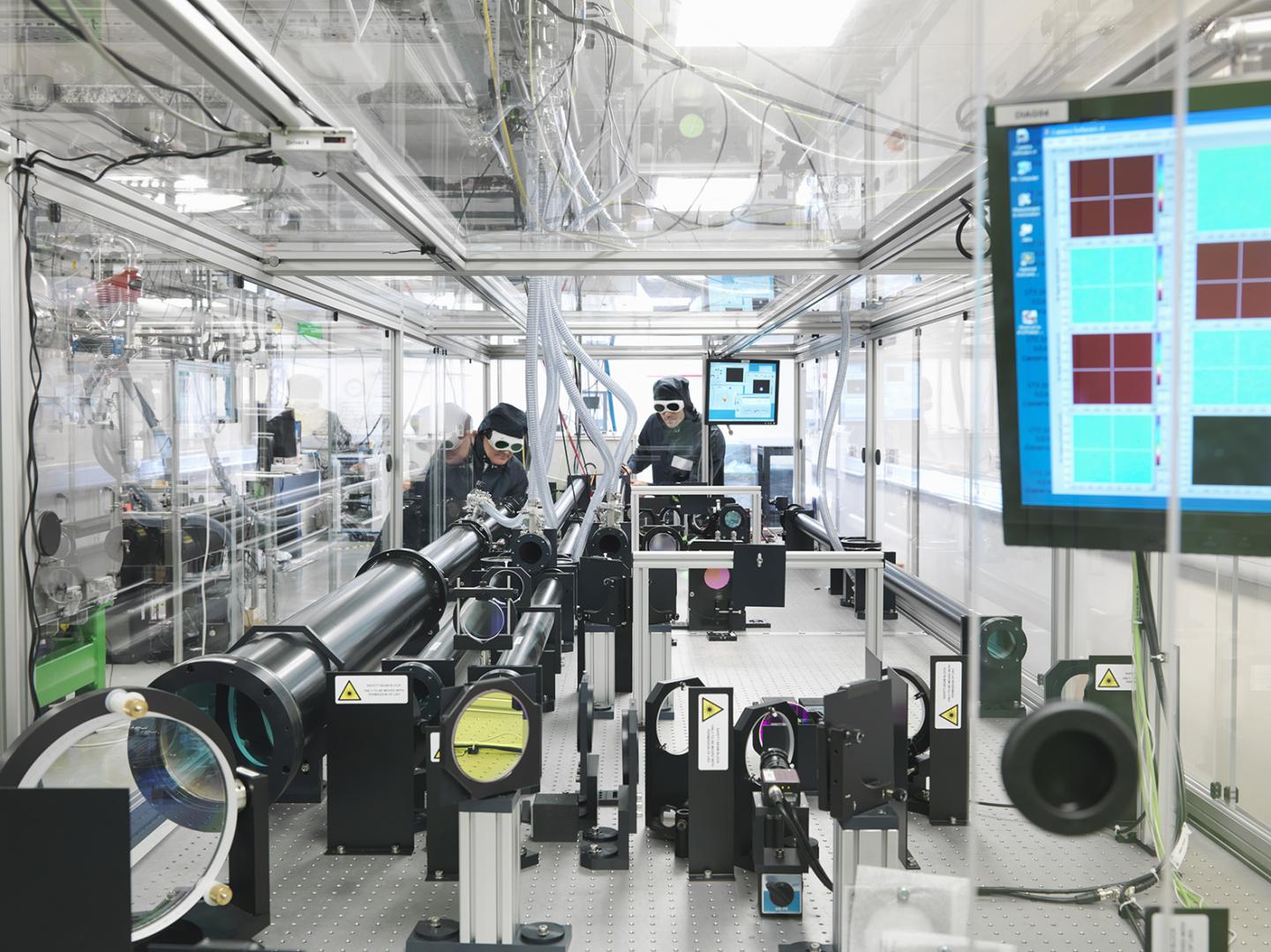
Combining powerful lasers and bright x-rays, Imperial and STFC researchers have demonstrated a technique that will allow new extreme experiments.

The new technique would be able to use a single x-ray flash to capture information about extremely dense and hot matter, such as can be found inside gas giant planets or on the crusts of dead stars.

The same conditions are also found in fusion experiments, which are trying to create a new source of energy that mimics the Sun.

The technique, reported this week in Physical Review Letters, was developed by a team led by Imperial College London scientists working with colleagues including those at the UK’s Central Laser Facility at the Science and Technology Facilities Council (STFC) Rutherford Appleton Laboratory, and was funded by the European Research Council.

The researchers wanted to improve ways to study ‘warm dense matter’ – matter that has the same density as a solid, but is heated up to 10,000?C. Researchers can create warm dense matter in the lab, recreating the conditions in the hearts of planets or crucial for fusion power, but it is difficult to study.

The team used the Gemini Laser, which has two beams – one which can create the conditions for warm dense matter, and one which can create ultrashort and bright x-rays to probe the conditions inside the warm dense matter.

Previous attempts using lower-powered lasers required 50-100 x-ray flashes to get the same information that the new technique can gain in just one flash. The flashes last only femtoseconds (quadrillionths of a second), meaning the new technique can reveal what is happening within warm dense matter across very short timescales.

First author Dr Brendan Kettle, from the Department of Physics at Imperial, said: “We will now be able to probe warm dense matter much more efficiently and in unprecedented resolution, which could accelerate discoveries in fusion experiments and astrophysics, such as the internal structure and evolution of planets including the Earth itself.”

The technique could also be used to probe fast-changing conditions inside new kinds of batteries and memory storage devices.

In the new study, the team used their technique to examine a heated sample of titanium, successfully showing that it could measure the distribution of electrons and ions.

Lead researcher Dr Stuart Mangles, from the Department of Physics at Imperial, said: “We are planning to use the technique to answer key questions about how the electrons and ions in this warm dense matter ‘talk’ to each other, and how quickly can energy transfer from the electrons to the ions.”

The Central Laser Facility’s Gemini Laser is currently one of the few places the right conditions for the technique can be created, but as new facilities start operating around the world, the team hope the technique can be expanded and used to do a whole new class of experiments.

Dr Rajeev Pattathil, Gemini Group Leader at the Central Laser Facility, said: “With ultrashort x-ray flashes we can get a freeze-frame focus on transient or dynamic processes in materials, revealing key new fundamental information about materials here and in the wider Universe, and especially those in extreme states.”

###

Media Contact
Hayley Dunning
[email protected]
020-759-42412

Original Source

https://www.imperial.ac.uk/news/194486/ultrashort-xray-technique-will-probe-conditions/

Related Journal Article

http://dx.doi.org/10.1103/PhysRevLett.123.254801

Tags: Chemistry/Physics/Materials SciencesMaterialsMolecular PhysicsNuclear PhysicsOptics
Share13Tweet8Share2ShareShareShare2

Related Posts

blank

Iridium Catalysis Enables Piperidine Synthesis from Pyridines

December 3, 2025
Neighboring Groups Speed Up Polymer Self-Deconstruction

Neighboring Groups Speed Up Polymer Self-Deconstruction

November 28, 2025

Activating Alcohols as Sulfonium Salts for Photocatalysis

November 26, 2025

Carbonate Ions Drive Water Ordering in CO₂ Reduction

November 25, 2025
Please login to join discussion

POPULAR NEWS

  • New Research Unveils the Pathway for CEOs to Achieve Social Media Stardom

    New Research Unveils the Pathway for CEOs to Achieve Social Media Stardom

    204 shares
    Share 82 Tweet 51
  • Scientists Uncover Chameleon’s Telephone-Cord-Like Optic Nerves, A Feature Missed by Aristotle and Newton

    121 shares
    Share 48 Tweet 30
  • Neurological Impacts of COVID and MIS-C in Children

    107 shares
    Share 43 Tweet 27
  • MoCK2 Kinase Shapes Mitochondrial Dynamics in Rice Fungal Pathogen

    69 shares
    Share 28 Tweet 17

About

We bring you the latest biotechnology news from best research centers and universities around the world. Check our website.

Follow us

Recent News

Boosting Cancer Immunotherapy by Targeting DNA Repair

Evaluating eGFR Equations in Chinese Children

Metformin-Alogliptin Combo vs. Monotherapy in Diabetes

Subscribe to Blog via Email

Enter your email address to subscribe to this blog and receive notifications of new posts by email.

Join 69 other subscribers
  • Contact Us

Bioengineer.org © Copyright 2023 All Rights Reserved.

Welcome Back!

Login to your account below

Forgotten Password?

Retrieve your password

Please enter your username or email address to reset your password.

Log In
No Result
View All Result
  • Homepages
    • Home Page 1
    • Home Page 2
  • News
  • National
  • Business
  • Health
  • Lifestyle
  • Science

Bioengineer.org © Copyright 2023 All Rights Reserved.