• HOME
  • NEWS
  • EXPLORE
    • CAREER
      • Companies
      • Jobs
    • EVENTS
    • iGEM
      • News
      • Team
    • PHOTOS
    • VIDEO
    • WIKI
  • BLOG
  • COMMUNITY
    • FACEBOOK
    • INSTAGRAM
    • TWITTER
Saturday, February 7, 2026
BIOENGINEER.ORG
No Result
View All Result
  • Login
  • HOME
  • NEWS
  • EXPLORE
    • CAREER
      • Companies
      • Jobs
        • Lecturer
        • PhD Studentship
        • Postdoc
        • Research Assistant
    • EVENTS
    • iGEM
      • News
      • Team
    • PHOTOS
    • VIDEO
    • WIKI
  • BLOG
  • COMMUNITY
    • FACEBOOK
    • INSTAGRAM
    • TWITTER
  • HOME
  • NEWS
  • EXPLORE
    • CAREER
      • Companies
      • Jobs
        • Lecturer
        • PhD Studentship
        • Postdoc
        • Research Assistant
    • EVENTS
    • iGEM
      • News
      • Team
    • PHOTOS
    • VIDEO
    • WIKI
  • BLOG
  • COMMUNITY
    • FACEBOOK
    • INSTAGRAM
    • TWITTER
No Result
View All Result
Bioengineer.org
No Result
View All Result
Home NEWS Science News Chemistry

Newly discovered protein gives signal for virus infection

Bioengineer by Bioengineer
December 17, 2019
in Chemistry
Reading Time: 2 mins read
0
IMAGE
Share on FacebookShare on TwitterShare on LinkedinShare on RedditShare on Telegram

IMAGE

Credit: University of Zurich


Viruses have been part of animals and humans for eons. When viruses invade a cell, they can infiltrate the nucleus with their genome and become part of the genome of the infected organism. Viruses transfer their genes between various organisms, as well as between tissues containing well differentiated cells inside a living creature. But how they uncoat their well-packed genes and release them to cause infection is largely unknown.

Mib1 protein systematically controls virus infection

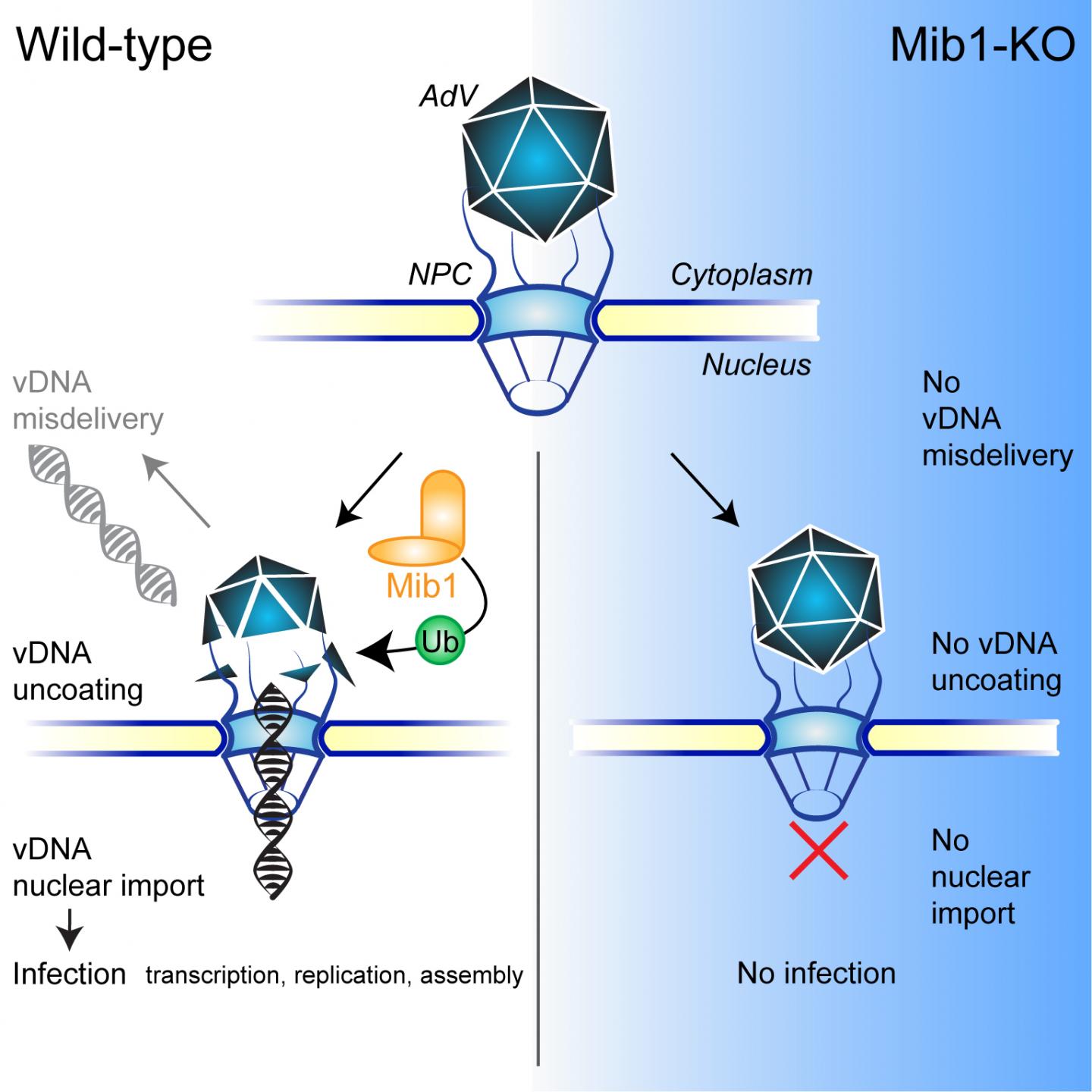
The research group of Urs Greber, professor at the Institute of Molecular Life Sciences of the University of Zurich (UZH), has now for the first time identified a protein in human cells that is key for successful viral DNA uncoating: the ubiquitin-ligase Mind bomb 1 (Mib1). “The protein enables adenoviruses to uncoat their DNA and discharge it into the nucleus – which is necessary for successful infection,” says Greber. If the protein is not produced or fails to work properly, the viruses can penetrate into the cell and reach the nuclear membrane, but they remain stuck on the porous structures of the nuclear envelope. “This finding opens up a new possibility for developing anti-viral therapies that block Mib1 in well differentiated cells,” says Greber. At present, there are no effective drugs to combat these widespread viruses.

Looking for door handle at nucleus entrance

Researchers found the protein by switching off most of the genes in human cells of the lung epithelium using RNA interference one by one, and then testing whether adenoviruses could infect the cells. “When we inhibited the gene for Mib1 or knocked it out using CRISPR-Cas technology, the virus infection rate declined drastically. Practically all adenoviruses remained stuck at the pore structures outside of the nucleus,” says Greber. As soon as these cells, after genetic interventions, produced small amounts of Mib1 again, the Mib1 reached the viruses at the nuclear pores, and the viruses uncoated their genes and infected the cells.

Adenoviruses: Life-threatening for people with weakened immune systems

Adenoviruses are widespread in humans and many animals. In humans, they can cause infections in the respiratory system and the gastrointestinal tract, as well as the kidney, liver, eyes and blood cells. For healthy people, the viruses are not life-threatening – the viruses simply settle in immune cells, where they remain for months without damaging the cells or tissue. In a person with a weakened immune system, however – for example stem-cell or organ transplant recipients – adenoviruses can easily spread to other cells and become life-threatening.

###

Media Contact
Urs Greber
[email protected]
41-446-354-841

Original Source

https://www.media.uzh.ch/en/Press-Releases/2019/Virus-Infection.html

Related Journal Article

http://dx.doi.org/10.1016/j.celrep.2019.11.064

Tags: BiochemistryBiologyBiotechnologyCell BiologyGeneticsInfectious/Emerging DiseasesMedicine/HealthMolecular BiologyVirology
Share12Tweet8Share2ShareShareShare2

Related Posts

blank

Breakthrough in Environmental Cleanup: Scientists Develop Solar-Activated Biochar for Faster Remediation

February 7, 2026
blank

Cutting Costs: Making Hydrogen Fuel Cells More Affordable

February 6, 2026

Scientists Develop Hand-Held “Levitating” Time Crystals

February 6, 2026

Observing a Key Green-Energy Catalyst Dissolve Atom by Atom

February 6, 2026
Please login to join discussion

POPULAR NEWS

  • Robotic Ureteral Reconstruction: A Novel Approach

    Robotic Ureteral Reconstruction: A Novel Approach

    82 shares
    Share 33 Tweet 21
  • Digital Privacy: Health Data Control in Incarceration

    63 shares
    Share 25 Tweet 16
  • Study Reveals Lipid Accumulation in ME/CFS Cells

    57 shares
    Share 23 Tweet 14
  • Breakthrough in RNA Research Accelerates Medical Innovations Timeline

    53 shares
    Share 21 Tweet 13

About

We bring you the latest biotechnology news from best research centers and universities around the world. Check our website.

Follow us

Recent News

Phage-Antibiotic Combo Beats Resistant Peritoneal Infection

Boosting Remote Healthcare: Stepped-Wedge Trial Insights

Barriers and Boosters of Seniors’ Physical Activity in Karachi

Subscribe to Blog via Email

Enter your email address to subscribe to this blog and receive notifications of new posts by email.

Join 73 other subscribers
  • Contact Us

Bioengineer.org © Copyright 2023 All Rights Reserved.

Welcome Back!

Login to your account below

Forgotten Password?

Retrieve your password

Please enter your username or email address to reset your password.

Log In
No Result
View All Result
  • Homepages
    • Home Page 1
    • Home Page 2
  • News
  • National
  • Business
  • Health
  • Lifestyle
  • Science

Bioengineer.org © Copyright 2023 All Rights Reserved.