• HOME
  • NEWS
  • EXPLORE
    • CAREER
      • Companies
      • Jobs
    • EVENTS
    • iGEM
      • News
      • Team
    • PHOTOS
    • VIDEO
    • WIKI
  • BLOG
  • COMMUNITY
    • FACEBOOK
    • INSTAGRAM
    • TWITTER
Saturday, February 7, 2026
BIOENGINEER.ORG
No Result
View All Result
  • Login
  • HOME
  • NEWS
  • EXPLORE
    • CAREER
      • Companies
      • Jobs
        • Lecturer
        • PhD Studentship
        • Postdoc
        • Research Assistant
    • EVENTS
    • iGEM
      • News
      • Team
    • PHOTOS
    • VIDEO
    • WIKI
  • BLOG
  • COMMUNITY
    • FACEBOOK
    • INSTAGRAM
    • TWITTER
  • HOME
  • NEWS
  • EXPLORE
    • CAREER
      • Companies
      • Jobs
        • Lecturer
        • PhD Studentship
        • Postdoc
        • Research Assistant
    • EVENTS
    • iGEM
      • News
      • Team
    • PHOTOS
    • VIDEO
    • WIKI
  • BLOG
  • COMMUNITY
    • FACEBOOK
    • INSTAGRAM
    • TWITTER
No Result
View All Result
Bioengineer.org
No Result
View All Result
Home NEWS Science News Biology

Protein injections in medicine

Bioengineer by Bioengineer
December 17, 2019
in Biology
Reading Time: 3 mins read
0
IMAGE
Share on FacebookShare on TwitterShare on LinkedinShare on RedditShare on Telegram

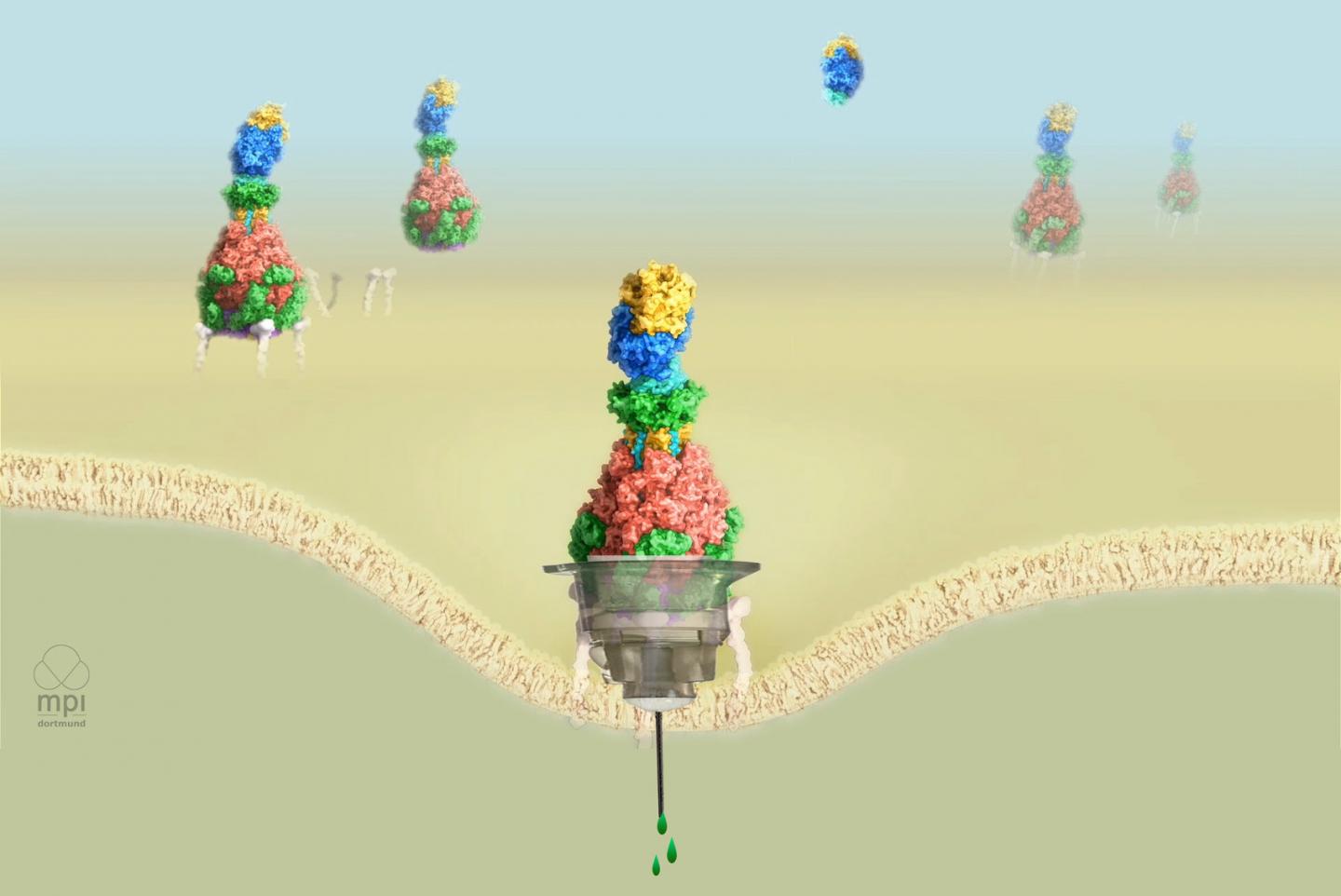
One day, medical compounds could be introduced into cells with the help of bacterial toxins
IMAGE

Credit: MPI f. Molecular Physiology


Pathogens can use a range of toxins to damage their host organism. Bacteria, such as those responsible for causing the deadly Plague, use a special injection mechanism to deliver their poisonous contents into the host cell. Stefan Raunser, Director at the Max Planck Institute for Molecular Physiology in Dortmund, together with his team, has already produced a detailed analysis of this toxin’s sophisticated mechanism. They have now succeeded in replacing the toxin in this nano-syringe with a different substance. This accomplishment creates a basis for their ultimate goal to use bacterial syringes as drug transporters in medicine.

As soon as bacteria have entered a host organism, they deploy their lethal weapon. Just like a syringe needle, they insert a channel through the outer protective layer of the host cell. The toxic protein contained in the capsule is then injected and attacks the cell’s structural framework. Within just a few minutes, the cell dies.

Raunser’s team discovered this lethal mechanism by using cryo-electron microscopy, a technique employed by only a few research groups in the world. What this technique reveals is the three-dimensional structure of proteins in near-atomic resolution.”

Targeted injection into body cells

Stefan Raunser’s researchers have now found a way to replace the toxin in the bacteria’s nano-syringe with different proteins, and then inject them into cells. For the exchange to work, however, the proteins must fulfil certain criteria: they must be a particular size, be positively charged, and must not interact with the toxin capsule. “With this technique, we have taken the first step towards our ultimate goal of using these nano-syringes in medicine to introduce drugs into body cells in a targeted manner,” says Raunser, describing the successful research results.

To transfer its toxic charge into the host cell, the injection mechanism must first dock with the cell. But the bacteria must trick the host cell- by pretending that the toxin is a substance that can be safely absorbed – similar to the famous trojan horse trick. To do this, they have areas that are recognized by sensors on the cell surface.

“We are currently looking for the toxin’s ‘docking stations’. Once we have found them and understood how the toxin binds to the cell surface, we aim to specifically modify the injection mechanism so that it can recognize cancer cells. We could then inject a killer protein exclusively into tumour cells. This would open up completely new possibilities in cancer medicine with minimal side effects,” predicts Raunser.

###

Original publication

Roderer D, Schubert E, Sitsel O, Raunser S

Towards the application of Tc toxins as a universal protein translocation system.

Nature Communications

Nat Commun 10, 5263 (2019) doi:10.1038/s41467-019-13253-8

Media Contact
Dr. Stefan Raunser
[email protected]
49-231-133-2356

Original Source

https://www.mpg.de/14261999/1212-moph-094806-protein-injections-in-medicine

Related Journal Article

http://dx.doi.org/10.1038/s41467-019-13253-8

Tags: BiologyMedicine/Health
Share12Tweet8Share2ShareShareShare2

Related Posts

New Study Uncovers Mechanism Behind Burn Pit Particulate Matter–Induced Lung Inflammation

New Study Uncovers Mechanism Behind Burn Pit Particulate Matter–Induced Lung Inflammation

February 6, 2026

DeepBlastoid: Advancing Automated and Efficient Evaluation of Human Blastoids with Deep Learning

February 6, 2026

Navigating the Gut: The Role of Formic Acid in the Microbiome

February 6, 2026

AI-Enhanced Optical Coherence Photoacoustic Microscopy Revolutionizes 3D Cancer Model Imaging

February 6, 2026
Please login to join discussion

POPULAR NEWS

  • Robotic Ureteral Reconstruction: A Novel Approach

    Robotic Ureteral Reconstruction: A Novel Approach

    82 shares
    Share 33 Tweet 21
  • Digital Privacy: Health Data Control in Incarceration

    63 shares
    Share 25 Tweet 16
  • Study Reveals Lipid Accumulation in ME/CFS Cells

    57 shares
    Share 23 Tweet 14
  • Breakthrough in RNA Research Accelerates Medical Innovations Timeline

    53 shares
    Share 21 Tweet 13

About

We bring you the latest biotechnology news from best research centers and universities around the world. Check our website.

Follow us

Recent News

Palmitoylation of Tfr1 Drives Platelet Ferroptosis and Exacerbates Liver Damage in Heat Stroke

Oxygen-Enhanced Dual-Section Microneedle Patch Improves Drug Delivery and Boosts Photodynamic and Anti-Inflammatory Treatment for Psoriasis

Scientists Identify SARS-CoV-2 PLpro and RIPK1 Inhibitors Showing Potent Synergistic Antiviral Effects in Mouse COVID-19 Model

Subscribe to Blog via Email

Enter your email address to subscribe to this blog and receive notifications of new posts by email.

Join 73 other subscribers
  • Contact Us

Bioengineer.org © Copyright 2023 All Rights Reserved.

Welcome Back!

Login to your account below

Forgotten Password?

Retrieve your password

Please enter your username or email address to reset your password.

Log In
No Result
View All Result
  • Homepages
    • Home Page 1
    • Home Page 2
  • News
  • National
  • Business
  • Health
  • Lifestyle
  • Science

Bioengineer.org © Copyright 2023 All Rights Reserved.