• HOME
  • NEWS
  • EXPLORE
    • CAREER
      • Companies
      • Jobs
    • EVENTS
    • iGEM
      • News
      • Team
    • PHOTOS
    • VIDEO
    • WIKI
  • BLOG
  • COMMUNITY
    • FACEBOOK
    • INSTAGRAM
    • TWITTER
Sunday, May 10, 2026
BIOENGINEER.ORG
No Result
View All Result
  • Login
  • HOME
  • NEWS
  • EXPLORE
    • CAREER
      • Companies
      • Jobs
        • Lecturer
        • PhD Studentship
        • Postdoc
        • Research Assistant
    • EVENTS
    • iGEM
      • News
      • Team
    • PHOTOS
    • VIDEO
    • WIKI
  • BLOG
  • COMMUNITY
    • FACEBOOK
    • INSTAGRAM
    • TWITTER
  • HOME
  • NEWS
  • EXPLORE
    • CAREER
      • Companies
      • Jobs
        • Lecturer
        • PhD Studentship
        • Postdoc
        • Research Assistant
    • EVENTS
    • iGEM
      • News
      • Team
    • PHOTOS
    • VIDEO
    • WIKI
  • BLOG
  • COMMUNITY
    • FACEBOOK
    • INSTAGRAM
    • TWITTER
No Result
View All Result
Bioengineer.org
No Result
View All Result
Home NEWS Science News Chemistry

PET/CT plays role in lung adenocarcinoma management

Bioengineer by Bioengineer
December 16, 2019
in Chemistry
Reading Time: 2 mins read
0
IMAGE
Share on FacebookShare on TwitterShare on LinkedinShare on RedditShare on Telegram

AJR finds fluorodeoxyglucose PET, combined with high-resolution CT, has value for predicting invasive histopathologic subtypes of early lung adenocarcinoma
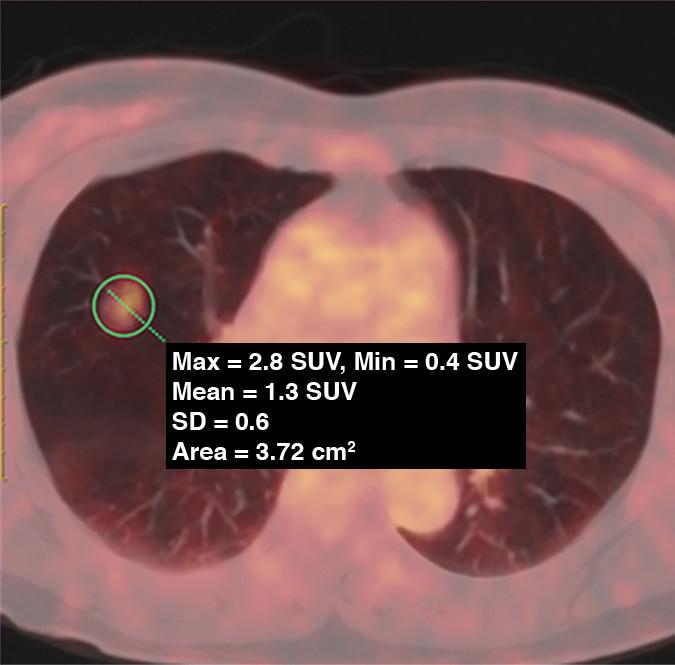
IMAGE

Credit: American Journal of Roentgenology (AJR)


Leesburg, VA, December 16, 2019–According to an article published ahead-of-print in the February 2020 issue of the American Journal of Roentgenology (AJR), fluorodeoxyglucose PET (FDG PET) can be used to predict the histopathologic subtypes and growth patterns of early lung adenocarcinoma.

“FDG PET, combined with high-resolution CT (HRCT), has value for predicting invasive histopathologic subtypes, but there was no significance for predicting invasive growth patterns,” clarified lead author Xiaoliang Shao from the department of nuclear medicine at Soochow University in Changzhou, China.

Shao and colleagues’ retrospective analysis was conducted on the PET/CT data on ground-glass nodules (GGNs) resected from patients with stage IA lung adenocarcinoma, evaluating the efficacy of PET maximum standardized uptake value (SUVmax) combined with HRCT signs in prediction of histopathologic subtype and growth pattern of lung adenocarcinoma.

Although SUVmax measured significantly higher in GGNs with invasive HRCT signs, the diameter of GGN, as well as the attenuation value differential between ground-glass components and adjacent lung tissues, were independent predictors of FDG uptake by GGNs.

Additionally, SUVmax was higher in invasive adenocarcinoma than in adenocarcinoma in situ (AIS)-minimally invasive adenocarcinoma (MIA), with SUVmax 2.0 the optimal cutoff value for differentiation.

Acinar-papillary adenocarcinoma had a higher SUVmax than lepidic adenocarcinoma, with SUVmax 1.4 the optimal cutoff value for differentiation.

“In stage IA lung adenocarcinoma characterized by GGNs, the SUVmax of GGNs with invasive CT features was high,” Shao wrote, adding that HRCT can be used in diagnosing the subtypes of lung adenocarcinoma.

“However, it cannot be used to differentiate different growth patterns of lung adenocarcinomas.”

As Shao concluded: “The efficacy of FDG PET SUVmax in differentiating lung adenocarcinoma subtypes is similar to that of HRCT signs, however, the diagnostic efficiency of FDG PET combined with HRCT is significantly higher than that of each imaging technique alone.”

###

Founded in 1900, the American Roentgen Ray Society (ARRS) is the first and oldest radiology society in the North America, dedicated to the advancement of medicine through the profession of radiology and its allied sciences. An international forum for progress since the discovery of the x-ray, ARRS maintains its mission of improving health through a community committed to advancing knowledge and skills with an annual scientific meeting, monthly publication of the peer-reviewed American Journal of Roentgenology (AJR), quarterly issues of InPractice magazine, AJR Live Webinars and Podcasts, topical symposia, print and online educational materials, as well as awarding scholarships via The Roentgen FundĀ®.

Media Contact
Logan K. Young
[email protected]
703-858-4332

Original Source

https://arrs.org/ARRSLIVE/Pressroom/PressReleases/PET_CT_Plays_Role_Lung_Adenocarcinoma_Management.aspx

Related Journal Article

http://dx.doi.org/10.2214/AJR.19.21585

Tags: cancerCarcinogensDiagnosticsHealth CareHealth Care Systems/ServicesInternal MedicineMedicine/HealthPharmaceutical SciencePublic HealthPulmonary/Respiratory Medicine
Share12Tweet8Share2ShareShareShare2

Related Posts

Miniature Sensor Uses Light to Detect Touch — Chemistry

Miniature Sensor Uses Light to Detect Touch

May 8, 2026
Iron Minerals Determine Whether Dissolved Organic Matter Fuels Microbes or Becomes Long-Term Carbon Storage — Chemistry

Iron Minerals Determine Whether Dissolved Organic Matter Fuels Microbes or Becomes Long-Term Carbon Storage

May 8, 2026

Kate Evans Appointed Associate Lab Director for Biological and Environmental Systems Science at ORNL

May 8, 2026

Advancing Multiscale Modeling and Overcoming Operational Challenges in Autothermal COā‚‚-to-Methanol Reactors

May 8, 2026
Please login to join discussion

POPULAR NEWS

  • Research Indicates Potential Connection Between Prenatal Medication Exposure and Elevated Autism Risk

    840 shares
    Share 336 Tweet 210
  • New Study Reveals Plants Can Detect the Sound of Rain

    727 shares
    Share 290 Tweet 181
  • Scientists Investigate Possible Connection Between COVID-19 and Increased Lung Cancer Risk

    68 shares
    Share 27 Tweet 17
  • Salmonella Haem Blocks Macrophages, Boosts Infection

    61 shares
    Share 24 Tweet 15

About

We bring you the latest biotechnology news from best research centers and universities around the world. Check our website.

Follow us

Recent News

Evaluating Digoxin Use in Patients with Symptomatic Rheumatic Heart Disease

Evaluating the Effectiveness and Safety of Digitalis Glycosides in Treating Heart Failure

Urdu Fall Risk Questionnaire Adapted for Elderly

Subscribe to Blog via Email

Enter your email address to subscribe to this blog and receive notifications of new posts by email.

Join 82 other subscribers
  • Contact Us

Bioengineer.org Ā© Copyright 2023 All Rights Reserved.

Welcome Back!

Login to your account below

Forgotten Password?

Retrieve your password

Please enter your username or email address to reset your password.

Log In
No Result
View All Result
  • Homepages
    • Home Page 1
    • Home Page 2
  • News
  • National
  • Business
  • Health
  • Lifestyle
  • Science

Bioengineer.org Ā© Copyright 2023 All Rights Reserved.