• HOME
  • NEWS
  • EXPLORE
    • CAREER
      • Companies
      • Jobs
    • EVENTS
    • iGEM
      • News
      • Team
    • PHOTOS
    • VIDEO
    • WIKI
  • BLOG
  • COMMUNITY
    • FACEBOOK
    • INSTAGRAM
    • TWITTER
Sunday, March 29, 2026
BIOENGINEER.ORG
No Result
View All Result
  • Login
  • HOME
  • NEWS
  • EXPLORE
    • CAREER
      • Companies
      • Jobs
        • Lecturer
        • PhD Studentship
        • Postdoc
        • Research Assistant
    • EVENTS
    • iGEM
      • News
      • Team
    • PHOTOS
    • VIDEO
    • WIKI
  • BLOG
  • COMMUNITY
    • FACEBOOK
    • INSTAGRAM
    • TWITTER
  • HOME
  • NEWS
  • EXPLORE
    • CAREER
      • Companies
      • Jobs
        • Lecturer
        • PhD Studentship
        • Postdoc
        • Research Assistant
    • EVENTS
    • iGEM
      • News
      • Team
    • PHOTOS
    • VIDEO
    • WIKI
  • BLOG
  • COMMUNITY
    • FACEBOOK
    • INSTAGRAM
    • TWITTER
No Result
View All Result
Bioengineer.org
No Result
View All Result
Home NEWS Science News Biology

Leaving home is beneficial for male squirrels but not for females, study shows

Bioengineer by Bioengineer
December 13, 2019
in Biology
Reading Time: 2 mins read
0
IMAGE
Share on FacebookShare on TwitterShare on LinkedinShare on RedditShare on Telegram

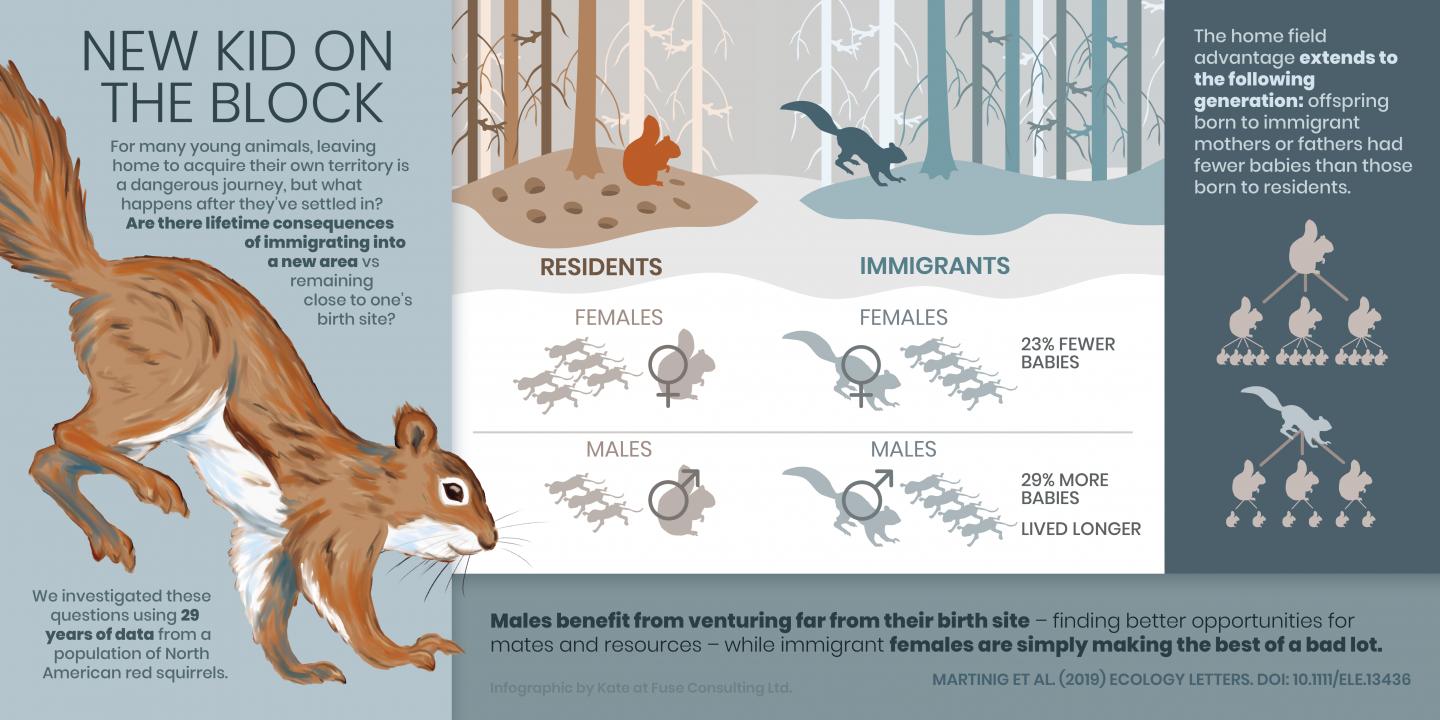
New research shows that male squirrels who move outside of the population they were born to live longer and have more offspring.
IMAGE

Credit: Kate Broadley


In the world of squirrels, moving away from your home turf has better outcomes for males than for females, according to a new study by University of Alberta ecologists.

The study uses 30 years of data on a population of North American red squirrels in Yukon, Canada, examining how the number of offspring and total lifespan differed between squirrels who lived in the same area in which they were born and those who were newcomers to the area. And the results show that sex plays a major role.

“The benefits to living in a different population than you were born are sex-dependent,” explained April Martinig, PhD student in the Department of Biological Sciences and lead author on the study. “Males benefit from moving away, whereas females do not. We also found that the decision to move away or stay at home has an impact on offspring.”

New research shows that male squirrels who move outside of the population they were born to live longer and have more offspring.

For male squirrels, moving away is beneficial because they no longer need to compete with their siblings for limited resources, such as mates or food. Males also benefit, because female squirrels prefer to mate with newcomer males. Female squirrels, on the other hand, do not reap the same benefits, and instead lose out on the support of nearby family–something that male squirrels don’t receive.

“Squirrels live in a world where there are only so many ’empty apartments’ to live in,” said Martinig, who is conducting her PhD studies under the supervision of Professor Stan Boutin. “Sometimes one sibling is allowed to stay at home–so everyone else must go. If there are no vacancies nearby, squirrels then have no choice but to move further away. This is what females face: losing the benefits of having family nearby.”

“Movement is a crucial component of species persistence,” added Martinig. “Understanding how and why certain individuals move is key to protecting populations as climate change impacts their distribution on the landscape.”

###

The paper, “The new kid on the block: Immigrant males win big whereas females pay fitness cost after dispersal,” is published in Ecology Letters (doi: 10.1111/ELE.13436).

Media Contact
Katie Willis
[email protected]
780-267-0880

Original Source

https://www.ualberta.ca/science/news/2019/december/squirrel-migration

Related Journal Article

http://dx.doi.org/10.1111/ELE.13436

Tags: BiologyPopulation BiologyZoology/Veterinary Science
Share12Tweet8Share2ShareShareShare2

Related Posts

How to sway group opinions: Encourage opponents to stay undecided

How to sway group opinions: Encourage opponents to stay undecided

March 23, 2026
Deep Learning Model Maps How Individual Cells Shape Disease Outcomes

Deep Learning Model Maps How Individual Cells Shape Disease Outcomes

March 20, 2026

Removing only 15 female sharks annually could endanger the entire population, scientists warn

March 20, 2026

Scientists Urge Fragrance Industry to Transition from Sustainability Talk to Active Funding of Plant Conservation

March 20, 2026
Please login to join discussion

POPULAR NEWS

  • blank

    Revolutionary AI Model Enhances Precision in Detecting Food Contamination

    96 shares
    Share 38 Tweet 24
  • Imagine a Social Media Feed That Challenges Your Views Instead of Reinforcing Them

    1004 shares
    Share 397 Tweet 248
  • Uncovering Functions of Cavernous Malformation Proteins in Organoids

    54 shares
    Share 22 Tweet 14
  • Promising Outcomes from First Clinical Trials of Gene Regulation in Epilepsy

    51 shares
    Share 20 Tweet 13

About

We bring you the latest biotechnology news from best research centers and universities around the world. Check our website.

Follow us

Recent News

In-Sensor Cryptography Links Physical Process to Digital Identity

Can Psychosocial Factors Influence Cancer Risk?

Depression Factors in Elderly: Pre vs. Post-COVID Analysis

Subscribe to Blog via Email

Enter your email address to subscribe to this blog and receive notifications of new posts by email.

Join 78 other subscribers
  • Contact Us

Bioengineer.org © Copyright 2023 All Rights Reserved.

Welcome Back!

Login to your account below

Forgotten Password?

Retrieve your password

Please enter your username or email address to reset your password.

Log In
No Result
View All Result
  • Homepages
    • Home Page 1
    • Home Page 2
  • News
  • National
  • Business
  • Health
  • Lifestyle
  • Science

Bioengineer.org © Copyright 2023 All Rights Reserved.