Researchers from the Centre for Astro-Particle Physics (CAPP) within the Department of Physics at the University of Johannesburg (UJ) collaborate with the teams from the Fermi gamma-ray space telescope, the…
view more
A dying star emits intense flashes of light called a gamma-ray burst. Most days, the Fermi gamma-ray space telescope detects these flashes. About 20 years ago, scientists predicted that a gargantuan energy level – tera-electron volts – would be detected in burst afterglow.
In January, the MAGIC telescopes on the Canary Islands observed light at this energy level for the first time. The theories predicting how such light would be produced, are now validated.
Burst mechanics
When a star dies, its core collapses. While it collapses, the core shoots out hot plasma material at nearly the speed of light. Intense flashes of light called gamma-ray bursts result from these hot plasma jets.
When telescopes on satellites observe an area of the night sky, they use two ways to recognise the bursts coming from dying stars.
First, if the bursts last relatively long, from a few seconds to a few minutes, then they are called long-duration bursts. Second, such a burst starts with a ‘bang’ of very bright gamma-ray emission that pulses brighter and dimmer before it fades away. This is called the variable phase of its emission.
The making of afterglow
While the star’s core is collapsing, the star is still rotating on its axis. At the same time, the core starts spewing the fast-moving jet of super-heated ionized matter, which radiates along the star’s axis of rotation. It is this jet of ionized star matter that causes the gamma-ray burst from the dying star.
As the jet radiates away from the star, it encounters resistance, even though this is happening in outer space. Pressure builds up and slows down the jet – and then starts producing shock waves. The shock waves are just like the sonic boom from a supersonic jet plane.
The shock waves heat up electrons in the space environment around the jet. The heated electrons then start spiralling in the magnetic medium surrounding the jet. At the same time, the electrons emit light in all wavelengths of the electromagnetic spectrum.
The electrons’ light is called the afterglow radiation from the gamma-ray burst. It can last from days to months and is relatively easy to observe. It is explained by the synchrotron radiation model in physics.
Scientists routinely detect afterglow radiation at radio, optical, X-ray and gamma-ray wavelengths. The Fermi Gamma-Ray Space Telescope (FGST) can even detect afterglow light at giga-electron volt energies. A giga-electron volt is 10 to the power 9 electron volts.
Elusive light
Until January 2019 something had been missing from the afterglow picture, however. It was the light energy that scientists had been expecting to see for about 20 years.
Researchers, including Prof Soebur Razzaque, predicted that afterglow from gamma-ray bursts would include far more powerful light. They said there would be light generated at the tera-electron volt level. Which is ten to the power 12, at least a thousand times more powerful than what the FGST had detected up to then.
Prof Razzaque is the Director of the Centre for Astro-Particle Physics (CAPP) within the Department of Physics at the University of Johannesburg (UJ).
“We said that the heated, spiralling electrons around the jet should be undergoing another process. This additional process is called inverse-Compton radiation. Also, this process would generate light with an energy level of a tera-electron volts.
“But it was not possible to validate this theory, because we had not detected light at that energy level yet,” says Razzaque.
“Also, if we could detect such light, we hoped for a new window to study the extreme environment that gamma-ray burst afterglow is produced in,” he adds.
Caught in space and terra firma
On 14 January 2019, that window opened up. Several telescopes on board space missions observed a gamma ray burst, which was named GRB 190114C. One of these telescopes was the Fermi Gamma-ray Space Telescope, another the Swift Space Observatory.
Within hours, scientists realised GRB 190114C was out of the ordinary. They could see extremely high-energy photons, or light particles. The established synchrotron radiation model could not readily explain these photons.
In fact, about a minute after the gamma-ray bursts’ light got to Earth, the MAGIC telescope on the Canary Islands found what researchers had hoped for. The telescope had detected radiation of 1 tera-electron volt or more, lasting as long as predicted for a dying star.
Later, the Fermi and SWIFT satellites also observed the burst’s long-lasting afterglow radiation. For the first 10 days after the burst, many telescopes on Earth could detect the afterglow also. The radiation ranged from radio frequencies up to very high energy gamma-rays.
Extreme environment
In South Africa, Dr Feraol Fana Dirirsa started analysing gamma-ray data from the Fermi space telescope soon after the burst. He is a research fellow at the Centre for Astro-Particle Physics at UJ.
Meanwhile, Prof. Razzaque worked with several other scientists from the Fermi, Swift and MAGIC telescope teams. They investigated modelling of multi-wavelength afterglow emission from GRB 190114C.
It soon became clear that the high-energy light that MAGIC detected, had validated their predictions. This light was the tera-electron volt radiation from inverse Compton emission, identified for the first time.
“We observed a huge range of frequencies in the electromagnetic radiation afterglow of GRB 190114C. It is the most extensive to date for a gamma-ray burst,” says Razzaque.
“We’re elated that the theories around inverse-Compton emission are now validated. However, we need more observations from bursts like this. More data will help us to better understand the extreme environment that gamma-ray burst afterglow is produced in. Meanwhile, other theoretical models about gamma rays and stars are still waiting for direct observation,” he adds.
###
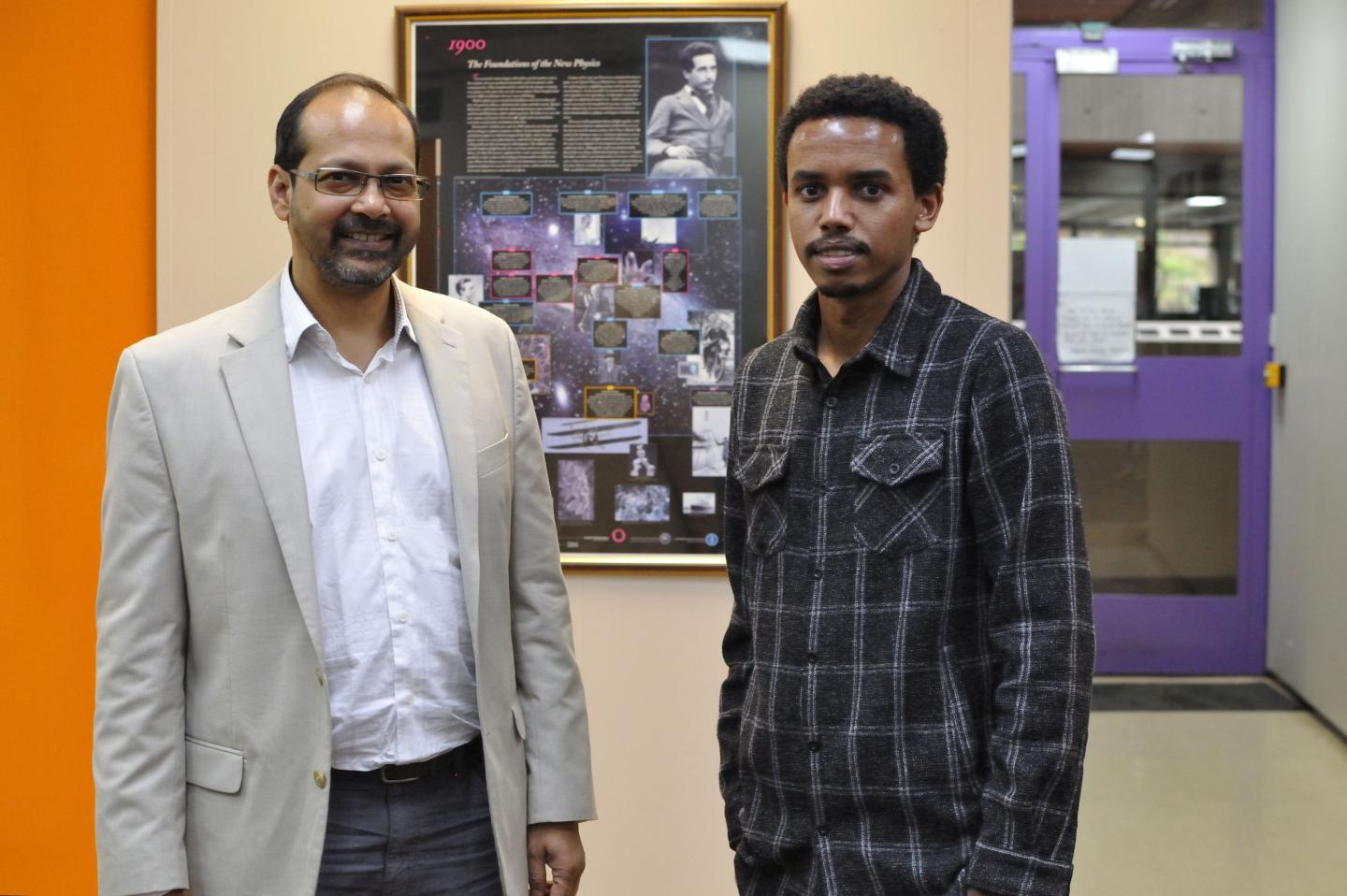
Prof Soebur Razzaque and Dr. Feraol F. Dirirsa from the University of Johannesburg’s (UJ) Centre for Astro-Particle Physics (CAPP) contributed to this global research project.
CAPP within the UJ Department of Physics is a member of the Fermi Large Area Telescope Collaboration.
Prof Razzaque was partially supported by The South African Gamma-ray Astronomy Programme (SA-GAMMA), which is funded by the Department of Science and Technology / National Research Foundation, South Africa. The University of Johannesburg provided fellowship support to Dr Dirirsa.
For email or broadcast interviews, contact Prof Soebur Razzaque, PhD, Professor of Physics and Director, UJ Centre for Astro-Particle Physics (CAPP) at [email protected]
Thanks to ESO/A. Roquette for the image of a gamma-ray burst at https:/
Media Contact
Ms Therese van Wyk
[email protected]
27-711-398-407
Related Journal Article
http://dx.