• HOME
  • NEWS
  • EXPLORE
    • CAREER
      • Companies
      • Jobs
    • EVENTS
    • iGEM
      • News
      • Team
    • PHOTOS
    • VIDEO
    • WIKI
  • BLOG
  • COMMUNITY
    • FACEBOOK
    • INSTAGRAM
    • TWITTER
Saturday, February 7, 2026
BIOENGINEER.ORG
No Result
View All Result
  • Login
  • HOME
  • NEWS
  • EXPLORE
    • CAREER
      • Companies
      • Jobs
        • Lecturer
        • PhD Studentship
        • Postdoc
        • Research Assistant
    • EVENTS
    • iGEM
      • News
      • Team
    • PHOTOS
    • VIDEO
    • WIKI
  • BLOG
  • COMMUNITY
    • FACEBOOK
    • INSTAGRAM
    • TWITTER
  • HOME
  • NEWS
  • EXPLORE
    • CAREER
      • Companies
      • Jobs
        • Lecturer
        • PhD Studentship
        • Postdoc
        • Research Assistant
    • EVENTS
    • iGEM
      • News
      • Team
    • PHOTOS
    • VIDEO
    • WIKI
  • BLOG
  • COMMUNITY
    • FACEBOOK
    • INSTAGRAM
    • TWITTER
No Result
View All Result
Bioengineer.org
No Result
View All Result
Home NEWS Science News Biology

Shark skin microbiome resists infection

Bioengineer by Bioengineer
November 4, 2019
in Biology
Reading Time: 2 mins read
0
IMAGE
Share on FacebookShare on TwitterShare on LinkedinShare on RedditShare on Telegram

IMAGE

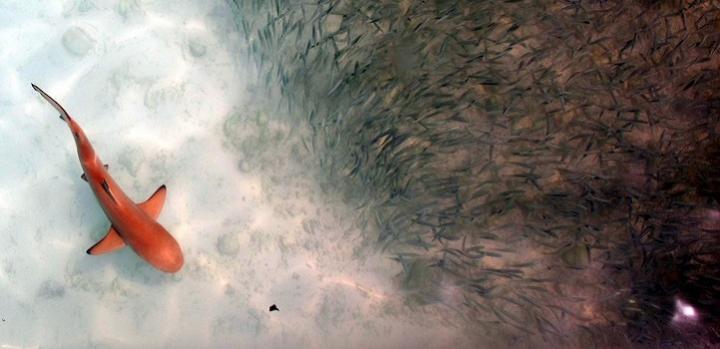
Credit: © 2019 Claudia Pogoreutz


A survey of the shark skin microbiome provides the first step toward understanding the remarkable resilience of shark wounds to infection.

In the wild, blacktip reef sharks are often seen bearing wounds, but they rarely exhibit obvious signs of infection around the wounds. As a first step toward understanding this phenomenon, an international team led by researchers at KAUST’s Red Sea Research Center investigated the microbial community living on the skin of sharks.

The team collected skin mucus samples from the backs and gills of wild-caught blacktip reef sharks around the Seychelles Islands. Next, they sequenced the 16S rRNA gene from these samples in order to identify the bacteria. Finally, they compared the bacterial communities from different samples to detect changes in response to injury.

The team’s analysis revealed no difference between the bacterial communities on injured skin on gills and uninjured gills or backs. In other words, there was no evidence of infection around the wounds. “We were surprised not to find any substantial change in the skin bacterial communities,” says Claudia Pogoreutz, the postdoctoral fellow who led the study.

“This suggests shark skin doesn’t become infected easily and that the native bacterial community of the skin can be maintained even after injury,” she adds. “We really need to delve deeper into bacterial functions and innate immunity of sharks to understand what is really going on and how wound healing in sharks is mediated.”

However, the team did find differences in the bacterial communities collected from the skin of sharks at different locations. Although the sites were just a few kilometers apart, they could be relatively isolated from each other by factors, such as ocean currents and the reluctance of blacktip reef sharks to move between habitats or cross deeper straits. The differences in shark skin microbial communities may reflect differences in the ambient environment, such as temperature, population density, nutrient availability or pollution, but researchers cannot rule out the possibility that the changes could provide an adaptive benefit to the sharks.

Based on their findings, the team identified a core skin microbiome that is conserved across blacktip reef sharks, alongside site-specific differences. They also found no changes in the microbiome around wounds, suggesting that they don’t get infected or that any infections are too mild to detect.

Plenty of questions remain: from understanding the regional differences to figuring out if and how the microbiome contributes to wound healing and infection resistance. “There’s still so much to learn with respect to shark skin-associated bacteria,” says Pogoreutz.

###

Media Contact
Carolyn Unck
[email protected]
966-054-470-0408

Original Source

https://discovery.kaust.edu.sa/en/article/899/shark-skin-microbiome-resists-infection

Related Journal Article

http://dx.doi.org/10.1186/s42523-019-0011-5

Tags: BacteriologyBiodiversityBiologyEcology/EnvironmentFisheries/AquacultureMarine/Freshwater BiologyMicrobiologyZoology/Veterinary Science
Share12Tweet8Share2ShareShareShare2

Related Posts

Florida Cane Toad: Complex Spread and Selective Evolution

Florida Cane Toad: Complex Spread and Selective Evolution

February 7, 2026
New Study Uncovers Mechanism Behind Burn Pit Particulate Matter–Induced Lung Inflammation

New Study Uncovers Mechanism Behind Burn Pit Particulate Matter–Induced Lung Inflammation

February 6, 2026

DeepBlastoid: Advancing Automated and Efficient Evaluation of Human Blastoids with Deep Learning

February 6, 2026

Navigating the Gut: The Role of Formic Acid in the Microbiome

February 6, 2026
Please login to join discussion

POPULAR NEWS

  • Robotic Ureteral Reconstruction: A Novel Approach

    Robotic Ureteral Reconstruction: A Novel Approach

    82 shares
    Share 33 Tweet 21
  • Digital Privacy: Health Data Control in Incarceration

    63 shares
    Share 25 Tweet 16
  • Study Reveals Lipid Accumulation in ME/CFS Cells

    57 shares
    Share 23 Tweet 14
  • Breakthrough in RNA Research Accelerates Medical Innovations Timeline

    53 shares
    Share 21 Tweet 13

About

We bring you the latest biotechnology news from best research centers and universities around the world. Check our website.

Follow us

Recent News

Menopause Care: Insights from Workforce Review and Consultation

LRRK2R1627P Mutation Boosts Gut Inflammation, α-Synuclein

3D Gut-Brain-Vascular Model Reveals Disease Links

Subscribe to Blog via Email

Enter your email address to subscribe to this blog and receive notifications of new posts by email.

Join 73 other subscribers
  • Contact Us

Bioengineer.org © Copyright 2023 All Rights Reserved.

Welcome Back!

Login to your account below

Forgotten Password?

Retrieve your password

Please enter your username or email address to reset your password.

Log In
No Result
View All Result
  • Homepages
    • Home Page 1
    • Home Page 2
  • News
  • National
  • Business
  • Health
  • Lifestyle
  • Science

Bioengineer.org © Copyright 2023 All Rights Reserved.