• HOME
  • NEWS
  • EXPLORE
    • CAREER
      • Companies
      • Jobs
    • EVENTS
    • iGEM
      • News
      • Team
    • PHOTOS
    • VIDEO
    • WIKI
  • BLOG
  • COMMUNITY
    • FACEBOOK
    • INSTAGRAM
    • TWITTER
Monday, March 30, 2026
BIOENGINEER.ORG
No Result
View All Result
  • Login
  • HOME
  • NEWS
  • EXPLORE
    • CAREER
      • Companies
      • Jobs
        • Lecturer
        • PhD Studentship
        • Postdoc
        • Research Assistant
    • EVENTS
    • iGEM
      • News
      • Team
    • PHOTOS
    • VIDEO
    • WIKI
  • BLOG
  • COMMUNITY
    • FACEBOOK
    • INSTAGRAM
    • TWITTER
  • HOME
  • NEWS
  • EXPLORE
    • CAREER
      • Companies
      • Jobs
        • Lecturer
        • PhD Studentship
        • Postdoc
        • Research Assistant
    • EVENTS
    • iGEM
      • News
      • Team
    • PHOTOS
    • VIDEO
    • WIKI
  • BLOG
  • COMMUNITY
    • FACEBOOK
    • INSTAGRAM
    • TWITTER
No Result
View All Result
Bioengineer.org
No Result
View All Result
Home NEWS Science News Health

Malaria pathogen under the X-ray microscope

Bioengineer by Bioengineer
October 30, 2019
in Health
Reading Time: 3 mins read
0
IMAGE
Share on FacebookShare on TwitterShare on LinkedinShare on RedditShare on Telegram

IMAGE

Credit: S. Kapishnikov


Around 40 percent of humanity lives in regions affected by malaria, around 200 million people contract the disease every year, and an estimated 600,000 people die as a result. Anopheles mosquitoes that transmit malaria pathogens are spreading due to climate change. These pathogens are unicellular organisms (plasmodia) that settle inside the red blood cells of their hosts and metabolize hemoglobin there to grow and multiply.

The main avenue to deal with the disease is treatment by active compounds in the quinoline family and, more recently, from the artemisinin family. However, the exact way that active compounds keep the pathogenic plasmodia in check has so far been subject to controversy.

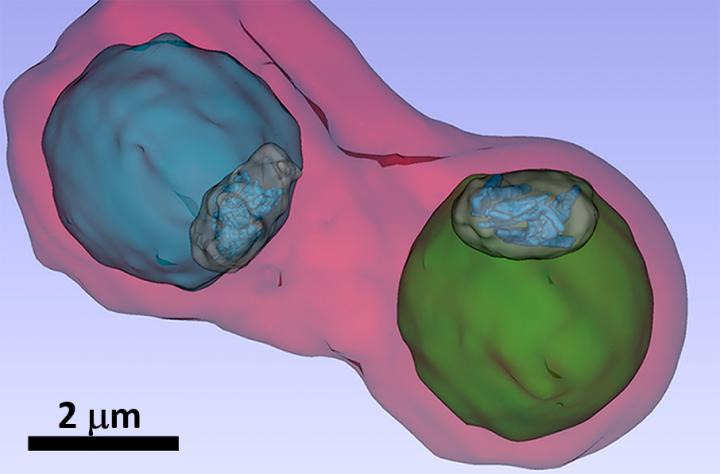
One thesis relates to the digestive process of the pathogenic plasmodia. Research has shown that plasmodia store large amounts of hemoglobin in their digestive vacuole, an organelle that resembles a bag. This releases iron-containing hemozoin molecules that the plasmodia cannot tolerate. The plasmodia manage to crystallize these toxic hemozoin molecules so that they can no longer poison them. The idea was that active compounds might prevent the formation of hemozoin crystals and thus boycott the detoxification process of the plasmodia.

A team led by Sergey Kapishnikov from the University of Copenhagen and the Weizmann Institute of Science in Rehovot, Israel, together with Danish, Spanish, French and Berlin colleagues, has now investigated this process in infected blood cells for the first time. The blood cells were infected with the malaria pathogen Plasmodium falciparum and then mixed with different concentrations of bromoquine from the quinoline family.

Malaria pathogens in blood cells can only be examined in vivo and in their natural environment using X-ray microscopy at synchrotron sources. Other investigation methods, such as electron microscopy, require the pathogens to be dried and cut into ultra-thin slices.

At BESSY II, Stephan Werner and Peter Guttmann together with Sergey Kapishnikov were able to examine the samples using X-ray microscopy. “The blood samples are flash-frozen for the examination so that we can observe the pathogens in vivo and also produce three-dimensional X-ray tomography images”, explains Guttmann. Further X-ray microscopy studies were carried out at the ALBA synchrotron light source in Barcelona.

Fluorescence spectromicroscopy at the European Synchrotron Radiation Facility ESRF in Grenoble made it possible to map the distribution of elements in blood cells . When combined with the cellular structure revealed by the three-dimensional X-ray images, the bromoquine distribution and its mode of action could be precisely interpreted. “We see in our images that the bromoquine accumulates at the surface of hemozoin crystals. This should lead to inhibition of the crystal growth and thus disrupt the detoxification process by the plasmodia parasites”, explains Kapishnikov.

These investigations can also be extended to other drug groups such as Artemisinin and provide valuable information for the design of more effective malaria treatments.

###

Media Contact
Antonia Roetger
[email protected]

Original Source

https://www.helmholtz-berlin.de/pubbin/news_seite?nid=20851;sprache=en;seitenid=1

Related Journal Article

http://dx.doi.org/10.1073/pnas.1910123116

Tags: Infectious/Emerging DiseasesMedicine/HealthMicrobiologyPublic Health
Share12Tweet8Share2ShareShareShare2

Related Posts

New Study Reveals Intermittent Fasting Enhances Hormonal Balance in Women with PCOS

March 30, 2026

Immune Remodeling in Myasthenia Gravis Post-Tacrolimus

March 30, 2026

Dr. Yangzhi Zhu of Terasaki Institute Receives American Heart Association Career Development Award for Pioneering Translational Biosensing Research

March 30, 2026

Tetracenomycin Y: Rare Actinomycete’s Plant Growth Booster

March 30, 2026
Please login to join discussion

POPULAR NEWS

  • blank

    Revolutionary AI Model Enhances Precision in Detecting Food Contamination

    96 shares
    Share 38 Tweet 24
  • Imagine a Social Media Feed That Challenges Your Views Instead of Reinforcing Them

    1005 shares
    Share 397 Tweet 248
  • Promising Outcomes from First Clinical Trials of Gene Regulation in Epilepsy

    51 shares
    Share 20 Tweet 13
  • Advancements in EV Battery Technology to Surpass Climate Change-Induced Degradation

    45 shares
    Share 18 Tweet 11

About

We bring you the latest biotechnology news from best research centers and universities around the world. Check our website.

Follow us

Recent News

Drone Imaging Unveils Fresh Insights into the Impact of Grazing on Grassland Ecosystems

New Study Reveals Intermittent Fasting Enhances Hormonal Balance in Women with PCOS

Plasmonic Nanocavities Unlock Detection of Layer-Breathing Vibrations in 2D Materials and Heterostructures

Subscribe to Blog via Email

Success! An email was just sent to confirm your subscription. Please find the email now and click 'Confirm' to start subscribing.

Join 78 other subscribers
  • Contact Us

Bioengineer.org © Copyright 2023 All Rights Reserved.

Welcome Back!

Login to your account below

Forgotten Password?

Retrieve your password

Please enter your username or email address to reset your password.

Log In
No Result
View All Result
  • Homepages
    • Home Page 1
    • Home Page 2
  • News
  • National
  • Business
  • Health
  • Lifestyle
  • Science

Bioengineer.org © Copyright 2023 All Rights Reserved.