• HOME
  • NEWS
  • EXPLORE
    • CAREER
      • Companies
      • Jobs
    • EVENTS
    • iGEM
      • News
      • Team
    • PHOTOS
    • VIDEO
    • WIKI
  • BLOG
  • COMMUNITY
    • FACEBOOK
    • INSTAGRAM
    • TWITTER
Sunday, March 29, 2026
BIOENGINEER.ORG
No Result
View All Result
  • Login
  • HOME
  • NEWS
  • EXPLORE
    • CAREER
      • Companies
      • Jobs
        • Lecturer
        • PhD Studentship
        • Postdoc
        • Research Assistant
    • EVENTS
    • iGEM
      • News
      • Team
    • PHOTOS
    • VIDEO
    • WIKI
  • BLOG
  • COMMUNITY
    • FACEBOOK
    • INSTAGRAM
    • TWITTER
  • HOME
  • NEWS
  • EXPLORE
    • CAREER
      • Companies
      • Jobs
        • Lecturer
        • PhD Studentship
        • Postdoc
        • Research Assistant
    • EVENTS
    • iGEM
      • News
      • Team
    • PHOTOS
    • VIDEO
    • WIKI
  • BLOG
  • COMMUNITY
    • FACEBOOK
    • INSTAGRAM
    • TWITTER
No Result
View All Result
Bioengineer.org
No Result
View All Result
Home NEWS Science News Biology

Paleontologists discover complete Saurornitholestes langstoni specimen

Bioengineer by Bioengineer
October 17, 2019
in Biology
Reading Time: 3 mins read
0
IMAGE
Share on FacebookShare on TwitterShare on LinkedinShare on RedditShare on Telegram

Discovery provides valuable insight into evolution of theropod dinosaurs around the world
IMAGE

Credit: Jan Sovak

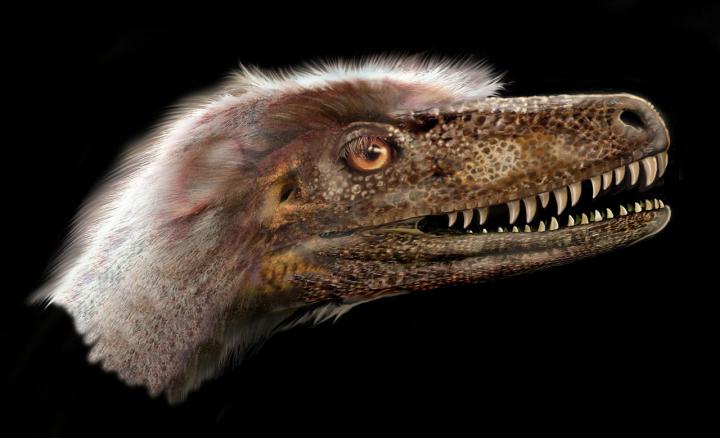
The discovery of a nearly complete dromaeosaurid Saurornitholestes langstoni specimen is providing critical information for the evolution of theropod dinosaurs, according to new research by a University of Alberta paleontologist.

The 76-million-year-old species was long thought to be so closely related to Velociraptor from Mongolia that some researchers even called it Velociraptor langstoni–until now.

The landmark discovery was made by world-renowned paleontologists Philip Currie and Clive Coy from the University of Alberta and David Evans, James and Louise Temerty Endowed Chair of Vertebrate Palaeontology at the Royal Ontario Museum. The research illustrates how Saurornitholestes differs from Velociraptor. Importantly, the research also identifies a unique tooth evolved for preening feathers and provides new evidence that the dromaeosaurid lineage from North America that includes Saurornitholestes is distinct from an Asian lineage that includes the famous Velociraptor.

“Palaeontology in general is a gigantic puzzle where most of the pieces are missing. The discovery and description of this specimen represents the recovery of many pieces of the puzzle,” said Currie, professor in the Department of Biological Sciences and Canada Research Chair in Dinosaur Paleobiology. “This ranks in the top discoveries of my career. It is pretty amazing.”

Another piece of the puzzle

Saurornitholestes is a small, feathered carnivorous dinosaur within the dromaeosaurid family (also known as “raptors”) that was previously known from fragmentary remains. Discovered by Coy in Dinosaur Provincial Park in 2014, the new skeleton is remarkably complete and exquisitely preserved, with all the bones (except for the tail) preserved in life position. The new research, which focuses on the skull, shows that the North American form has a shorter and deeper skull than the Velociraptor. At the front of the skull’s mouth, the researchers also discovered a flat tooth with long ridges, which was likely used for preening feathers. The same tooth has since been identified in Velociraptor and other dromaeosaurids.

“Because of their small size and delicate bones, small meat-eating dinosaur skeletons are exceptionally rare in the fossil record. The new skeleton is by far the most complete and best-preserved raptor skeleton ever found in North America. It’s a scientific goldmine,” said Evans.

The study also establishes a distinction between dromaeosaurids in North America and Asia. “The new anatomical information we have clearly shows that the North American dromaeosaurids are a separate lineage from the Asian dromaeosaurids, although they do have a common ancestor,” said Currie. “This changes our understanding of intercontinental movements of these animals and ultimately will help us understand their evolution.”

Future research will investigate the remainder of the skeleton as well as additional analyses on the relationships between dromaeosaurids.

###

The paper, “Cranial Anatomy of New Specimens of Saurornitholestes langstoni (Dinosauria, Theropoda, Dromaeosauridae) from the Dinosaur Park Formation (Campanian) of Alberta,” was published in The Anatomical Record (doi: 10.1002/ar.24241).

Media Contact
Katie Willis
[email protected]
780-267-0880

Original Source

https://www.ualberta.ca/science/science-news/2019/october/dinosaurs-theropod-specimen

Related Journal Article

http://dx.doi.org/10.1002/ar.24241

Tags: BiologyEvolutionPaleontology
Share14Tweet9Share2ShareShareShare2

Related Posts

Two Salk Scientists Honored as 2025 AAAS Fellows

Two Salk Scientists Honored as 2025 AAAS Fellows

March 27, 2026
How to sway group opinions: Encourage opponents to stay undecided

How to sway group opinions: Encourage opponents to stay undecided

March 23, 2026

Deep Learning Model Maps How Individual Cells Shape Disease Outcomes

March 20, 2026

Removing only 15 female sharks annually could endanger the entire population, scientists warn

March 20, 2026
Please login to join discussion

POPULAR NEWS

  • blank

    Revolutionary AI Model Enhances Precision in Detecting Food Contamination

    96 shares
    Share 38 Tweet 24
  • Imagine a Social Media Feed That Challenges Your Views Instead of Reinforcing Them

    1004 shares
    Share 397 Tweet 248
  • Uncovering Functions of Cavernous Malformation Proteins in Organoids

    54 shares
    Share 22 Tweet 14
  • Promising Outcomes from First Clinical Trials of Gene Regulation in Epilepsy

    51 shares
    Share 20 Tweet 13

About

We bring you the latest biotechnology news from best research centers and universities around the world. Check our website.

Follow us

Recent News

In-Sensor Cryptography Links Physical Process to Digital Identity

Can Psychosocial Factors Influence Cancer Risk?

Depression Factors in Elderly: Pre vs. Post-COVID Analysis

Subscribe to Blog via Email

Success! An email was just sent to confirm your subscription. Please find the email now and click 'Confirm' to start subscribing.

Join 78 other subscribers
  • Contact Us

Bioengineer.org © Copyright 2023 All Rights Reserved.

Welcome Back!

Login to your account below

Forgotten Password?

Retrieve your password

Please enter your username or email address to reset your password.

Log In
No Result
View All Result
  • Homepages
    • Home Page 1
    • Home Page 2
  • News
  • National
  • Business
  • Health
  • Lifestyle
  • Science

Bioengineer.org © Copyright 2023 All Rights Reserved.