• HOME
  • NEWS
  • EXPLORE
    • CAREER
      • Companies
      • Jobs
    • EVENTS
    • iGEM
      • News
      • Team
    • PHOTOS
    • VIDEO
    • WIKI
  • BLOG
  • COMMUNITY
    • FACEBOOK
    • INSTAGRAM
    • TWITTER
Saturday, February 7, 2026
BIOENGINEER.ORG
No Result
View All Result
  • Login
  • HOME
  • NEWS
  • EXPLORE
    • CAREER
      • Companies
      • Jobs
        • Lecturer
        • PhD Studentship
        • Postdoc
        • Research Assistant
    • EVENTS
    • iGEM
      • News
      • Team
    • PHOTOS
    • VIDEO
    • WIKI
  • BLOG
  • COMMUNITY
    • FACEBOOK
    • INSTAGRAM
    • TWITTER
  • HOME
  • NEWS
  • EXPLORE
    • CAREER
      • Companies
      • Jobs
        • Lecturer
        • PhD Studentship
        • Postdoc
        • Research Assistant
    • EVENTS
    • iGEM
      • News
      • Team
    • PHOTOS
    • VIDEO
    • WIKI
  • BLOG
  • COMMUNITY
    • FACEBOOK
    • INSTAGRAM
    • TWITTER
No Result
View All Result
Bioengineer.org
No Result
View All Result
Home NEWS Science News

NASA-NOAA satellite catches last burst before demise of Tropical Depression 17E

Bioengineer by Bioengineer
October 16, 2019
in Science News
Reading Time: 3 mins read
0
IMAGE
Share on FacebookShare on TwitterShare on LinkedinShare on RedditShare on Telegram

IMAGE

Credit: Credit: NASA/NRL


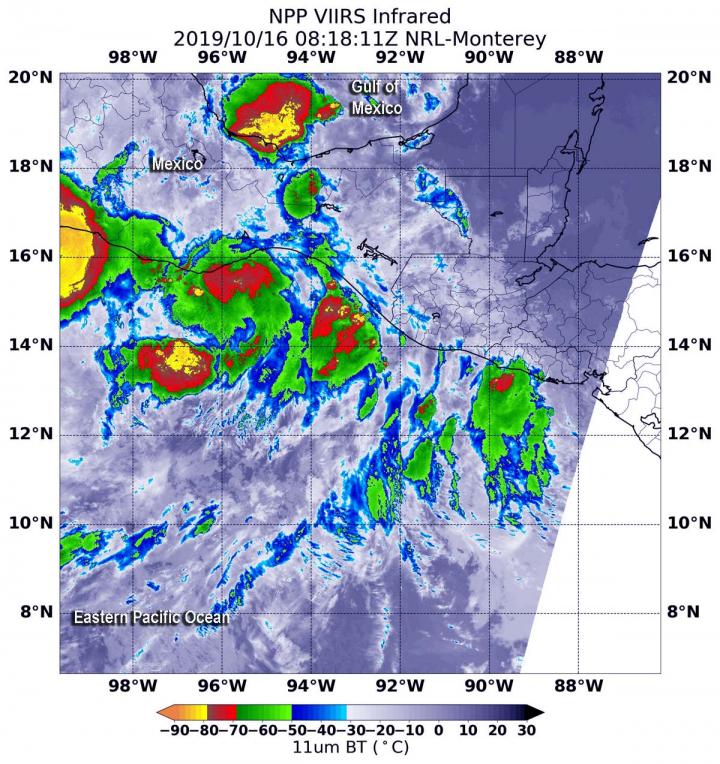
NASA-NOAA’s Suomi NPP satellite passed over Mexico and found two small areas of very strong thunderstorms near two different coastlines. One area was in Potential Tropical Cyclone 17E in the Eastern Pacific Ocean and the other was for another system developing in the western Gulf of Mexico.

Potential Tropical Cyclone Seventeen-E developed around 11 p.m. EDT on Oct. 15 and by 11 a.m. EDT on Oct. 16, the center of circulation made landfall over the Mexican state of Oaxaca.

The Visible Infrared Imaging Radiometer Suite (VIIRS) instrument aboard Suomi NPP provided an infrared image of the storm. Infrared imagery reveals cloud top temperatures, and the higher the cloud top, the colder it is, and as such the stronger the storm. On Oct. 16 at 4:18 a.m. EDT (0818 UTC), an infrared VIIRS image showed two small areas around southern Mexico where cloud top temperatures were as cold as minus 80 degrees Fahrenheit (minus 62.2 Celsius). One area, located in the Eastern Pacific Ocean is associated with Potential Tropical Cyclone 17E. Both areas with strongest storms were over water. One in the Eastern Pacific and the other in the western Gulf of Mexico. Storms with cloud tops that cold have been found to generate heavy rainfall.

Potential Tropical Cyclone 17E

At 2 p.m. EDT (1800 UTC), the disturbance was centered near latitude 16.6 degrees north and longitude 96.6 degrees west. That is about 95 miles (155 km) west-northwest of Salina Cruz, Mexico. The system is moving toward the northwest near 14 mph (22 kph), and this motion is expected to continue through tonight. Maximum sustained winds were near 30 mph (45 kph) with higher gusts.

NOAA’s National Hurricane Center or NHC said, “The disturbance is now unlikely to bring tropical-storm conditions to the coast of Mexico, although the rainfall threat continues for portions of southeastern Mexico.”

While the chances that the disturbance will become a tropical cyclone are decreasing, the NHC forecasters said there is still a small chance that a tropical depression could develop if the center can re-form along the coast later today or tonight.

The Gulf of Mexico Low Pressure Area

The other area of strong storms seen on the Suomi NPP infrared image area is associated with a large area low pressure located just offshore of the coast of southern Mexico, in the Bay of Campeche. That low pressure area is producing disorganized showers and thunderstorms. NHC said that gradual development is possible, and a tropical or subtropical cyclone could form late this week over the western or central Gulf of Mexico while the system is moving generally northeastward. Regardless of development, this system could produce gusty winds, rainfall, and rough surf along portions of the northern Gulf Coast Friday and Saturday.

Hurricanes are the most powerful weather event on Earth. NASA’s expertise in space and scientific exploration contributes to essential services provided to the American people by other federal agencies, such as hurricane weather forecasting.

For updated forecasts. Visit: http://www.nhc.noaa.gov

###

Media Contact
Rob Gutro
[email protected]

Original Source

https://blogs.nasa.gov/hurricanes/2019/10/16/17e-eastern-pacific-ocean/

Tags: Atmospheric ChemistryAtmospheric ScienceClimate ChangeClimate ScienceEarth ScienceMeteorologyTechnology/Engineering/Computer ScienceTemperature-Dependent PhenomenaWeather/Storms
Share12Tweet8Share2ShareShareShare2

Related Posts

Evaluating Pediatric Emergency Care Quality in Ethiopia

February 7, 2026

TPMT Expression Predictions Linked to Azathioprine Side Effects

February 7, 2026

Improving Dementia Care with Enhanced Activity Kits

February 7, 2026

Decoding Prostate Cancer Origins via snFLARE-seq, mxFRIZNGRND

February 7, 2026
Please login to join discussion

POPULAR NEWS

  • Robotic Ureteral Reconstruction: A Novel Approach

    Robotic Ureteral Reconstruction: A Novel Approach

    82 shares
    Share 33 Tweet 21
  • Digital Privacy: Health Data Control in Incarceration

    63 shares
    Share 25 Tweet 16
  • Study Reveals Lipid Accumulation in ME/CFS Cells

    57 shares
    Share 23 Tweet 14
  • Breakthrough in RNA Research Accelerates Medical Innovations Timeline

    53 shares
    Share 21 Tweet 13

About

We bring you the latest biotechnology news from best research centers and universities around the world. Check our website.

Follow us

Recent News

Evaluating Pediatric Emergency Care Quality in Ethiopia

TPMT Expression Predictions Linked to Azathioprine Side Effects

Improving Dementia Care with Enhanced Activity Kits

Subscribe to Blog via Email

Success! An email was just sent to confirm your subscription. Please find the email now and click 'Confirm' to start subscribing.

Join 73 other subscribers
  • Contact Us

Bioengineer.org © Copyright 2023 All Rights Reserved.

Welcome Back!

Login to your account below

Forgotten Password?

Retrieve your password

Please enter your username or email address to reset your password.

Log In
No Result
View All Result
  • Homepages
    • Home Page 1
    • Home Page 2
  • News
  • National
  • Business
  • Health
  • Lifestyle
  • Science

Bioengineer.org © Copyright 2023 All Rights Reserved.