• HOME
  • NEWS
  • EXPLORE
    • CAREER
      • Companies
      • Jobs
    • EVENTS
    • iGEM
      • News
      • Team
    • PHOTOS
    • VIDEO
    • WIKI
  • BLOG
  • COMMUNITY
    • FACEBOOK
    • INSTAGRAM
    • TWITTER
Saturday, February 7, 2026
BIOENGINEER.ORG
No Result
View All Result
  • Login
  • HOME
  • NEWS
  • EXPLORE
    • CAREER
      • Companies
      • Jobs
        • Lecturer
        • PhD Studentship
        • Postdoc
        • Research Assistant
    • EVENTS
    • iGEM
      • News
      • Team
    • PHOTOS
    • VIDEO
    • WIKI
  • BLOG
  • COMMUNITY
    • FACEBOOK
    • INSTAGRAM
    • TWITTER
  • HOME
  • NEWS
  • EXPLORE
    • CAREER
      • Companies
      • Jobs
        • Lecturer
        • PhD Studentship
        • Postdoc
        • Research Assistant
    • EVENTS
    • iGEM
      • News
      • Team
    • PHOTOS
    • VIDEO
    • WIKI
  • BLOG
  • COMMUNITY
    • FACEBOOK
    • INSTAGRAM
    • TWITTER
No Result
View All Result
Bioengineer.org
No Result
View All Result
Home NEWS Science News Biology

How hunger makes food tastier: a neural circuit in the hypothalamus

Bioengineer by Bioengineer
October 16, 2019
in Biology
Reading Time: 2 mins read
0
IMAGE
Share on FacebookShare on TwitterShare on LinkedinShare on RedditShare on Telegram

Researchers at the National Institute for Physiological Sciences in Okazaki identify the neural pathways that cause hunger-induced increases in the preference for sweet foods and the decreased sensitivity to aversive tastes in mice
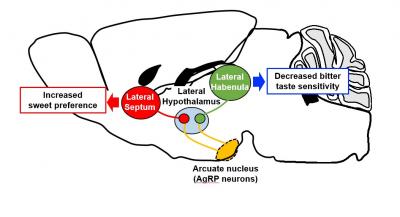
IMAGE

Credit: Ken-ichiro Nakajima

Okazaki, Japan – Why does everything taste better when we’re hungry? According to new findings from the National Institute for Physiological Sciences in Japan, not only does food taste sweeter when our stomachs are rumbling, but bitter food also becomes less difficult to eat–and both effects are moderated by a neural circuit in the hypothalamus.

Generally, we prefer sweet tastes because they signal calorie-rich food, and avoid bitter and sour tastes because they signal spoiled food. However, these preferences are modified by internal states such as hunger. In a study published in Nature Communications last week, researchers found that starved mice had a greater preference for sweetness and a decreased sensitivity to aversive tastes. The research team focused on Agouti-related peptide (AgRP)-expressing neurons, which are known to be activated during hunger states to trigger feeding behavior, and identified two neural pathways that underlie hunger-induced changes in taste preferences.

“AgRP-expressing neurons are found in the hypothalamus, which is a brain region that plays a vital role in appetite regulation,” says first author Ou Fu. “We selectively activated these AgRP-expressing neurons in mice using chemogenetic and optogenetic techniques to see whether they influence the perception of tastes observed under fasting conditions.”

Optogenetic and chemogenetic techniques are popular methods for studying neuronal activity because they can manipulate neural activity very precisely. Optogenetics introduces light-sensitive agents into target neurons, whose activity can then be manipulated by light, and chemogenetics introduces designer receptors to affect the target neurons’ activity by their specific synthetic ligands.

After AgRP-expressing neuron activation, downstream glutamate neurons in the lateral hypothalamus in turn modulated mice’s taste preferences via two different pathways. Glutamate neurons projecting to the lateral septum increased the preference for sweet tastes, and those projecting to the lateral habenula decreased the sensitivity to bitter tastes.

“The next steps will be to investigate whether these hypothalamic neuronal pathways are altered in pathophysiological conditions such as diabetes and obesity,” says Yasuhiko Minokoshi, co-author of the study. “For example, we already know that people with obesity have a strong preference for sweetness; this might be associated with a change in the activity of the glutamate neurons projecting to the lateral septum.”

These new findings could therefore provide the groundwork for the future development of methods to control taste preferences, which would have significant health benefits. However, much work remains to be done before this becomes a reality.

###

Media Contact
Ken-ichiro Nakajima
[email protected]
81-564-557-742

Related Journal Article

http://dx.doi.org/10.1038/s41467-019-12478-x

Tags: AgricultureCell BiologyDiet/Body WeightFood/Food ScienceMedicine/HealthneurobiologyOlfactory/TastePhysiology
Share12Tweet8Share2ShareShareShare2

Related Posts

Florida Cane Toad: Complex Spread and Selective Evolution

Florida Cane Toad: Complex Spread and Selective Evolution

February 7, 2026
New Study Uncovers Mechanism Behind Burn Pit Particulate Matter–Induced Lung Inflammation

New Study Uncovers Mechanism Behind Burn Pit Particulate Matter–Induced Lung Inflammation

February 6, 2026

DeepBlastoid: Advancing Automated and Efficient Evaluation of Human Blastoids with Deep Learning

February 6, 2026

Navigating the Gut: The Role of Formic Acid in the Microbiome

February 6, 2026
Please login to join discussion

POPULAR NEWS

  • Robotic Ureteral Reconstruction: A Novel Approach

    Robotic Ureteral Reconstruction: A Novel Approach

    82 shares
    Share 33 Tweet 21
  • Digital Privacy: Health Data Control in Incarceration

    63 shares
    Share 25 Tweet 16
  • Study Reveals Lipid Accumulation in ME/CFS Cells

    57 shares
    Share 23 Tweet 14
  • Breakthrough in RNA Research Accelerates Medical Innovations Timeline

    53 shares
    Share 21 Tweet 13

About

We bring you the latest biotechnology news from best research centers and universities around the world. Check our website.

Follow us

Recent News

Florida Cane Toad: Complex Spread and Selective Evolution

Exploring Decision-Making in Dementia Caregivers’ Mobility

Succinate Receptor 1 Limits Blood Cell Formation, Leukemia

Subscribe to Blog via Email

Enter your email address to subscribe to this blog and receive notifications of new posts by email.

Join 73 other subscribers
  • Contact Us

Bioengineer.org © Copyright 2023 All Rights Reserved.

Welcome Back!

Login to your account below

Forgotten Password?

Retrieve your password

Please enter your username or email address to reset your password.

Log In
No Result
View All Result
  • Homepages
    • Home Page 1
    • Home Page 2
  • News
  • National
  • Business
  • Health
  • Lifestyle
  • Science

Bioengineer.org © Copyright 2023 All Rights Reserved.