• HOME
  • NEWS
  • EXPLORE
    • CAREER
      • Companies
      • Jobs
    • EVENTS
    • iGEM
      • News
      • Team
    • PHOTOS
    • VIDEO
    • WIKI
  • BLOG
  • COMMUNITY
    • FACEBOOK
    • INSTAGRAM
    • TWITTER
Sunday, March 29, 2026
BIOENGINEER.ORG
No Result
View All Result
  • Login
  • HOME
  • NEWS
  • EXPLORE
    • CAREER
      • Companies
      • Jobs
        • Lecturer
        • PhD Studentship
        • Postdoc
        • Research Assistant
    • EVENTS
    • iGEM
      • News
      • Team
    • PHOTOS
    • VIDEO
    • WIKI
  • BLOG
  • COMMUNITY
    • FACEBOOK
    • INSTAGRAM
    • TWITTER
  • HOME
  • NEWS
  • EXPLORE
    • CAREER
      • Companies
      • Jobs
        • Lecturer
        • PhD Studentship
        • Postdoc
        • Research Assistant
    • EVENTS
    • iGEM
      • News
      • Team
    • PHOTOS
    • VIDEO
    • WIKI
  • BLOG
  • COMMUNITY
    • FACEBOOK
    • INSTAGRAM
    • TWITTER
No Result
View All Result
Bioengineer.org
No Result
View All Result
Home NEWS Science News Chemistry

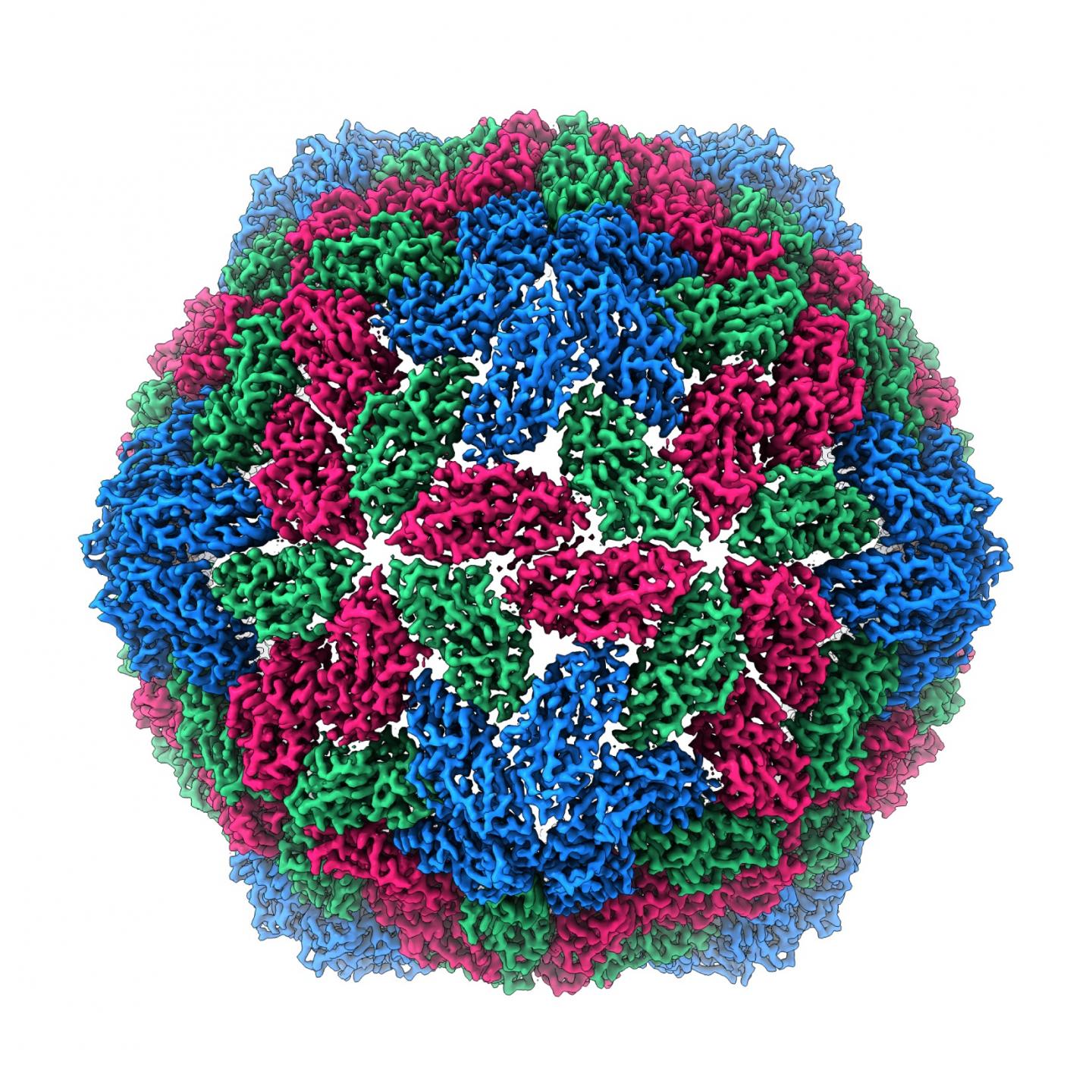
Family of crop viruses revealed at high resolution for the first time

Bioengineer by Bioengineer
October 11, 2019
in Chemistry
Reading Time: 2 mins read
0
IMAGE
Share on FacebookShare on TwitterShare on LinkedinShare on RedditShare on Telegram

IMAGE

Credit: Univeristy of Leeds


For the first-time we can take a molecular-level look at one of the world’s deadliest crop killers.

The Luteoviridae are pathogenic plant viruses responsible for major crop losses worldwide. Transmitted by aphids, the viruses infect a wide range of food crops including cereals, legumes, cucurbits, sugar beet, sugarcane and potato.

Until now researchers have been unable to generate the quantities of these viruses needed to study their structures in high resolution.

Now a team of researchers have used recent advances in plant expression technology to generate sufficient quantities of the pathogen to allow more detailed scrutiny with state of the art microscopy techniques.

The method involves infiltrating a type of tobacco plant with the genes necessary to create virus-like particles (VLPs). From the inserted genetic information, the VLPs self-assemble inside the plant host. This technique avoids the need to handle the infectious virus.

Using the VLPs extracted from the plants the team from the John Innes Centre and the Astbury Biostructure Laboratory at the University of Leeds could observe the viral structures to high resolution by cryo-electron microscopy.

This provided, for the first time, a molecular-level insight into how the luteovirid capsid forms and suggests how it is transmitted by aphids. The method may help unlock the secrets of other viruses, say the team involved in the study.

Professor George Lomonossoff of the John Innes Centre says. “This development provides a platform for the development of diagnostic tools for this important family of plant viruses that cause enormous loses worldwide.”

Professor Neil Ranson from the University of Leeds adds: “The combination of plant expression technology and structural biology is hugely exciting, and we can use it to understand the structures of many other types of virus.”

Plant virus infection is responsible for global economic losses estimated at $30billion.

The Luteoviridae attack the plant vasculature which causes severe stunting leading to crop loss. The family includes barley yellow dwarf virus and potato leafroll virus which cause crop losses to a value of £40-60m per year in the United Kingdom.

###

The full study ‘Combining Transient Expression and Cryo-EM to Obtain High-Resolution Structures of Luteovirid Particles’ appears in the Cell Press journal Structure.

Media Contact
Adrian Galvin
[email protected]
01-603-450-238

Tags: Agricultural Production/EconomicsBiologyBiomechanics/BiophysicsBiotechnologyFertilizers/Pest ManagementGenesMicrobiologyMolecular BiologyVirology
Share13Tweet8Share2ShareShareShare2

Related Posts

Isolated H2-Reduced Clusters Boost CO2-to-Methanol Catalysis

Isolated H2-Reduced Clusters Boost CO2-to-Methanol Catalysis

March 25, 2026
blank

Physicists Identify Electronic Drivers Behind Flat Band Quantum Materials

March 21, 2026

Würzburg Chemistry Professor Claudia Höbartner Receives Prestigious Honor

March 20, 2026

Scientists Reveal How Magnets Control Metamaterial Behavior

March 20, 2026
Please login to join discussion

POPULAR NEWS

  • blank

    Revolutionary AI Model Enhances Precision in Detecting Food Contamination

    96 shares
    Share 38 Tweet 24
  • Imagine a Social Media Feed That Challenges Your Views Instead of Reinforcing Them

    1004 shares
    Share 397 Tweet 248
  • Uncovering Functions of Cavernous Malformation Proteins in Organoids

    54 shares
    Share 22 Tweet 14
  • Promising Outcomes from First Clinical Trials of Gene Regulation in Epilepsy

    51 shares
    Share 20 Tweet 13

About

We bring you the latest biotechnology news from best research centers and universities around the world. Check our website.

Follow us

Recent News

In-Sensor Cryptography Links Physical Process to Digital Identity

Can Psychosocial Factors Influence Cancer Risk?

Depression Factors in Elderly: Pre vs. Post-COVID Analysis

Subscribe to Blog via Email

Enter your email address to subscribe to this blog and receive notifications of new posts by email.

Join 78 other subscribers
  • Contact Us

Bioengineer.org © Copyright 2023 All Rights Reserved.

Welcome Back!

Login to your account below

Forgotten Password?

Retrieve your password

Please enter your username or email address to reset your password.

Log In
No Result
View All Result
  • Homepages
    • Home Page 1
    • Home Page 2
  • News
  • National
  • Business
  • Health
  • Lifestyle
  • Science

Bioengineer.org © Copyright 2023 All Rights Reserved.