• HOME
  • NEWS
  • EXPLORE
    • CAREER
      • Companies
      • Jobs
    • EVENTS
    • iGEM
      • News
      • Team
    • PHOTOS
    • VIDEO
    • WIKI
  • BLOG
  • COMMUNITY
    • FACEBOOK
    • INSTAGRAM
    • TWITTER
Saturday, February 7, 2026
BIOENGINEER.ORG
No Result
View All Result
  • Login
  • HOME
  • NEWS
  • EXPLORE
    • CAREER
      • Companies
      • Jobs
        • Lecturer
        • PhD Studentship
        • Postdoc
        • Research Assistant
    • EVENTS
    • iGEM
      • News
      • Team
    • PHOTOS
    • VIDEO
    • WIKI
  • BLOG
  • COMMUNITY
    • FACEBOOK
    • INSTAGRAM
    • TWITTER
  • HOME
  • NEWS
  • EXPLORE
    • CAREER
      • Companies
      • Jobs
        • Lecturer
        • PhD Studentship
        • Postdoc
        • Research Assistant
    • EVENTS
    • iGEM
      • News
      • Team
    • PHOTOS
    • VIDEO
    • WIKI
  • BLOG
  • COMMUNITY
    • FACEBOOK
    • INSTAGRAM
    • TWITTER
No Result
View All Result
Bioengineer.org
No Result
View All Result
Home NEWS Science News Biology

Why are there no animals with three legs?

Bioengineer by Bioengineer
October 2, 2019
in Biology
Reading Time: 3 mins read
0
IMAGE
Share on FacebookShare on TwitterShare on LinkedinShare on RedditShare on Telegram

IMAGE

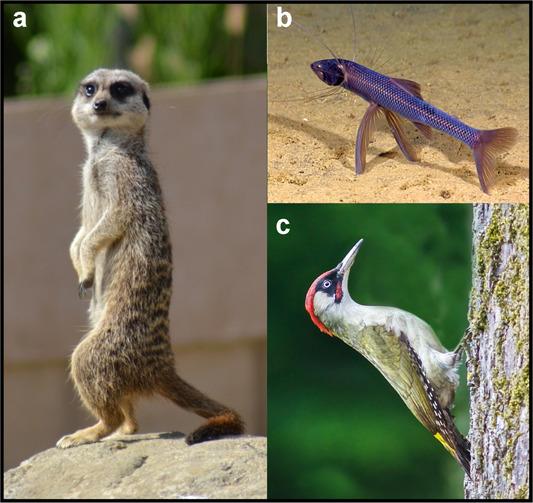
Credit: Tracy J. Thomson in BioEssays

If “Why?” is the first question in science, “Why not?” must be a close second. Sometimes it’s worth thinking about why something does not exist.

Such as a truly three-legged animal. Tracy Thomson, graduate student in the UC Davis Department of Earth and Planetary Sciences, has been pondering the non-existence of tripeds. He recently published an essay on it, “Three-Legged Locomotion and the Constraints on Limb Number: Why Tripeds Don’t Have a Leg to Stand On” in BioEssays.

Thomson got the idea after taking a graduate class on evolution with UC Davis paleontologist Geerat Vermeij, who challenged the students to come up with a “forbidden phenotype:” an animal or plant that does not and cannot exist.

Thomson points out that there are lots of animals that use a tripod stance to rest. Meerkats in an upright stance rest on their tail and rear feet; woodpeckers use tail feathers to brace themselves against a tree-trunk.

A tripod stance does not require any energy to be stable, Thomson noted. Unlike, for example, standing upright on two feet, which does require some muscle work as well as relatively large feet.

Three-limbed movement is less common. Insects, which of course have six legs, have a mode of movement where their legs move in sets of three: two legs on one side and one on the opposite side are on the ground, with the opposite legs moving, at any time. This is called the “alternating tripod” gait.

Gripping tails and beaks

Many tree-dwelling animals use their tails for additional gripping, although they may be moving with all four of their limbs as well. Parrots are quite tripedal, using their strong, flexible beak as an additional grip to maneuver in tree branches.

Long rear feet make it difficult for kangaroos to “walk” like other mammals. Instead, they use their strong tail and front limbs to push the rear feet off the ground and forwards while grazing.

Given that three-limbed movement does seems to work for some animals, why are there no animals with three legs? That might go back a long, long way, Thomson said.

“Almost all animals are bilateral,” he said. The code for having two sides to everything seems to have got embedded in our DNA very early in the evolution of life – perhaps before appendages like legs, fins or flippers even evolved. Once that trait for bilateral symmetry was baked in, it was hard to change.

With our built-in bias to two-handedness, it can be hard to figure out how a truly three-legged animal would work – although that has not stopped science fiction writers from imagining them. Perhaps trilateral life has evolved on Enceladus or Alpha Centauri (or Mars!) and has as much difficulty thinking about two-limbed locomotion as we do thinking about three.

This kind of thought experiment is useful for developing our ideas about evolution, Thomson said.

“If we’re trying to understand evolution as a process we need to understand what it can and can’t do,” he said.

###

Media Contact
Andy Fell
[email protected]

Original Source

https://egghead.ucdavis.edu/2019/10/01/why-not-three-legs/

Related Journal Article

http://dx.doi.org/10.1002/bies.201900061

Tags: BiologyBiomechanics/BiophysicsEvolutionPaleontologyZoology/Veterinary Science
Share15Tweet10Share3ShareShareShare2

Related Posts

Florida Cane Toad: Complex Spread and Selective Evolution

Florida Cane Toad: Complex Spread and Selective Evolution

February 7, 2026
New Study Uncovers Mechanism Behind Burn Pit Particulate Matter–Induced Lung Inflammation

New Study Uncovers Mechanism Behind Burn Pit Particulate Matter–Induced Lung Inflammation

February 6, 2026

DeepBlastoid: Advancing Automated and Efficient Evaluation of Human Blastoids with Deep Learning

February 6, 2026

Navigating the Gut: The Role of Formic Acid in the Microbiome

February 6, 2026
Please login to join discussion

POPULAR NEWS

  • Robotic Ureteral Reconstruction: A Novel Approach

    Robotic Ureteral Reconstruction: A Novel Approach

    82 shares
    Share 33 Tweet 21
  • Digital Privacy: Health Data Control in Incarceration

    63 shares
    Share 25 Tweet 16
  • Study Reveals Lipid Accumulation in ME/CFS Cells

    57 shares
    Share 23 Tweet 14
  • Breakthrough in RNA Research Accelerates Medical Innovations Timeline

    53 shares
    Share 21 Tweet 13

About

We bring you the latest biotechnology news from best research centers and universities around the world. Check our website.

Follow us

Recent News

Barriers and Boosters of Seniors’ Physical Activity in Karachi

Evaluating Pediatric Emergency Care Quality in Ethiopia

TPMT Expression Predictions Linked to Azathioprine Side Effects

Subscribe to Blog via Email

Enter your email address to subscribe to this blog and receive notifications of new posts by email.

Join 73 other subscribers
  • Contact Us

Bioengineer.org © Copyright 2023 All Rights Reserved.

Welcome Back!

Login to your account below

Forgotten Password?

Retrieve your password

Please enter your username or email address to reset your password.

Log In
No Result
View All Result
  • Homepages
    • Home Page 1
    • Home Page 2
  • News
  • National
  • Business
  • Health
  • Lifestyle
  • Science

Bioengineer.org © Copyright 2023 All Rights Reserved.