Credit: Matthew Sasaki
It’s common knowledge that, through the process of natural selection, organisms adapt to their environments. But what happens when there are no barriers to gene flow and organisms are free-floating between extremely variable environmental conditions?
A new study by UConn researchers seeks to tease out some of the myriad pressures that drive adaptation in small, widely dispersed marine animals called copepods — small crustaceans found in nearly every freshwater and saltwater habitat — to understand how these animals may cope with an increasingly warming climate.
“We often assume that species adapt in fairly predictable patterns,” says Matthew Sasaki a doctoral student in the UConn’s Department of Marine Sciences, who is based in the lab of Professor Hans Dam. “However, what we know about these patterns is mainly from animals living on land rather than animals living in ocean currents.”
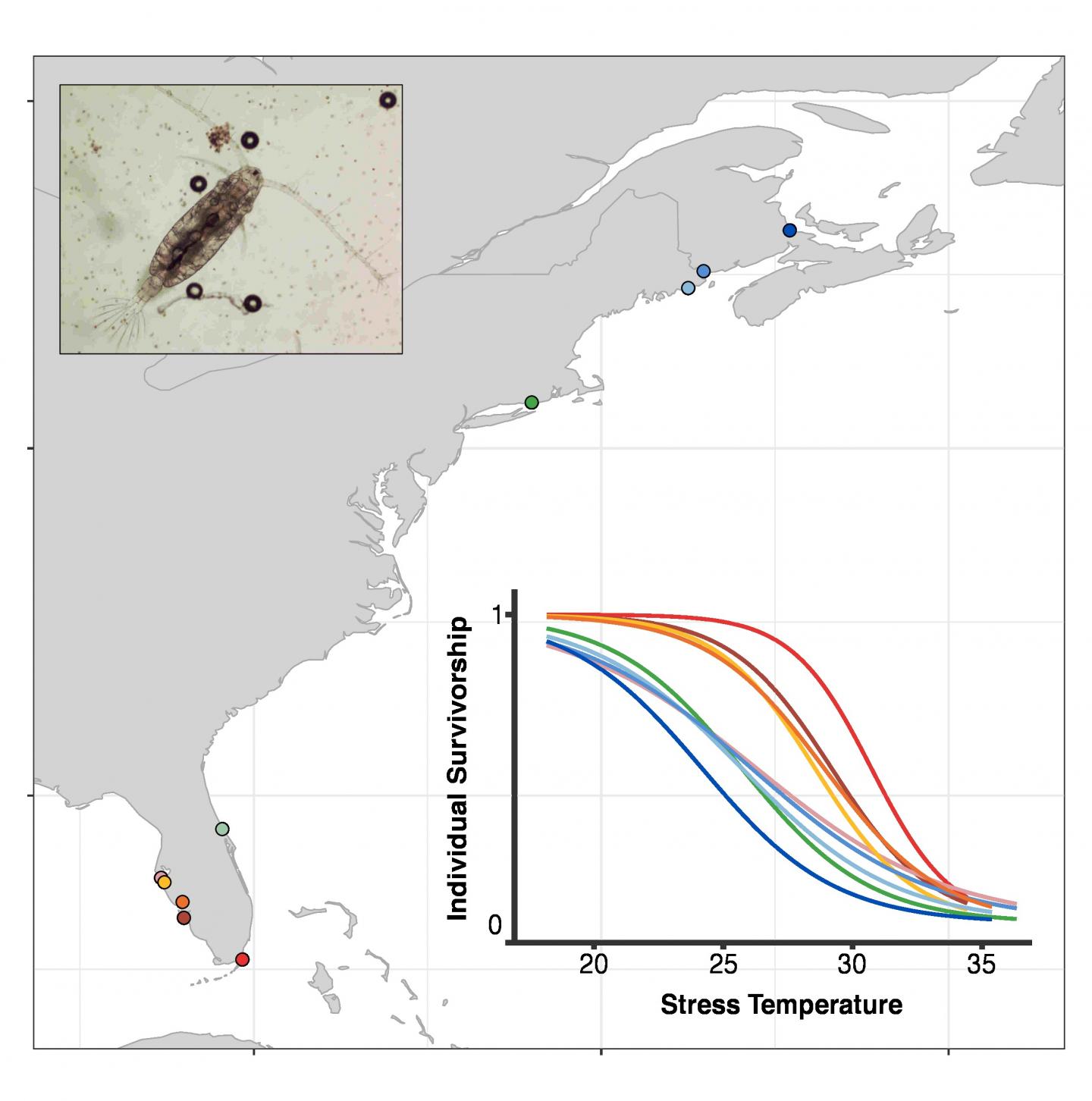
Sample range of copepods studied. (Matthew Sasaki/Submitted Illustration)
Based on what we know about organisms on land, the expectation is that populations of copepods in warmer environments, like Florida, would be more resistant to higher temperatures whereas populations in colder environments like Canada would have lower thermal tolerance.
To test if this hypothesis held true in the marine environment, the researchers collected copepods from sites spanning over 20 degrees of latitude, from Northern New Brunswick, Canada to the Florida Keys.
Sasaki sampled genetic information from the organisms as they were collected to analyze how connected the populations were. He also took live copepods back to the laboratory to be reared under controlled conditions to test thermal tolerance.
The findings did not show a lot of local genetic adaptation. “Despite the fact the sample locations are thousands of miles apart, and you would expect local adaptations, that is not what we saw for most cases,” says Dam.
Across most of the sampled range, there were no real differences in thermal tolerance between populations even when populations were separated by more than 1,000 kilometers.
But, another way organisms can cope with environmental change is phenotypic plasticity, which is the ability of organisms to respond without genetic change. The researchers showed that plasticity is extremely important in copepods.
Some populations in colder waters had higher plasticity — a better ability to respond to environmental change — than some populations in the warmest waters.
The researchers write that this plasticity may reduce vulnerability to extreme temperature changes, such as those seen with heatwaves, but only to a point. As overall ocean temperatures increase, the likelihood for extreme weather events like heatwaves also increases, which may push marine ecosystems to their limits.
Fortunately this research suggests that the wide distribution of thermal plasticity and gene flow means thermal adaptation can happen relatively quickly, reducing organisms’ vulnerability to warming.
Small, Yet Mighty
Though tiny, copepods are the most abundant animals in the ocean and perhaps on the planet, says Dam, and they play a vital role in the marine food web and the cycling of nutrients within the ecosystem.
Copepods eat phytoplankton, which are extremely small, single-celled organisms at the base of the food web. In order for the energy contained in phytoplankton to get passed up the food chain to larger animals like fish or whales, it needs to pass through copepods.
Beyond the role copepods play in the food web, Sasaki says they are also a vital component of the ocean’s carbon cycle. With torpedo-shaped fecal pellets, the carbon contained in their droppings is able to sink to great depths within the marine environment where it remains sequestered and out of the atmosphere for long periods of time.
Given the vital role of copepods in the overall health of the ocean, significant changes in population size will have ramifications.
“By virtue of their sheer numbers they are bound to have large effects on carbon transfer from the upper levels of the ocean as well as from removing carbon from the surface waters and transporting to the deep ocean,” says Dam.
But, climate changes may also be favorable in some cases. “It all depends on where a particular population is located and if or how well they are locally adapted,” says Dam.
“In terrestrial environments, there are geographic boundaries between populations whereas in the ocean there is a constant mixing and exchange. The beauty of this paper is that it shows evidence of how that exchange constrains the ability of populations to adapt locally.”
###
Media Contact
Elaina Hancock
[email protected]
Original Source
https:/
Related Journal Article
http://dx.