• HOME
  • NEWS
  • EXPLORE
    • CAREER
      • Companies
      • Jobs
    • EVENTS
    • iGEM
      • News
      • Team
    • PHOTOS
    • VIDEO
    • WIKI
  • BLOG
  • COMMUNITY
    • FACEBOOK
    • INSTAGRAM
    • TWITTER
Thursday, May 14, 2026
BIOENGINEER.ORG
No Result
View All Result
  • Login
  • HOME
  • NEWS
  • EXPLORE
    • CAREER
      • Companies
      • Jobs
        • Lecturer
        • PhD Studentship
        • Postdoc
        • Research Assistant
    • EVENTS
    • iGEM
      • News
      • Team
    • PHOTOS
    • VIDEO
    • WIKI
  • BLOG
  • COMMUNITY
    • FACEBOOK
    • INSTAGRAM
    • TWITTER
  • HOME
  • NEWS
  • EXPLORE
    • CAREER
      • Companies
      • Jobs
        • Lecturer
        • PhD Studentship
        • Postdoc
        • Research Assistant
    • EVENTS
    • iGEM
      • News
      • Team
    • PHOTOS
    • VIDEO
    • WIKI
  • BLOG
  • COMMUNITY
    • FACEBOOK
    • INSTAGRAM
    • TWITTER
No Result
View All Result
Bioengineer.org
No Result
View All Result
Home NEWS Science News

NASA finds heavy rain potential in Tropical Storm Hikaa

Bioengineer by Bioengineer
September 23, 2019
in Science News
Reading Time: 2 mins read
0
IMAGE
Share on FacebookShare on TwitterShare on LinkedinShare on RedditShare on Telegram

IMAGE

Credit: Credit: NASA JPL/Heidar Thrastarson

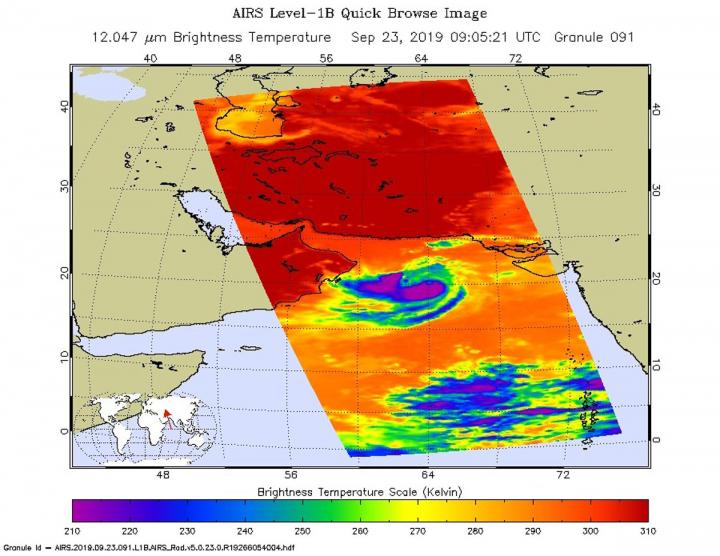
The Northern Indian Ocean has generated a new tropical cyclone. NASA provided an infrared look a recently formed Tropical Storm Hikaa, moving through the Arabian Sea.

One of the ways NASA researches tropical cyclones is by using infrared data that provides temperature information. The AIRS instrument aboard NASA’s Aqua satellite captured a look at those temperatures in Hikaa and gave insight into the storm’s rainfall potential. Cloud top temperatures provide information to forecasters about where the strongest storms are located within a tropical cyclone. Tropical cyclones do not always have uniform strength, and some sides have stronger sides than others. The stronger the storms, the higher they extend into the troposphere, and the colder the cloud temperatures are.

NASA provides data to forecasters around the world so they can incorporate that data into their forecasting.

On Sept. 23 at 4:05 a.m. EDT (0905 UTC) NASA’s Aqua satellite analyzed the storm using the Atmospheric Infrared Sounder or AIRS instrument. AIRS found coldest cloud top temperatures as cold as or colder than minus 63 degrees Fahrenheit (minus 53 degrees Celsius) from west to south around Hikaa’s center. NASA research has shown that cloud top temperatures that cold indicate strong storms that have the capability to create heavy rain.

At 11 a.m. EDT (1500 UTC), The Joint Typhoon Warning Center said the center of Tropical Hikaa was located near latitude 20.2 degrees north and longitude 65.5 degrees east. It is located about 265 miles east of Masirah Island, Oman. The tropical storm was moving toward the west. Maximum sustained winds are near 60 knots (69 mph/111 kph) with higher gusts.

Hikaa will strengthen slightly before making landfall in Oman after a day or so.

The AIRS instrument is one of six instruments flying onboard NASA’s Aqua satellite, launched on May 4, 2002.

Hurricanes are the most powerful weather event on Earth. NASA’s expertise in space and scientific exploration contributes to essential services provided to the American people by other federal agencies, such as hurricane weather forecasting.

###

Media Contact
Rob Gutro
[email protected]

Original Source

https://blogs.nasa.gov/hurricanes/2019/09/23/hikaa-northern-indian-ocean/

Tags: Atmospheric ChemistryAtmospheric ScienceClimate ChangeClimate ScienceEarth ScienceMeteorologyTechnology/Engineering/Computer ScienceTemperature-Dependent PhenomenaWeather/Storms
Share12Tweet8Share2ShareShareShare2

Related Posts

CU Anschutz School of Medicine Launches Innovative 3-Year MD Program to Combat Physician Shortages and Reduce Training Costs

May 14, 2026
Call for Submissions: JMIR Biomedical Engineering Explores “Sex and Gender in Biomedical Engineering: Advancing Equity in Workforce and Modeling” — Technology and Engineering

Call for Submissions: JMIR Biomedical Engineering Explores “Sex and Gender in Biomedical Engineering: Advancing Equity in Workforce and Modeling”

May 14, 2026

Expanding Proton Therapy Access: Five New Centres Planned Across Romania, Greece, Italy, Northern Ireland, and Poland to Serve Patients Europe-Wide

May 14, 2026

Rare Case of Extraluminal Esophageal Cancer Invading Spine Detected Despite Normal Endoscopy

May 14, 2026
Please login to join discussion

POPULAR NEWS

  • Research Indicates Potential Connection Between Prenatal Medication Exposure and Elevated Autism Risk

    842 shares
    Share 337 Tweet 211
  • New Study Reveals Plants Can Detect the Sound of Rain

    729 shares
    Share 291 Tweet 182
  • Salmonella Haem Blocks Macrophages, Boosts Infection

    62 shares
    Share 25 Tweet 16
  • Breastmilk Balances E. coli and Beneficial Bacteria in Infant Gut Microbiomes

    58 shares
    Share 23 Tweet 15

About

We bring you the latest biotechnology news from best research centers and universities around the world. Check our website.

Follow us

Recent News

CU Anschutz School of Medicine Launches Innovative 3-Year MD Program to Combat Physician Shortages and Reduce Training Costs

Call for Submissions: JMIR Biomedical Engineering Explores “Sex and Gender in Biomedical Engineering: Advancing Equity in Workforce and Modeling”

Expanding Proton Therapy Access: Five New Centres Planned Across Romania, Greece, Italy, Northern Ireland, and Poland to Serve Patients Europe-Wide

Subscribe to Blog via Email

Enter your email address to subscribe to this blog and receive notifications of new posts by email.

Join 82 other subscribers
  • Contact Us

Bioengineer.org © Copyright 2023 All Rights Reserved.

Welcome Back!

Login to your account below

Forgotten Password?

Retrieve your password

Please enter your username or email address to reset your password.

Log In
No Result
View All Result
  • Homepages
    • Home Page 1
    • Home Page 2
  • News
  • National
  • Business
  • Health
  • Lifestyle
  • Science

Bioengineer.org © Copyright 2023 All Rights Reserved.