When functional ability declines, changing the way of walking can facilitate older adults’ outdoor mobility
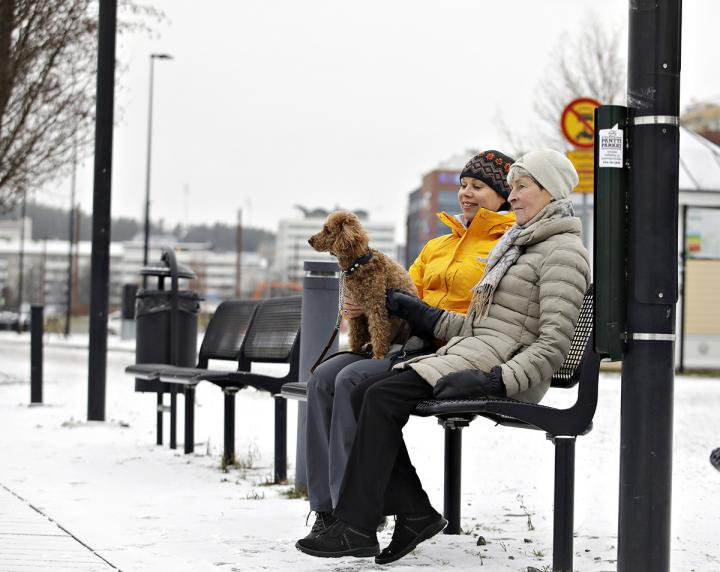
Credit: Petteri Kivimäki / University of Jyväskylä
When functional ability declines, changing the way of walking by, for instance, walking slower, pausing for rest or using walking aids, can facilitate older adults’ outdoor mobility. These were the findings of a study conducted at the Faculty of Sport and Health Sciences, University of Jyväskylä.
As functional ability declines, older people may start to have difficulties in walking long distances. At this point, older people might change their way of walking consciously or unconsciously.
“Changes may be seen, for instance, in lowering walking speed, pausing walking for rest or even in avoiding long walking distances altogether. These early changes in walking are called walking modifications,” doctoral student Heidi Skantz explains.
Previous research on walking modifications has implicitly considered modifications as an early sign of functional decline and such modifications have been shown to predict walking difficulties in the future. This previous research, however, has emphasized mainly the negative side of the use of walking modifications. We think that the potential positive, enabling, effects of walking modifications should also be considered.
“We wanted to find out if some of these changes in walking would be beneficial in maintaining outdoor mobility,” Skantz says.
Using walking aids, lowered walking speed and pausing for rest were categorized as adaptive walking modifications, since they were considered to reduce the task demand, whereas reduced frequency of walking and avoiding long walking distances were categorized as maladaptive modifications. This categorization was shown to be meaningful.
“Those older people who used maladaptive walking modifications had smaller life-space mobility and they perceived that they lacked possibilities for outdoor mobility,” Skantz says. “As for those older people who had chosen to utilise adaptive walking modifications, they were able to maintain wider life-space mobility and they were also satisfied with their outdoor mobility opportunities.”
As functional ability declines, walking long distances might become a harder and scarier task than before. In such a case, it still remains important to continue covering long distances by walking, even if with walking aids or by pausing walking, in order to maintain outdoor mobility.
“Encouraging older people to opt for adaptive walking modifications might be possible by designing age-friendly environments, for instance by providing opportunities to rest when walking outdoors. However this warrants further studies,” says Skantz.
The study participants were older people between the ages of 75 and 90, who were living in the Jyväskylä and Muurame regions in central Finland. The study was conducted at the Gerontology Research Center and Faculty of Sport and Health Sciences, University of Jyväskylä. This study was supported by European Research Council, the Academy of Finland, the Ministry of Education and Culture and the University of Jyväskylä.
###
Reference: Skantz, H., Rantanen, T., Palmberg, L., Rantalainen, T., Aartolahti, E., Portegijs, E., Viljanen, A., Eronen, J. & Rantakokko, M. (2019). Outdoor Mobility and Use of Adaptive or Maladaptive Walking Modifications among Older People. The Journals of Gerontology: Series A, First published July 29, 2019. https:/
Media Contact
Heidi Skantz
[email protected]
Original Source
https:/
Related Journal Article
http://dx.