• HOME
  • NEWS
  • EXPLORE
    • CAREER
      • Companies
      • Jobs
    • EVENTS
    • iGEM
      • News
      • Team
    • PHOTOS
    • VIDEO
    • WIKI
  • BLOG
  • COMMUNITY
    • FACEBOOK
    • INSTAGRAM
    • TWITTER
Friday, March 27, 2026
BIOENGINEER.ORG
No Result
View All Result
  • Login
  • HOME
  • NEWS
  • EXPLORE
    • CAREER
      • Companies
      • Jobs
        • Lecturer
        • PhD Studentship
        • Postdoc
        • Research Assistant
    • EVENTS
    • iGEM
      • News
      • Team
    • PHOTOS
    • VIDEO
    • WIKI
  • BLOG
  • COMMUNITY
    • FACEBOOK
    • INSTAGRAM
    • TWITTER
  • HOME
  • NEWS
  • EXPLORE
    • CAREER
      • Companies
      • Jobs
        • Lecturer
        • PhD Studentship
        • Postdoc
        • Research Assistant
    • EVENTS
    • iGEM
      • News
      • Team
    • PHOTOS
    • VIDEO
    • WIKI
  • BLOG
  • COMMUNITY
    • FACEBOOK
    • INSTAGRAM
    • TWITTER
No Result
View All Result
Bioengineer.org
No Result
View All Result
Home NEWS Science News Health

Artificial nose identifies malignant tissue in brain tumours during surgery

Bioengineer by Bioengineer
June 14, 2019
in Health
Reading Time: 2 mins read
0
IMAGE
Share on FacebookShare on TwitterShare on LinkedinShare on RedditShare on Telegram

IMAGE

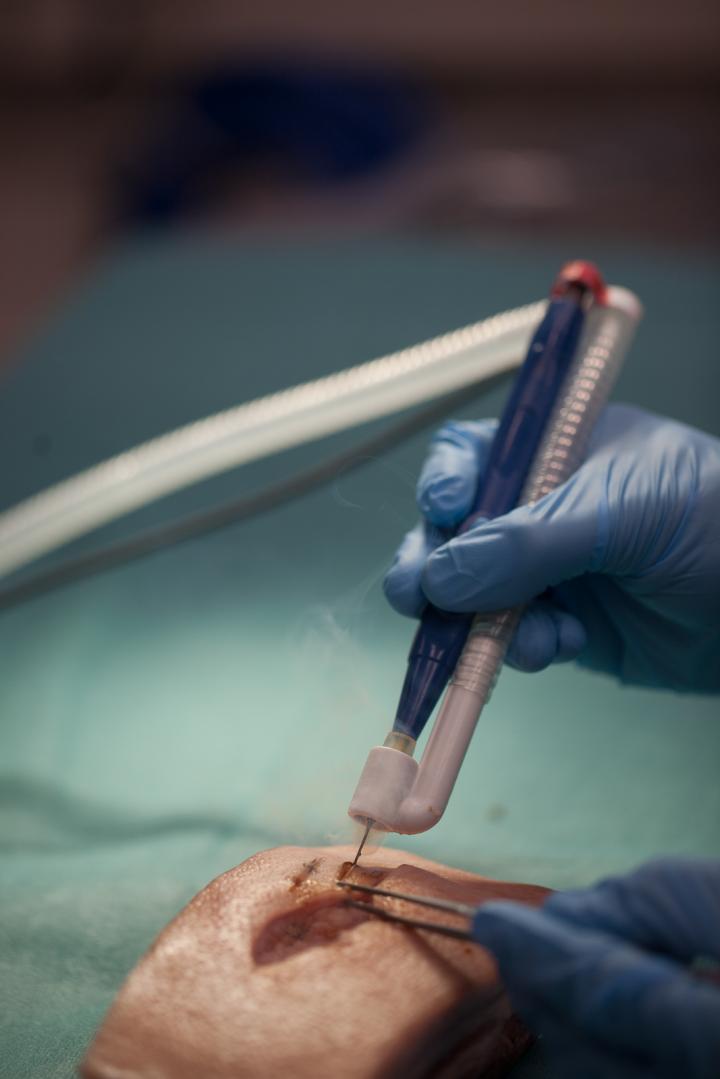
Credit: Antti Roine

An artificial nose developed at Tampere University, Finland, helps neurosurgeons to identify cancerous tissue during surgery and enables the more precise excision of tumours.

Electrosurgical resection using devices such as an electric knife or diathermy blade is currently a widely used technique in neurosurgery. When tissue is burned, tissue molecules are dispersed in the form of surgical smoke. In the method developed by researchers at Tampere University, the surgical smoke is fed into a new type of measuring system that can identify malignant tissue and distinguish it from healthy tissue.

An article on using surgical smoke to identify brain tumours was recently published in the Journal of Neurosurgery.

“In current clinical practice, frozen section analysis is the gold standard for intraoperative tumour identification. In that method, a small sample of the tumour is given to a pathologist during surgery,” says researcher Ilkka Haapala from Tampere University.

The pathologist undertakes a microscopic analysis of the sample and phones the operating theatre to report the results.

“Our new method offers both a promising way to identify malignant tissue in real time and the ability to study several samples from different points of the tumour,” Haapala explains.

“The specific advantage of the equipment is that it can be connected to the instrumentation already present in neurosurgical operating theatres,” Haapala points out.

The technology is based on differential mobility spectrometry (DMS), wherein flue gas ions are fed into an electric field. The distribution of ions in the electric field is tissue-specific, and the tissue can be identified on the basis of the resulting “odour fingerprint”.

The study analysed 694 tissue samples collected from 28 brain tumours and control specimens.

The equipment used was developed specifically for the study. It consists of a machine learning system, which analyses the flue gas with DMS technology, and an electric knife, which is used to produce the flue gas from the tissues.

The system’s classification accuracy was 83% when all the samples were analysed. The accuracy improved in more restricted settings. When comparing low malignancy tumours (gliomas) to control samples, the classification accuracy of the system was 94%, reaching to 97% sensitivity and 90% specificity.

###

Media Contact
Ilkka Haapala
[email protected]

Tags: DiagnosticsMedicine/HealthSurgery
Share13Tweet8Share2ShareShareShare2

Related Posts

Aversive Learning Hijacks Brain Sugar Sensor

March 25, 2026

Can Psychosocial Factors Influence Cancer Risk?

March 23, 2026

Depression Factors in Elderly: Pre vs. Post-COVID Analysis

March 23, 2026

Hidden Health Crises Among US and UK Volunteers in Ukraine Uncovered in New Study

March 23, 2026
Please login to join discussion

POPULAR NEWS

  • blank

    Revolutionary AI Model Enhances Precision in Detecting Food Contamination

    96 shares
    Share 38 Tweet 24
  • Imagine a Social Media Feed That Challenges Your Views Instead of Reinforcing Them

    1003 shares
    Share 397 Tweet 248
  • Uncovering Functions of Cavernous Malformation Proteins in Organoids

    54 shares
    Share 22 Tweet 14
  • Promising Outcomes from First Clinical Trials of Gene Regulation in Epilepsy

    51 shares
    Share 20 Tweet 13

About

We bring you the latest biotechnology news from best research centers and universities around the world. Check our website.

Follow us

Recent News

In-Sensor Cryptography Links Physical Process to Digital Identity

Can Psychosocial Factors Influence Cancer Risk?

Depression Factors in Elderly: Pre vs. Post-COVID Analysis

Subscribe to Blog via Email

Success! An email was just sent to confirm your subscription. Please find the email now and click 'Confirm' to start subscribing.

Join 78 other subscribers
  • Contact Us

Bioengineer.org © Copyright 2023 All Rights Reserved.

Welcome Back!

Login to your account below

Forgotten Password?

Retrieve your password

Please enter your username or email address to reset your password.

Log In
No Result
View All Result
  • Homepages
    • Home Page 1
    • Home Page 2
  • News
  • National
  • Business
  • Health
  • Lifestyle
  • Science

Bioengineer.org © Copyright 2023 All Rights Reserved.