• HOME
  • NEWS
  • EXPLORE
    • CAREER
      • Companies
      • Jobs
    • EVENTS
    • iGEM
      • News
      • Team
    • PHOTOS
    • VIDEO
    • WIKI
  • BLOG
  • COMMUNITY
    • FACEBOOK
    • INSTAGRAM
    • TWITTER
Thursday, June 25, 2026
BIOENGINEER.ORG
No Result
View All Result
  • Login
  • HOME
  • NEWS
  • EXPLORE
    • CAREER
      • Companies
      • Jobs
        • Lecturer
        • PhD Studentship
        • Postdoc
        • Research Assistant
    • EVENTS
    • iGEM
      • News
      • Team
    • PHOTOS
    • VIDEO
    • WIKI
  • BLOG
  • COMMUNITY
    • FACEBOOK
    • INSTAGRAM
    • TWITTER
  • HOME
  • NEWS
  • EXPLORE
    • CAREER
      • Companies
      • Jobs
        • Lecturer
        • PhD Studentship
        • Postdoc
        • Research Assistant
    • EVENTS
    • iGEM
      • News
      • Team
    • PHOTOS
    • VIDEO
    • WIKI
  • BLOG
  • COMMUNITY
    • FACEBOOK
    • INSTAGRAM
    • TWITTER
No Result
View All Result
Bioengineer.org
No Result
View All Result
Home NEWS Science News Chemistry

Concert of magnetic moments

Bioengineer by Bioengineer
June 13, 2019
in Chemistry
Reading Time: 2 mins read
0
IMAGE
Share on FacebookShare on TwitterShare on LinkedinShare on RedditShare on Telegram

IMAGE

Credit: Forschungszentrum Jülich / Jan-Philipp Hanke

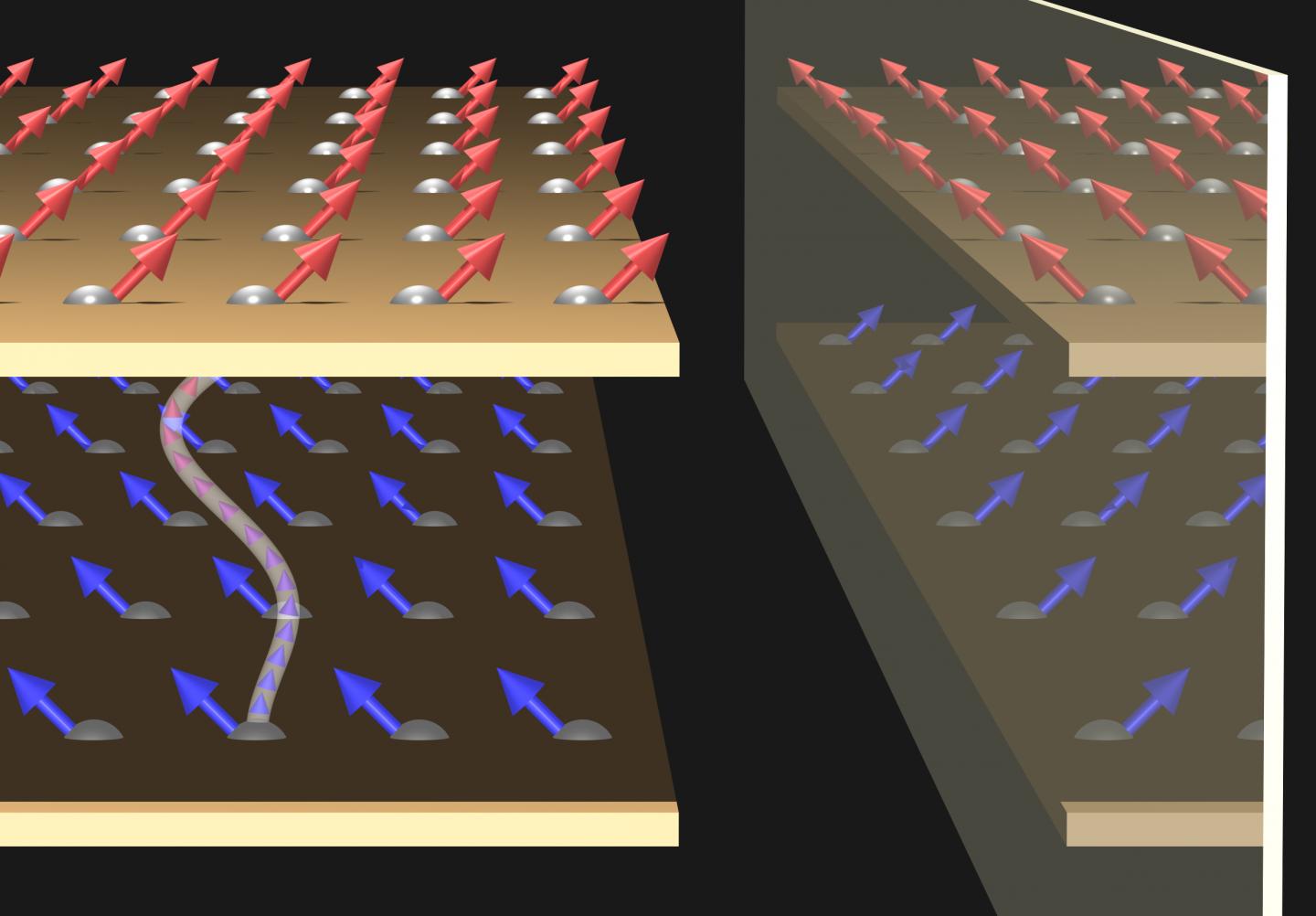
An international collaboration between researchers from Germany, the Netherlands, and South Korea has uncovered a new way how the electron spins in layered materials can interact. In their publication in the journal Nature Materials, the scientists report a hitherto unknown chiral coupling that is active over relatively long distances. As a consequence, spins in two different magnetic layers that are separated by non-magnetic materials can influence each other even though they are not adjacent.

Magnetic solids form the foundation of modern information technology. For example, these materials are ubiquitous in memories such as hard disk drives. Functionality and efficiency of these devices is determined by the physical properties of the magnetic solids. The latter originate from the “concert of spins” – the interactions between microscopically small magnetic moments within the material. Understanding and directing this concert is a fundamental question for both research and applications.

Two magnetic materials can influence each other over long distances even if they are not in direct contact. In the past, such a long-range interaction has been observed, for example, in heterostructures of magnetic iron layers that are separated by a thin chromium spacer. A unique fingerprint of the so-called interlayer coupling is the parallel or antiparallel alignment of the magnetic moments in the iron layers. This phenomenon is technologically important since the electrical resistance of the two possible configurations is drastically different – which is known as giant magnetoresistance effect. It is used in operating magnetic memories and sensors, and in 2007 the Nobel Prize in Physics was awarded jointly to Peter Grünberg and Albert Fert for their discovery.

A group of scientists has now extended this “concert of spins” by a new type of long-range interlayer coupling. They report in the journal Nature Materials that the discovered interaction leads to a special configuration of the magnetic moments, which is neither parallel nor antiparallel but has a specific chirality. This means that the resulting arrangement of spins is not identical to its mirror image – just like our left hand is different from our right hand. Such chiral interactions in crystals are very rare in nature. Using theoretical simulations on the supercomputer JURECA in Jülich, the researchers identified the interplay between the crystal structure and relativistic effects as origin of the observed chiral interlayer coupling. This flavor of the “concert of spins” offers novel opportunities for engineering complex magnetic configurations that could be useful to store and process data more efficiently in the future.

###

Media Contact
Tobias Schlößer
[email protected]

Original Source

https://www.fz-juelich.de/SharedDocs/Pressemitteilungen/UK/EN/2019/notifications/2019-06-13-chirale-ww.html

Related Journal Article

http://dx.doi.org/10.1038/s41563-019-0370-z

Tags: Atomic/Molecular/Particle PhysicsChemistry/Physics/Materials SciencesElectromagneticsMaterials
Share14Tweet8Share2ShareShareShare2

Related Posts

AI and Physics Collaborate to Design Advanced Hydrogen Storage Materials

June 25, 2026

International Team Including Dresden Scientists Develops Novel Designer Proteins for Advanced Study of Living Tissue

June 25, 2026

New Study Uncovers Key Factors Driving Water Chemistry in Nanoscale Environments

June 25, 2026

Plasma Technology Extends Catalyst Lifespan in Hydrogen Production

June 24, 2026
Please login to join discussion

POPULAR NEWS

  • Saying Goodbye to PGY-6: Pediatric Fellowship Realities

    103 shares
    Share 41 Tweet 26
  • Multi-Hospital Study Reveals Long Covid Burden Is Twice as High as Current Estimates

    92 shares
    Share 36 Tweet 23
  • Detection of EDCs in Breast Milk and Infant Urine Up to Six Months Highlights Early Exposure Risks

    77 shares
    Share 31 Tweet 19
  • New Drug Candidate Developed at McMaster Shows Potential for Treating Brain Cancer

    58 shares
    Share 23 Tweet 15

About

We bring you the latest biotechnology news from best research centers and universities around the world. Check our website.

Follow us

Recent News

Tracking Lanthanide-Labeled Microplastics in Plants

POSTECH Researchers Slash Cost of Reconstituted Cell-Free Systems by 95%

AI and Physics Collaborate to Design Advanced Hydrogen Storage Materials

Subscribe to Blog via Email

Enter your email address to subscribe to this blog and receive notifications of new posts by email.

Join 82 other subscribers
  • Contact Us

Bioengineer.org © Copyright 2023 All Rights Reserved.

Welcome Back!

Login to your account below

Forgotten Password?

Retrieve your password

Please enter your username or email address to reset your password.

Log In
No Result
View All Result
  • Homepages
    • Home Page 1
    • Home Page 2
  • News
  • National
  • Business
  • Health
  • Lifestyle
  • Science

Bioengineer.org © Copyright 2023 All Rights Reserved.