• HOME
  • NEWS
  • EXPLORE
    • CAREER
      • Companies
      • Jobs
    • EVENTS
    • iGEM
      • News
      • Team
    • PHOTOS
    • VIDEO
    • WIKI
  • BLOG
  • COMMUNITY
    • FACEBOOK
    • INSTAGRAM
    • TWITTER
Sunday, August 16, 2026
BIOENGINEER.ORG
No Result
View All Result
  • Login
  • HOME
  • NEWS
  • EXPLORE
    • CAREER
      • Companies
      • Jobs
        • Lecturer
        • PhD Studentship
        • Postdoc
        • Research Assistant
    • EVENTS
    • iGEM
      • News
      • Team
    • PHOTOS
    • VIDEO
    • WIKI
  • BLOG
  • COMMUNITY
    • FACEBOOK
    • INSTAGRAM
    • TWITTER
  • HOME
  • NEWS
  • EXPLORE
    • CAREER
      • Companies
      • Jobs
        • Lecturer
        • PhD Studentship
        • Postdoc
        • Research Assistant
    • EVENTS
    • iGEM
      • News
      • Team
    • PHOTOS
    • VIDEO
    • WIKI
  • BLOG
  • COMMUNITY
    • FACEBOOK
    • INSTAGRAM
    • TWITTER
No Result
View All Result
Bioengineer.org
No Result
View All Result
Home NEWS Science News Biology

New snake species in Europe named after a long-forgotten Iron Age kingdom

Bioengineer by Bioengineer
May 28, 2019
in Biology
Reading Time: 3 mins read
0
IMAGE
Share on FacebookShare on TwitterShare on LinkedinShare on RedditShare on Telegram

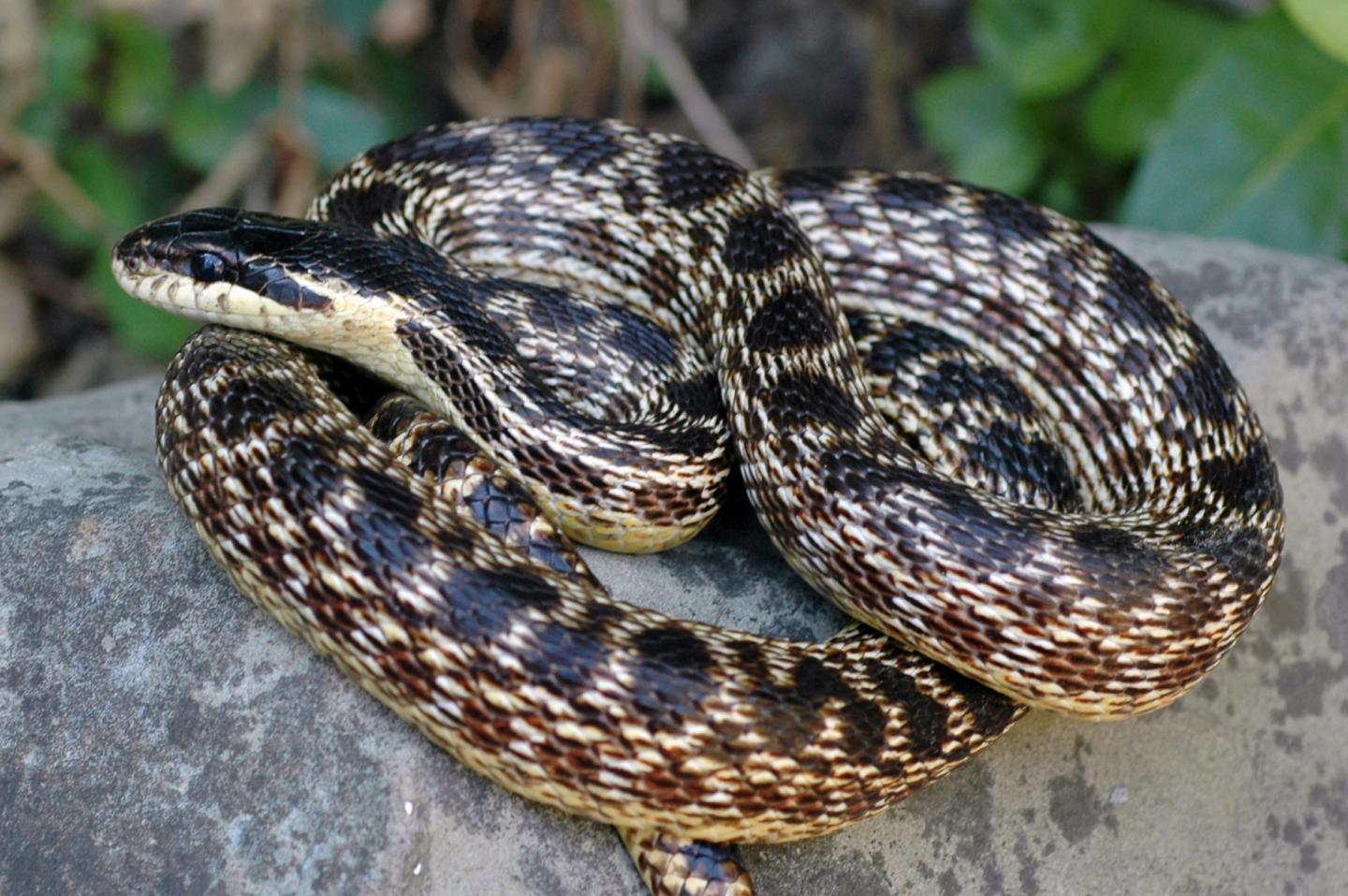
The description of a new rat snake species from eastern Turkey, Elaphe urartica, has been published in the journal PeerJ
IMAGE

Credit: Boris Tuniyev

An international team of scientists identified the snake and its range, which includes Turkey, Azerbaijan, Armenia, Georgia, Iraq, Iran, and Russia including a small region extending into the corner of Europe. Based on the genetic and morphological data, the researchers were able to say that the Blotched Rat Snake (Elaphe sauromates) is actually comprised of two different species and includes a cryptic species that has been named after the old kingdom of Urartu.

The kingdom, forgotten for over a thousand years, flourished between the 9th and 6th centuries BCE in the region of today’s Armenian Highlands, centered around Lake Van in Turkey, where this new snake species occurs. The name was chosen out of respect for the original scientific name of the Blotched Rat Snake proposed by the famous Prussian natural historian of the 19th century, Peter Simon Pallas.

The name Elaphe sauromates refers to Sarmatians, a confederation of nomadic peoples who inhabited vast areas of the recent range of the Blotched Rat Snake between the 5th century BCE and 4th century CE. According to Daniel Jablonski and David Jandzik, lead scientists of the project from the Comenius University in Bratislava, Slovakia, these snakes are very rarely observed in the field and are mostly distributed in geopolitically complicated regions. As a result, the material for their study was collected for over 17 years and required a broad international collaboration.

The new snake species is a member of large-bodied snakes of an iconic genus Elaphe, which is very popular with snake hobbyists. The discovery and analysis of the biogeographical history of this new snake fills in an important piece of the Eurasian biota evolutionary puzzle.

###

Images:

An individual of the new rat sake species, Elaphe urartica, from Armenia

Image credits: Boris Tuniyev

Full Media Pack including image: https://drive.google.com/drive/folders/15CN1uA0yJly6maLbPIM1VfK3fXlVLq7K?usp=sharing

EMBARGOED until 28 May 2019: 7 am EST; 12 midday UK local time; 11 am GMT (i.e. the date of publication)

Link to the Published Version of the article (quote this link in your story – the link will ONLY work after the embargo lifts): https://peerj.com/articles/6944 your readers will be able to freely access this article at this URL.

Citation to the article: Jablonski D, Kukushkin OV, Avc? A, Bunyatova S, Kumluta? Y, Ilgaz Ç, Polyakova E, Shiryaev K, Tuniyev B, Jandzik D. 2019. The biogeography of Elaphe sauromates (Pallas, 1814), with a description of a new rat snake species. PeerJ 7:e6944 https://doi.org/10.7717/peerj.6944

About:

PeerJ is an Open Access publisher of seven peer-reviewed journals and a preprint server. PeerJ‘s mission is to help the world efficiently publish its knowledge. All works published by PeerJ are Open Access and published using a Creative Commons license (CC-BY 4.0). PeerJ is based in San Diego, CA and the UK and can be accessed at peerj.com

PeerJ is the peer-reviewed journal for Biology, Medicine and Environmental Sciences. PeerJ has recently added 15 areas in environmental science subject areas, including Natural Resource Management, Climate Change Biology, and Environmental Impacts.
peerj.com/environmental-sciences

PeerJ has an Editorial Board of over 1,900 respected academics, including 5 Nobel Laureates. PeerJ was the recipient of the 2013 ALPSP Award for Publishing Innovation. PeerJ Media Resources (including logos) can be found at: peerj.com/about/press

Media Contacts

For the authors:

Daniel Jablonski, email: [email protected]

David Jandzik, email: [email protected]

For PeerJ: email: [email protected] , https://peerj.com/about/press/

Note: If you would like to join the PeerJ Press Release list, please register at: http://bit.ly/PressList

Media Contact
Daniel Jablonski
[email protected]

Related Journal Article

http://dx.doi.org/10.7717/peerj.6944

Tags: BiodiversityBiologyEvolutionGeographyZoology/Veterinary Science
Share13Tweet8Share2ShareShareShare2

Related Posts

Strubbelig–NHL3 Receptor Complex Helps Arabidopsis Respond to Cellulose Deficiency

Strubbelig–NHL3 Receptor Complex Helps Arabidopsis Respond to Cellulose Deficiency

August 15, 2026
Bombyx mori Satellitome Analysis Reveals Evolutionary Stability, Dispersed Chromosomal Organization, Transposon Origins

Bombyx mori Satellitome Analysis Reveals Evolutionary Stability, Dispersed Chromosomal Organization, Transposon Origins

August 15, 2026

Synthetic pyrenoid reconstruction reveals EPYC1-driven carbon concentration mechanisms and evolution

August 15, 2026

Endophytic Flavobacterium boosts root hairs and drought tolerance through ERF–CEP5 signaling

August 15, 2026
Please login to join discussion

POPULAR NEWS

  • KAIST develops semiconductor neuron that harnesses noise to selectively process signals

    29 shares
    Share 12 Tweet 7
  • Imagining natural and extra robotic thumbs together strengthens kinesthetic sensorimotor networks

    29 shares
    Share 12 Tweet 7
  • PARP1 Drives Neuropathic Pain Through GPX4-Dependent Ferroptosis in Injured Mice’s Sensory Neurons

    29 shares
    Share 12 Tweet 7
  • Strubbelig–NHL3 Receptor Complex Helps Arabidopsis Respond to Cellulose Deficiency

    29 shares
    Share 12 Tweet 7

About

We bring you the latest biotechnology news from best research centers and universities around the world. Check our website.

Follow us

Recent News

KAIST develops semiconductor neuron that harnesses noise to selectively process signals

Imagining natural and extra robotic thumbs together strengthens kinesthetic sensorimotor networks

PARP1 Drives Neuropathic Pain Through GPX4-Dependent Ferroptosis in Injured Mice’s Sensory Neurons

Subscribe to Blog via Email

Success! An email was just sent to confirm your subscription. Please find the email now and click 'Confirm' to start subscribing.

Join 85 other subscribers
  • Contact Us

Bioengineer.org © Copyright 2023 All Rights Reserved.

Welcome Back!

Login to your account below

Forgotten Password?

Retrieve your password

Please enter your username or email address to reset your password.

Log In
No Result
View All Result
  • Homepages
    • Home Page 1
    • Home Page 2
  • News
  • National
  • Business
  • Health
  • Lifestyle
  • Science

Bioengineer.org © Copyright 2023 All Rights Reserved.