• HOME
  • NEWS
  • EXPLORE
    • CAREER
      • Companies
      • Jobs
    • EVENTS
    • iGEM
      • News
      • Team
    • PHOTOS
    • VIDEO
    • WIKI
  • BLOG
  • COMMUNITY
    • FACEBOOK
    • INSTAGRAM
    • TWITTER
Saturday, February 7, 2026
BIOENGINEER.ORG
No Result
View All Result
  • Login
  • HOME
  • NEWS
  • EXPLORE
    • CAREER
      • Companies
      • Jobs
        • Lecturer
        • PhD Studentship
        • Postdoc
        • Research Assistant
    • EVENTS
    • iGEM
      • News
      • Team
    • PHOTOS
    • VIDEO
    • WIKI
  • BLOG
  • COMMUNITY
    • FACEBOOK
    • INSTAGRAM
    • TWITTER
  • HOME
  • NEWS
  • EXPLORE
    • CAREER
      • Companies
      • Jobs
        • Lecturer
        • PhD Studentship
        • Postdoc
        • Research Assistant
    • EVENTS
    • iGEM
      • News
      • Team
    • PHOTOS
    • VIDEO
    • WIKI
  • BLOG
  • COMMUNITY
    • FACEBOOK
    • INSTAGRAM
    • TWITTER
No Result
View All Result
Bioengineer.org
No Result
View All Result
Home NEWS Science News Chemistry

Mystery of texture of Guinness beer: inclination angle of a pint glass is key to solution

Bioengineer by Bioengineer
May 7, 2019
in Chemistry
Reading Time: 2 mins read
0
IMAGE
Share on FacebookShare on TwitterShare on LinkedinShare on RedditShare on Telegram

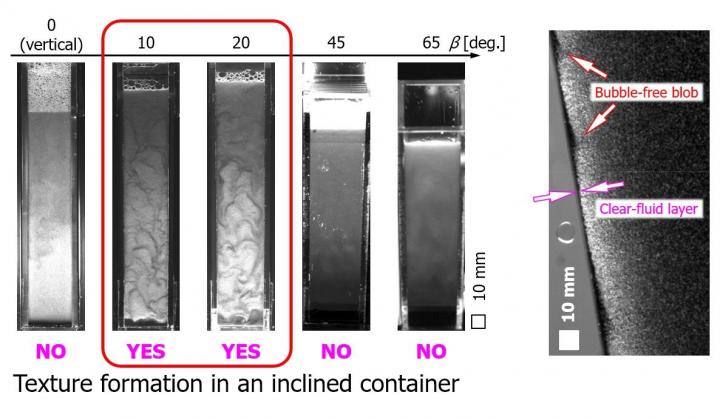
Bubble cascade in beer is found to be analogous to roll waves observed in water sliding downhill on a rainy day
IMAGE

Credit: Osaka University

Guinness beer, a dark stout beer, is pressurized with nitrogen gas. When poured Guinness beer into a pint glass, small-diameter bubbles (only 1/10 the size of those in carbonated drinks such as soda and carbonated water) disperse throughout the entire glass and the texture motion of the bubble swarm moves downwards.

Although some models to explain how the downward movement of a bubble swarm as waves are caused in Guinness beer have been proposed, the mechanism underlying the texture-formation was an open problem.

Because the opaque and dark-colored Guinness beer obstructs the physical observation in a glass and huge computation using supercomputers is necessary to conduct numerical simulation of flows including a vast number of small bubbles in the beer, the team of researchers led by Tomoaki Watamura produced transparent “pseudo-Guinness fluid” by using light particles and tap water. They filmed the movement of liquid with a high-speed video camera applying laser-induced-fluorescence method in order to accurately measure the movement of fluid. In addition, using molecular tags, they visualized the irregular movement of the fluid.

With these methods, the team poured pseudo-Guinness fluid in an inclined container to observe how the texture formed. The texture-formation appeared only in the region of about 1 mm away from the inclined wall and didn’t appear in the vertical wall vicinity.

They also observed a clear-fluid (bubble-free) film flow down along the inclined wall in the inclined wall vicinity, capturing velocity and thickness of bubble-free film flowing downward. While the texture appeared when the glass inclination angles were small, it did not when they were large, demonstrating that the texture-formation in a glass of Guinness beer was caused by the roll-wave instability of the gravity current.

Lead author Watamura says, “There are a large number of small objects in nature, such as fine rock particles transported from rivers to the sea and microorganisms living in lakes and ponds. Comprehending and regulating the movement of small objects is important in various industrial processes as well. Our research results will be useful in understanding and controlling flows of bubbles and particles used in industrial processes as well as protein crystallization and cell cultivation used in the field of life science.”

###

Media Contact
Saori Obayashi
[email protected]

Original Source

https://resou.osaka-u.ac.jp/en/research/2019/20190411_1

Related Journal Article

http://dx.doi.org/10.1038/s41598-019-42094-0

Tags: Chemistry/Physics/Materials Sciences
Share12Tweet8Share2ShareShareShare2

Related Posts

blank

Breakthrough in Environmental Cleanup: Scientists Develop Solar-Activated Biochar for Faster Remediation

February 7, 2026
blank

Cutting Costs: Making Hydrogen Fuel Cells More Affordable

February 6, 2026

Scientists Develop Hand-Held “Levitating” Time Crystals

February 6, 2026

Observing a Key Green-Energy Catalyst Dissolve Atom by Atom

February 6, 2026
Please login to join discussion

POPULAR NEWS

  • Robotic Ureteral Reconstruction: A Novel Approach

    Robotic Ureteral Reconstruction: A Novel Approach

    82 shares
    Share 33 Tweet 21
  • Digital Privacy: Health Data Control in Incarceration

    63 shares
    Share 25 Tweet 16
  • Study Reveals Lipid Accumulation in ME/CFS Cells

    57 shares
    Share 23 Tweet 14
  • Breakthrough in RNA Research Accelerates Medical Innovations Timeline

    53 shares
    Share 21 Tweet 13

About

We bring you the latest biotechnology news from best research centers and universities around the world. Check our website.

Follow us

Recent News

Evaluating Pediatric Emergency Care Quality in Ethiopia

TPMT Expression Predictions Linked to Azathioprine Side Effects

Improving Dementia Care with Enhanced Activity Kits

Subscribe to Blog via Email

Success! An email was just sent to confirm your subscription. Please find the email now and click 'Confirm' to start subscribing.

Join 73 other subscribers
  • Contact Us

Bioengineer.org © Copyright 2023 All Rights Reserved.

Welcome Back!

Login to your account below

Forgotten Password?

Retrieve your password

Please enter your username or email address to reset your password.

Log In
No Result
View All Result
  • Homepages
    • Home Page 1
    • Home Page 2
  • News
  • National
  • Business
  • Health
  • Lifestyle
  • Science

Bioengineer.org © Copyright 2023 All Rights Reserved.