• HOME
  • NEWS
  • EXPLORE
    • CAREER
      • Companies
      • Jobs
    • EVENTS
    • iGEM
      • News
      • Team
    • PHOTOS
    • VIDEO
    • WIKI
  • BLOG
  • COMMUNITY
    • FACEBOOK
    • INSTAGRAM
    • TWITTER
Thursday, March 26, 2026
BIOENGINEER.ORG
No Result
View All Result
  • Login
  • HOME
  • NEWS
  • EXPLORE
    • CAREER
      • Companies
      • Jobs
        • Lecturer
        • PhD Studentship
        • Postdoc
        • Research Assistant
    • EVENTS
    • iGEM
      • News
      • Team
    • PHOTOS
    • VIDEO
    • WIKI
  • BLOG
  • COMMUNITY
    • FACEBOOK
    • INSTAGRAM
    • TWITTER
  • HOME
  • NEWS
  • EXPLORE
    • CAREER
      • Companies
      • Jobs
        • Lecturer
        • PhD Studentship
        • Postdoc
        • Research Assistant
    • EVENTS
    • iGEM
      • News
      • Team
    • PHOTOS
    • VIDEO
    • WIKI
  • BLOG
  • COMMUNITY
    • FACEBOOK
    • INSTAGRAM
    • TWITTER
No Result
View All Result
Bioengineer.org
No Result
View All Result
Home NEWS Science News Chemistry

Scientists develop stereodefined N and S atom-codoped graphdiyne for oxygen evolution

Bioengineer by Bioengineer
April 30, 2019
in Chemistry
Reading Time: 2 mins read
0
IMAGE
Share on FacebookShare on TwitterShare on LinkedinShare on RedditShare on Telegram

IMAGE

Credit: ZHAO Yasong

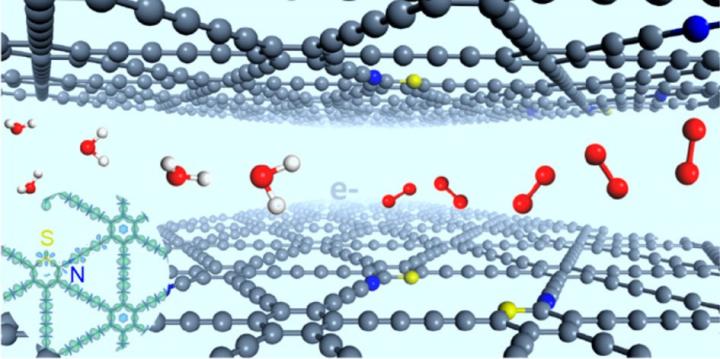
The oxygen evolution reaction (OER) is of great significance in energy-related techniques, such as metal-air batteries and water splitting. Chinese scientists have doped site-defined sp-N and S atoms into graphdiyne, which enables highly active catalysis of OER. Their findings were published in J. Am. Chem. Soc.

Traditional OER catalysts, e.g. RuO2 and IrO2, are limited by high cost and declining stability. Heteroatom-doped carbon materials, especially dual doping, have displayed intriguing potential for highly efficient electrocatalysis owing to the synergistic effect. However, the doping sites for different atoms are highly uncontrollable, which makes the structure-property study difficult.

The synergistic effect can only take place within a certain distance between the dual atoms, and 7.5 Å is the upper limit for N and S atoms to obtain a strong synergistic effect.

Scientists from the Institute of Process Engineering (IPE) of the Chinese Academy of Sciences successfully prepared “stereodefined” N and S atoms codoped graphdiyne, and the relative positions of the N and S atoms were well controlled.

“N-, S-codoped graphdiyne presented higher catalytic activity than those catalysts with individual-element doping (N or S atom) and commercial RuO2 in catalyzing the OER, possessing lower overpotential (299 mV) and higher current density (47.2 mA/cm2, 1.6 V), ” said WANG Dan, who led this research.

This study opens an avenue for understanding the synergistic effects in heteroelement-doped metal-free catalysts, and for further guiding the rational design and preparation of highly efficient catalysts for energy conversion and storage.

###

Media Contact
LI Xiangyu
[email protected]

Related Journal Article

http://dx.doi.org/10.1021/jacs.8b13695

Tags: Atomic/Molecular/Particle PhysicsChemistry/Physics/Materials SciencesMaterials
Share12Tweet8Share2ShareShareShare2

Related Posts

Isolated H2-Reduced Clusters Boost CO2-to-Methanol Catalysis

Isolated H2-Reduced Clusters Boost CO2-to-Methanol Catalysis

March 25, 2026
blank

Physicists Identify Electronic Drivers Behind Flat Band Quantum Materials

March 21, 2026

Würzburg Chemistry Professor Claudia Höbartner Receives Prestigious Honor

March 20, 2026

Scientists Reveal How Magnets Control Metamaterial Behavior

March 20, 2026
Please login to join discussion

POPULAR NEWS

  • blank

    Revolutionary AI Model Enhances Precision in Detecting Food Contamination

    96 shares
    Share 38 Tweet 24
  • Imagine a Social Media Feed That Challenges Your Views Instead of Reinforcing Them

    1003 shares
    Share 397 Tweet 248
  • Uncovering Functions of Cavernous Malformation Proteins in Organoids

    54 shares
    Share 22 Tweet 14
  • Promising Outcomes from First Clinical Trials of Gene Regulation in Epilepsy

    51 shares
    Share 20 Tweet 13

About

We bring you the latest biotechnology news from best research centers and universities around the world. Check our website.

Follow us

Recent News

In-Sensor Cryptography Links Physical Process to Digital Identity

Can Psychosocial Factors Influence Cancer Risk?

Depression Factors in Elderly: Pre vs. Post-COVID Analysis

Subscribe to Blog via Email

Success! An email was just sent to confirm your subscription. Please find the email now and click 'Confirm' to start subscribing.

Join 78 other subscribers
  • Contact Us

Bioengineer.org © Copyright 2023 All Rights Reserved.

Welcome Back!

Login to your account below

Forgotten Password?

Retrieve your password

Please enter your username or email address to reset your password.

Log In
No Result
View All Result
  • Homepages
    • Home Page 1
    • Home Page 2
  • News
  • National
  • Business
  • Health
  • Lifestyle
  • Science

Bioengineer.org © Copyright 2023 All Rights Reserved.