• HOME
  • NEWS
  • EXPLORE
    • CAREER
      • Companies
      • Jobs
    • EVENTS
    • iGEM
      • News
      • Team
    • PHOTOS
    • VIDEO
    • WIKI
  • BLOG
  • COMMUNITY
    • FACEBOOK
    • INSTAGRAM
    • TWITTER
Saturday, February 7, 2026
BIOENGINEER.ORG
No Result
View All Result
  • Login
  • HOME
  • NEWS
  • EXPLORE
    • CAREER
      • Companies
      • Jobs
        • Lecturer
        • PhD Studentship
        • Postdoc
        • Research Assistant
    • EVENTS
    • iGEM
      • News
      • Team
    • PHOTOS
    • VIDEO
    • WIKI
  • BLOG
  • COMMUNITY
    • FACEBOOK
    • INSTAGRAM
    • TWITTER
  • HOME
  • NEWS
  • EXPLORE
    • CAREER
      • Companies
      • Jobs
        • Lecturer
        • PhD Studentship
        • Postdoc
        • Research Assistant
    • EVENTS
    • iGEM
      • News
      • Team
    • PHOTOS
    • VIDEO
    • WIKI
  • BLOG
  • COMMUNITY
    • FACEBOOK
    • INSTAGRAM
    • TWITTER
No Result
View All Result
Bioengineer.org
No Result
View All Result
Home NEWS Science News Chemistry

Marine Skin dives deeper for better monitoring

Bioengineer by Bioengineer
April 22, 2019
in Chemistry
Reading Time: 2 mins read
0
IMAGE
Share on FacebookShare on TwitterShare on LinkedinShare on RedditShare on Telegram

IMAGE

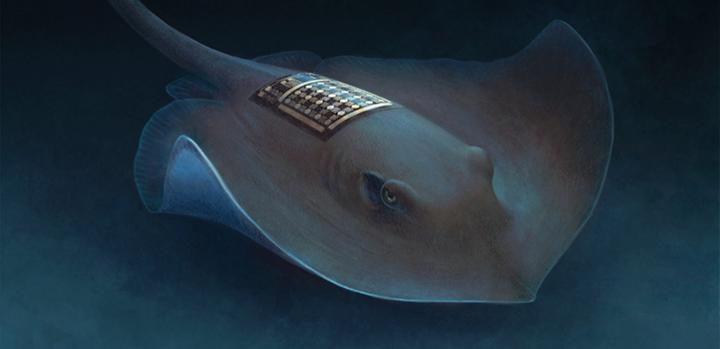
Credit: © 2019 KAUST; Xavier Pita

A new and greatly improved version of an electronic tag, called Marine Skin, used for monitoring marine animals could revolutionize our ability to study sea life and its natural environment, say KAUST researchers.

Marine Skin is a thin, flexible, lightweight polymer-based material with integrated electronics which can track an animal’s movement and diving behavior and the health of the surrounding marine environment. Early versions of the sensors, reported previously, proved their worth when glued onto the swimming crab, Portunus pelagicus.

The latest and much more robust version can operate at unprecedented depths and can also be attached to an animal using a noninvasive bracelet or jacket. This can, when necessary, avoid the need for any glues that might harm an animal’s sensitive skin.

“The system can now operate down to a depth of 2 kilometers, which has never been achieved before by anyone,” says Ph.D. student Sohail Shaikh of the KAUST team.

The sensitivity of the monitoring electronics has also been enhanced by up to 15 times. The data collected reveals a tagged animal’s depth and the temperature and salinity of the surrounding water. Further development is planned to incorporate additional environmental sensing capabilities, such as measuring oxygen and carbon dioxide levels and precise geolocation tracking.

Shaikh reports that a major challenge in developing the enhancements was to make the system sufficiently robust to tolerate operating at much greater depths. The researchers also managed to reduce the size down to half that of the previous version. Tests also showed improved performance, flexibility and durability when the skin was attached to different fish, including sea bass, sea bream and small goldfish. Lab tests in highly saline Red Sea water also demonstrated integrity through a full month’s immersion and 10,000 extreme bending cycles.

“Marine skin is a unique and groundbreaking innovation in wearable technology for marine animals,” says Muhammad Mustafa Hussain, whose research group has developed the system in collaboration with Carlos Duarte’s group, also at KAUST.

Professor Hussain adds that Marine Skin outperforms all existing alternatives while emphasizing that ongoing development work will continue to enhance the sensing capacities, overall performance, reliability and affordability.

###

Media Contact
Carmen Denman
[email protected]

Original Source

https://discovery.kaust.edu.sa/en/article/815/marine-skin-dives-deeper-for-better-monitoring

Related Journal Article

http://dx.doi.org/10.1002/smll.201804385

Tags: BiodiversityBiologyClimate ChangeEcology/EnvironmentElectrical Engineering/ElectronicsMarine/Freshwater BiologyMaterials
Share13Tweet7Share2ShareShareShare1

Related Posts

blank

Breakthrough in Environmental Cleanup: Scientists Develop Solar-Activated Biochar for Faster Remediation

February 7, 2026
blank

Cutting Costs: Making Hydrogen Fuel Cells More Affordable

February 6, 2026

Scientists Develop Hand-Held “Levitating” Time Crystals

February 6, 2026

Observing a Key Green-Energy Catalyst Dissolve Atom by Atom

February 6, 2026
Please login to join discussion

POPULAR NEWS

  • Robotic Ureteral Reconstruction: A Novel Approach

    Robotic Ureteral Reconstruction: A Novel Approach

    82 shares
    Share 33 Tweet 21
  • Digital Privacy: Health Data Control in Incarceration

    63 shares
    Share 25 Tweet 16
  • Study Reveals Lipid Accumulation in ME/CFS Cells

    57 shares
    Share 23 Tweet 14
  • Breakthrough in RNA Research Accelerates Medical Innovations Timeline

    53 shares
    Share 21 Tweet 13

About

We bring you the latest biotechnology news from best research centers and universities around the world. Check our website.

Follow us

Recent News

Barriers and Boosters of Seniors’ Physical Activity in Karachi

Evaluating Pediatric Emergency Care Quality in Ethiopia

TPMT Expression Predictions Linked to Azathioprine Side Effects

Subscribe to Blog via Email

Enter your email address to subscribe to this blog and receive notifications of new posts by email.

Join 73 other subscribers
  • Contact Us

Bioengineer.org © Copyright 2023 All Rights Reserved.

Welcome Back!

Login to your account below

Forgotten Password?

Retrieve your password

Please enter your username or email address to reset your password.

Log In
No Result
View All Result
  • Homepages
    • Home Page 1
    • Home Page 2
  • News
  • National
  • Business
  • Health
  • Lifestyle
  • Science

Bioengineer.org © Copyright 2023 All Rights Reserved.