• HOME
  • NEWS
  • EXPLORE
    • CAREER
      • Companies
      • Jobs
    • EVENTS
    • iGEM
      • News
      • Team
    • PHOTOS
    • VIDEO
    • WIKI
  • BLOG
  • COMMUNITY
    • FACEBOOK
    • INSTAGRAM
    • TWITTER
Thursday, January 1, 2026
BIOENGINEER.ORG
No Result
View All Result
  • Login
  • HOME
  • NEWS
  • EXPLORE
    • CAREER
      • Companies
      • Jobs
        • Lecturer
        • PhD Studentship
        • Postdoc
        • Research Assistant
    • EVENTS
    • iGEM
      • News
      • Team
    • PHOTOS
    • VIDEO
    • WIKI
  • BLOG
  • COMMUNITY
    • FACEBOOK
    • INSTAGRAM
    • TWITTER
  • HOME
  • NEWS
  • EXPLORE
    • CAREER
      • Companies
      • Jobs
        • Lecturer
        • PhD Studentship
        • Postdoc
        • Research Assistant
    • EVENTS
    • iGEM
      • News
      • Team
    • PHOTOS
    • VIDEO
    • WIKI
  • BLOG
  • COMMUNITY
    • FACEBOOK
    • INSTAGRAM
    • TWITTER
No Result
View All Result
Bioengineer.org
No Result
View All Result
Home NEWS Science News Cancer

Scientists get sly, use deception to fight cancer

Bioengineer by Bioengineer
April 15, 2019
in Cancer
Reading Time: 2 mins read
0
IMAGE
Share on FacebookShare on TwitterShare on LinkedinShare on RedditShare on Telegram

Hebrew University researchers create decoys that block RNA-binding proteins from spreading cancer
IMAGE

Credit: Rotem Karni

In recent years, it’s become clear that RNA-binding proteins play a major role in cancer growth. These proteins, active in all cells but especially so in cancer cells, bind to RNA molecules and accelerate cancer cell growth. Unfortunately, no cancer treatment has targeted these proteins. Until now.

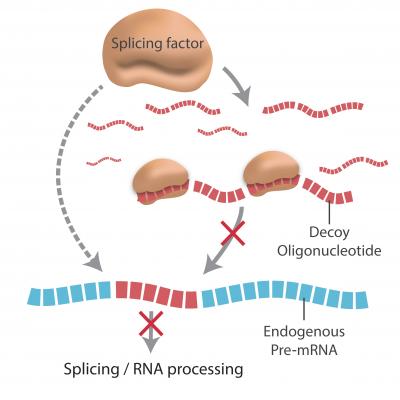
In the upcoming issue of Nature Communications, Professor Rotem Karni and his team at the Hebrew University of Jerusalem (HU) present a new technology to fight cancer. They designed decoy molecules that trick RNA-binding proteins into binding with them. Once bound, these RNA-binding proteins are no longer able to bind with the natural RNA molecules in cancer cells and lose their cancer-promoting activity. These “sterile” RNA molecule decoys are called oligonucleotides.

“Our technology is a new approach in the war on cancer. By understanding the biological function of RNA-binding proteins we successfully designed decoy molecules that inhibit these proteins and move us ever closer to creating an anti-cancer drug,” shared Professor Karni.

Prof. Karni and his HU Institute for Medical Research-Israel Canada (IMRIC) team, led by Ph.D. student Polina Cohen-Denichenko, developed several decoy molecules that inhibit the RNA-binding proteins that speed-up brain and breast cancer growth. To test the decoys, they treated brain cancer cells with decoy molecules. When the cells were then injected into healthy mice, the cancer cells did not replicate and, soon after, the tumors died off.

Though this study tested the efficacy of decoy molecules on breast and brain cancer cells, Karni explained that his technology enables scientists to tailor-make decoys for other types of cancer, thereby streamlining and improving treatment for cancer patients. “We still need to examine the toxicity of the decoy molecules and to test their efficacy on animals before we can move on to humans,” cautioned Karni. “However, I’m optimistic, given that we’ve already succeeded at creating decoy oligonucleotides that inhibit RNA binding proteins in other kinds of cancers.”

To date, a patent describing this technology has been registered in the United States and Europe by Yissum, Hebrew University’s R&D company.

###

Media Contact
Tali Aronsky
[email protected]

Related Journal Article

http://dx.doi.org/10.1038/s41467-019-09523-0

Tags: BiologyBreast CancercancerCell BiologyMedicine/HealthMicrobiologyMolecular Biology
Share12Tweet8Share2ShareShareShare2

Related Posts

Derazantinib Boosts Gemcitabine by Blocking MUC5AC

December 30, 2025

FOCUS Study Reveals Insights on Melphalan for Uveal Melanoma

December 29, 2025

Black Grape Anthocyanins Boost 5-FU Cancer Therapy

December 29, 2025

Girdin Silencing Boosts Mebendazole’s Ovarian Cancer Fight

December 29, 2025
Please login to join discussion

POPULAR NEWS

  • blank

    PTSD, Depression, Anxiety in Childhood Cancer Survivors, Parents

    107 shares
    Share 43 Tweet 27
  • NSF funds machine-learning research at UNO and UNL to study energy requirements of walking in older adults

    71 shares
    Share 28 Tweet 18
  • Exploring Audiology Accessibility in Johannesburg, South Africa

    52 shares
    Share 21 Tweet 13
  • SARS-CoV-2 Subvariants Affect Outcomes in Elderly Hip Fractures

    44 shares
    Share 18 Tweet 11

About

We bring you the latest biotechnology news from best research centers and universities around the world. Check our website.

Follow us

Recent News

Model-Free Optical Processors Learn via Proximal Policy Optimization

Preterm Birth’s Impact on Childhood Psychomotor Skills

Bioavailable Testosterone Lowers Lung Squamous Cell Carcinoma Risk

Subscribe to Blog via Email

Success! An email was just sent to confirm your subscription. Please find the email now and click 'Confirm' to start subscribing.

Join 71 other subscribers
  • Contact Us

Bioengineer.org © Copyright 2023 All Rights Reserved.

Welcome Back!

Login to your account below

Forgotten Password?

Retrieve your password

Please enter your username or email address to reset your password.

Log In
No Result
View All Result
  • Homepages
    • Home Page 1
    • Home Page 2
  • News
  • National
  • Business
  • Health
  • Lifestyle
  • Science

Bioengineer.org © Copyright 2023 All Rights Reserved.