• HOME
  • NEWS
  • EXPLORE
    • CAREER
      • Companies
      • Jobs
    • EVENTS
    • iGEM
      • News
      • Team
    • PHOTOS
    • VIDEO
    • WIKI
  • BLOG
  • COMMUNITY
    • FACEBOOK
    • INSTAGRAM
    • TWITTER
Tuesday, August 11, 2026
BIOENGINEER.ORG
No Result
View All Result
  • Login
  • HOME
  • NEWS
  • EXPLORE
    • CAREER
      • Companies
      • Jobs
        • Lecturer
        • PhD Studentship
        • Postdoc
        • Research Assistant
    • EVENTS
    • iGEM
      • News
      • Team
    • PHOTOS
    • VIDEO
    • WIKI
  • BLOG
  • COMMUNITY
    • FACEBOOK
    • INSTAGRAM
    • TWITTER
  • HOME
  • NEWS
  • EXPLORE
    • CAREER
      • Companies
      • Jobs
        • Lecturer
        • PhD Studentship
        • Postdoc
        • Research Assistant
    • EVENTS
    • iGEM
      • News
      • Team
    • PHOTOS
    • VIDEO
    • WIKI
  • BLOG
  • COMMUNITY
    • FACEBOOK
    • INSTAGRAM
    • TWITTER
No Result
View All Result
Bioengineer.org
No Result
View All Result
Home NEWS Science News Cancer

Researchers reveal new molecular mechanism involved in pancreas repair

Bioengineer by Bioengineer
March 25, 2019
in Cancer
Reading Time: 2 mins read
0
IMAGE
Share on FacebookShare on TwitterShare on LinkedinShare on RedditShare on Telegram

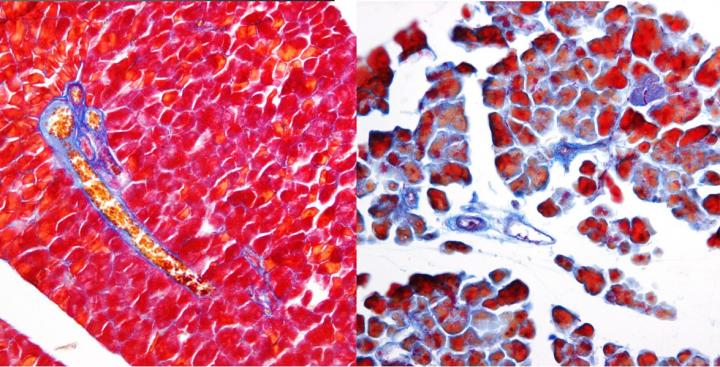
Researchers at the University of Malaga (UMA) demonstrate that Wt1 gene deletion causes deterioration of this organ
IMAGE

Credit: University of Malaga

Furthermore, they have verified that, after a pancreatic damage, Wt1 gene becomes activated in the so-called stellate cells -a special type of repairing cell present in pancreas and kidney- which are responsible for the repairing process. “Without activation of Wt1, these cells cannot fulfill their function”, says the Professor Muñoz-Chápuli, who further points out the crucial role that these cells play in the progression of pancreas cancer, since they ally to tumor cells.

Thus, the results of this study reveal that Wt1 gene is necessary not only for the normal maintenance of pancreas, but also for its repair after a damage.

The Wilms’ tumor suppressor gene encodes a protein that acts as a master regulator of the function of many other genes, so, as assured by these experts, it plays an important role in the embryonic development of different organs, such as kidneys, spleen, or heart. Likewise, in recent years, findings have been proving that this functional importance also extends to adults.

This study has been published in the scientific journal PLOS Genetics. Professors Muñoz-Chápuli and Carmona worked together with the researcher Laura Ariza, from the UMA, and Anabel Rojas, from the Andalusian Molecular Biology and Regenerative Medicine Centre (CABIMER).

Finding new functions of Wt1 gene in cardiogenesis and adult hearts is the next step of this research team.

###

UNIVERSITY OF MALAGA

University of Malaga brings together a community of 2,384 teachers, almost 40,000 students. Teaching, research, innovation, entrepreneurship, culture, and sport all take place on our campuses and form an integral part of the education model.

BIBLIOGRAPHIC REFERENCE:

Ariza L, Rojas A, Muñoz-Chápuli R, Carmona R (2019) The Wilms’ tumor suppressor gene regulates pancreas homeostasis and repair. PLoS Genet 15(2): e1007971.

https://doi.org/10.1371/journal.pgen.1007971

Media Contact
María Guerrero
[email protected]

Original Source

https://journals.plos.org/plosgenetics/article?id=10.1371/journal.pgen.1007971

Tags: cancerGene TherapyGeneticsMedicine/Health
Share12Tweet8Share2ShareShareShare2

Related Posts

Recurrence-linked eccDNA patterns offer new prognostic insights for lung adenocarcinoma

August 11, 2026

Spatial Transcriptomics Reveals Prostate Cancer’s Molecular Evolution

August 11, 2026

Gene-expression risk model personalizes stem cell transplant decisions for children with AML

August 11, 2026

Johns Hopkins Experts Co-Author New Treatment Framework for Liver Cancer

August 11, 2026
Please login to join discussion

POPULAR NEWS

  • Quantum Crystals Reveal a Mysterious Optical Glow

    29 shares
    Share 12 Tweet 7
  • Blood Metabolomic Signatures Link Air Pollution to Lung Cancer in Prevention Studies

    29 shares
    Share 12 Tweet 7
  • DGAT1 Controls Macrophage Pyroptosis During Klebsiella pneumoniae Infection

    29 shares
    Share 12 Tweet 7
  • ML Identifies Brain Regions Linked to Impulsivity in Young Adults With Obesity

    29 shares
    Share 12 Tweet 7

About

We bring you the latest biotechnology news from best research centers and universities around the world. Check our website.

Follow us

Recent News

Quantum Crystals Reveal a Mysterious Optical Glow

Blood Metabolomic Signatures Link Air Pollution to Lung Cancer in Prevention Studies

DGAT1 Controls Macrophage Pyroptosis During Klebsiella pneumoniae Infection

Subscribe to Blog via Email

Enter your email address to subscribe to this blog and receive notifications of new posts by email.

Join 86 other subscribers
  • Contact Us

Bioengineer.org © Copyright 2023 All Rights Reserved.

Welcome Back!

Login to your account below

Forgotten Password?

Retrieve your password

Please enter your username or email address to reset your password.

Log In
No Result
View All Result
  • Homepages
    • Home Page 1
    • Home Page 2
  • News
  • National
  • Business
  • Health
  • Lifestyle
  • Science

Bioengineer.org © Copyright 2023 All Rights Reserved.