• HOME
  • NEWS
  • EXPLORE
    • CAREER
      • Companies
      • Jobs
    • EVENTS
    • iGEM
      • News
      • Team
    • PHOTOS
    • VIDEO
    • WIKI
  • BLOG
  • COMMUNITY
    • FACEBOOK
    • INSTAGRAM
    • TWITTER
Friday, March 27, 2026
BIOENGINEER.ORG
No Result
View All Result
  • Login
  • HOME
  • NEWS
  • EXPLORE
    • CAREER
      • Companies
      • Jobs
        • Lecturer
        • PhD Studentship
        • Postdoc
        • Research Assistant
    • EVENTS
    • iGEM
      • News
      • Team
    • PHOTOS
    • VIDEO
    • WIKI
  • BLOG
  • COMMUNITY
    • FACEBOOK
    • INSTAGRAM
    • TWITTER
  • HOME
  • NEWS
  • EXPLORE
    • CAREER
      • Companies
      • Jobs
        • Lecturer
        • PhD Studentship
        • Postdoc
        • Research Assistant
    • EVENTS
    • iGEM
      • News
      • Team
    • PHOTOS
    • VIDEO
    • WIKI
  • BLOG
  • COMMUNITY
    • FACEBOOK
    • INSTAGRAM
    • TWITTER
No Result
View All Result
Bioengineer.org
No Result
View All Result
Home NEWS Science News Biology

UAlberta paleontologists report world’s biggest Tyrannosaurus rex

Bioengineer by Bioengineer
March 22, 2019
in Biology
Reading Time: 2 mins read
0
IMAGE
Share on FacebookShare on TwitterShare on LinkedinShare on RedditShare on Telegram

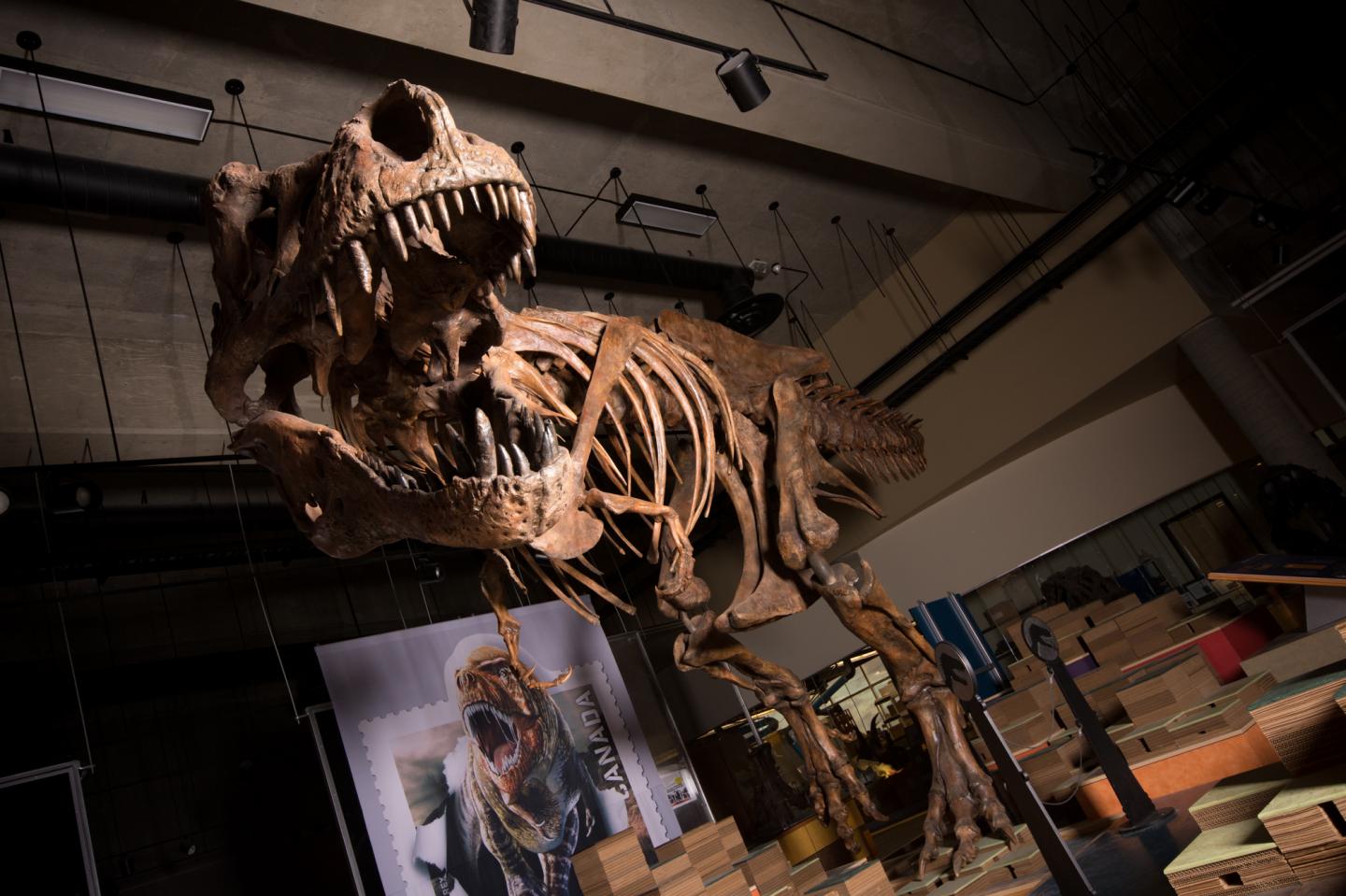
Nicknamed ‘Scotty,’ the record-breaking rex is also the largest dinosaur skeleton ever found in Canada.
IMAGE

Credit: Amanda Kelley

University of Alberta paleontologists have just reported the world’s biggest Tyrannosaurus rex and the largest dinosaur skeleton ever found in Canada. The 13-metre-long T. rex, nicknamed “Scotty,” lived in prehistoric Saskatchewan 66 million years ago.

“This is the rex of rexes,” said Scott Persons, lead author of the study and postdoctoral researcher in the Department of Biological Sciences. “There is considerable size variability among Tyrannosaurus. Some individuals were lankier than others and some were more robust. Scotty exemplifies the robust. Take careful measurements of its legs, hips, and even shoulder, and Scotty comes out a bit heftier than other T. rex specimens.”

Scotty, nicknamed for a celebratory bottle of scotch the night it was discovered, has leg bones suggesting a living weight of more than 8,800 kg, making it bigger than all other carnivorous dinosaurs. The scientific work on Scotty has been a correspondingly massive project.

The skeleton was first discovered in 1991, when paleontologists including T. rex expert and UAlberta professor Phil Currie were called in on the project. But the hard sandstone that encased the bones took more than a decade to remove–only now have scientists been able to study Scotty fully-assembled and realize how unique a dinosaur it is.

It is not just Scotty’s size and weight that set it apart. The Canadian mega rex also lays claim to seniority.

“Scotty is the oldest T. rex known,” Persons explains. “By which I mean, it would have had the most candles on its last birthday cake. You can get an idea of how old a dinosaur is by cutting into its bones and studying its growth patterns. Scotty is all old growth.”

But age is relative, and T. rexes grew fast and died young. Scotty was estimated to have only been in its early 30s when it died.

“By Tyrannosaurus standards, it had an unusually long life. And it was a violent one,” Persons said. “Riddled across the skeleton are pathologies–spots where scarred bone records large injuries.”

Among Scotty’s injures are broken ribs, an infected jaw, and what may be a bite from another T. rex on its tail–battle scars from a long life.

“I think there will always be bigger discoveries to be made,” said Persons “But as of right now, this particular Tyrannosaurus is the largest terrestrial predator known to science.”

A new exhibit featuring the skeleton of Scotty is set to open at the Royal Saskatchewan Museum in May 2019.

###

The paper, “An Older and Exceptionally Large Adult Specimen of Tyrannosaurus rex,” was published in The Anatomical Record (doi:10.1002/ar.24118).

Media Contact
Andrew Lyle
[email protected]

Related Journal Article

http://dx.doi.org/10.1002/ar.24118

Tags: BiologyPaleontology
Share12Tweet8Share2ShareShareShare2

Related Posts

Two Salk Scientists Honored as 2025 AAAS Fellows

Two Salk Scientists Honored as 2025 AAAS Fellows

March 27, 2026
How to sway group opinions: Encourage opponents to stay undecided

How to sway group opinions: Encourage opponents to stay undecided

March 23, 2026

Deep Learning Model Maps How Individual Cells Shape Disease Outcomes

March 20, 2026

Removing only 15 female sharks annually could endanger the entire population, scientists warn

March 20, 2026
Please login to join discussion

POPULAR NEWS

  • blank

    Revolutionary AI Model Enhances Precision in Detecting Food Contamination

    96 shares
    Share 38 Tweet 24
  • Imagine a Social Media Feed That Challenges Your Views Instead of Reinforcing Them

    1003 shares
    Share 397 Tweet 248
  • Uncovering Functions of Cavernous Malformation Proteins in Organoids

    54 shares
    Share 22 Tweet 14
  • Promising Outcomes from First Clinical Trials of Gene Regulation in Epilepsy

    51 shares
    Share 20 Tweet 13

About

We bring you the latest biotechnology news from best research centers and universities around the world. Check our website.

Follow us

Recent News

In-Sensor Cryptography Links Physical Process to Digital Identity

Can Psychosocial Factors Influence Cancer Risk?

Depression Factors in Elderly: Pre vs. Post-COVID Analysis

Subscribe to Blog via Email

Enter your email address to subscribe to this blog and receive notifications of new posts by email.

Join 78 other subscribers
  • Contact Us

Bioengineer.org © Copyright 2023 All Rights Reserved.

Welcome Back!

Login to your account below

Forgotten Password?

Retrieve your password

Please enter your username or email address to reset your password.

Log In
No Result
View All Result
  • Homepages
    • Home Page 1
    • Home Page 2
  • News
  • National
  • Business
  • Health
  • Lifestyle
  • Science

Bioengineer.org © Copyright 2023 All Rights Reserved.